

A 10-yuan bad review destroyed a street vendor. China is reckoning with the digital lynch mob

A 1,529-word suicide note written by a 32-year-old night market vendor has ignited a national conversation across China about the lethal toll of online bullying in tight-knit communities. Hu Ermei, who operated a small fried-snack stall in Qingfu, a township in Sichuan province, drowned herself on October 9, 2026—just three days after a single negative review on social media spiraled out of control.
Hu’s life story was a chronicle of shrinking horizons. At age 15, she had boarded a train alone for Chengdu, the sprawling provincial capital 270 kilometers away, determined to escape rural poverty. Over the next two decades, however, marriage and family responsibilities pulled her steadily backward. Moves to Zigong and eventually back to her hometown in Gao县 steadily compressed her world until it was confined to a two-square-meter food stall.
In her final note, Hu scrutinized her own nature with heartbreaking exhaustion: “I like to cry and overthink; these are my biggest flaws.” Since stepping out into the world as a young teenager, her hypersensitivity had been both her burden and her armor.
Her journey was defined by relentless grit. In Chengdu, she endured the stifling environment of a bustling restaurant job, walking back to her dormitory through dark alleys at 2 a.m. Through sheer perseverance, she rose from a canteen dishwasher to a shift supervisor in four years. Friends and family remembered her as fiercely ambitious, always eager to lift her family out of hardship—a struggle shared by her older sister, Hu Meina, who began working in a Guangdong electronic factory at 16.
At 21, an arranged marriage tethered Hu to a different path. Following her husband’s job transfers and the births of two children, she was repeatedly forced to abandon hard-earned jobs and personal networks, drifting from Chengdu to Zigong, and finally back to Qingfu town.
By 2021, weighed down by a mortgage on a new apartment and the expenses of raising two children, Hu turned to street vending. She invested 20,000 yuan in a transfer fee to secure a spot at the town’s bustling night market street, where 120 vendors competed for business. Eager to succeed, she traveled to Leshan to master the craft of making fried skewers, working up to 18 hours a day. She slept less than six hours nightly, juggling childcare, ingredient procurement, and running the stall from 11 a.m. to 11:30 p.m., followed by late-night chili oil preparation.
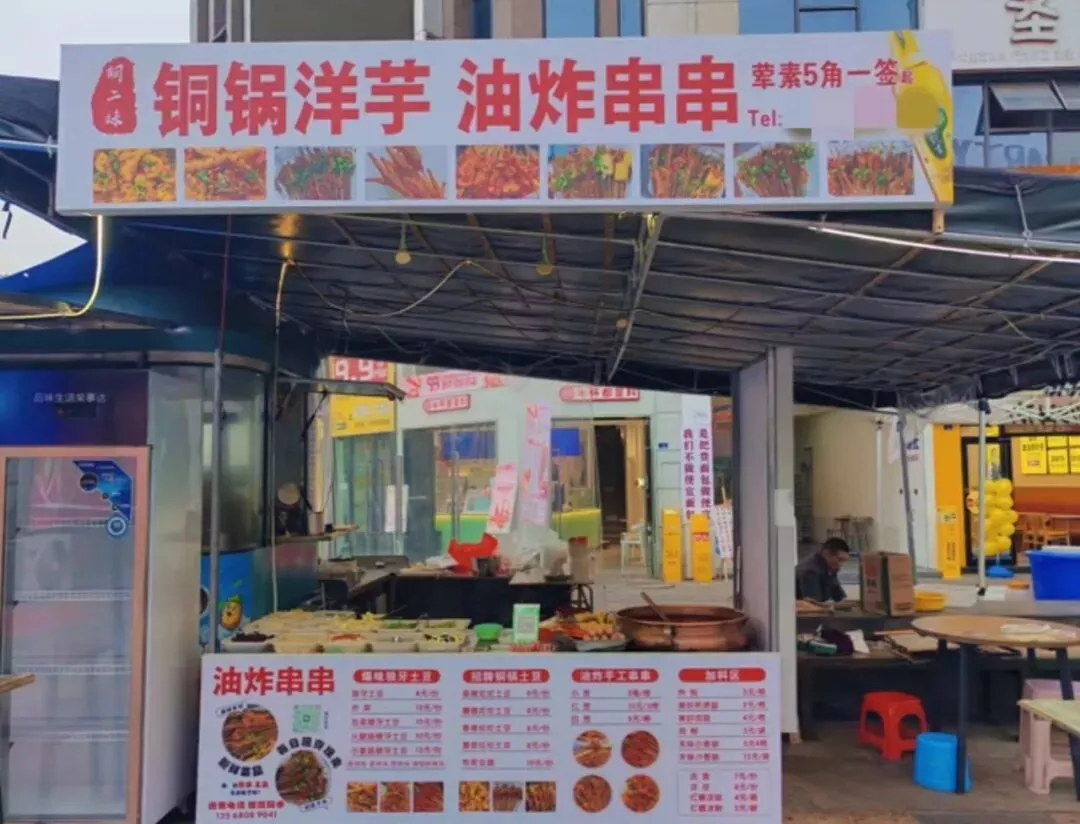
Photo: Hu Ermei’s stall at the far eastern end of the night market
Behind the daily grind lay soaring living costs. Vendors across the night market felt the squeeze: packaging boxes jumped from 60 to 77 yuan a box, cooking oil rose from 165 to 186 yuan a barrel, and gas cylinders surged from 90 to 140 yuan. To survive, Hu pushed herself past her physical limits, suffering severe hair loss from mounting exhaustion.
Then came the review that broke her.
On October 6, a customer who bought a 10-yuan portion of fried vegetables posted angry complaints across multiple local online platforms, accusing Hu of skimping on the portion size. In a small township of just over 80,000 residents, gossip spreads like wildfire. Within hours, hundreds of comments piled up, mocking her service and food portions.
As the thread ballooned across local WeChat groups, Hu attempted to reply to comments individually, trapped in a relentless loop of anxiety. Friends noted that in small-town China, a damaged reputation on social media is nearly impossible to shake.
On the evening of October 8, sensing her distress, her sister Hu Meina visited the stall with a bowl of homemade pork rib soup, urging her not to take the criticism to heart. Hu Ermei smiled and continued serving her customers, keeping her despair hidden.
Hours later, she pressed her freezing hands against her children’s study desk and penned her final words. “Running a small family is just too hard,” she wrote, concluding with a poignant blessing to her online detractors: “To those who stepped on me in the comments, I sincerely hope you never step on a mine yourselves.”

Photo: Dishes and fried snacks laid out for customers to choose from
On the afternoon of October 9, Hu Meina received the phone call that her sister had drowned in the Nan guang River. In the wake of her death, family members remember a woman who quietly cared for everyone around her—from bathing her elderly grandfather to offering free childcare to a young, exhausted delivery worker in the neighborhood.
For millions of internet users across China, Hu’s tragedy has sparked an urgent debate over the disproportionate cruelty of digital public shaming, exposing the crushing vulnerabilities faced by ordinary workers striving to stay afloat in a shifting economy.