

Chinese shoppers let AI haggle for them. Some sellers are begging them to ease off
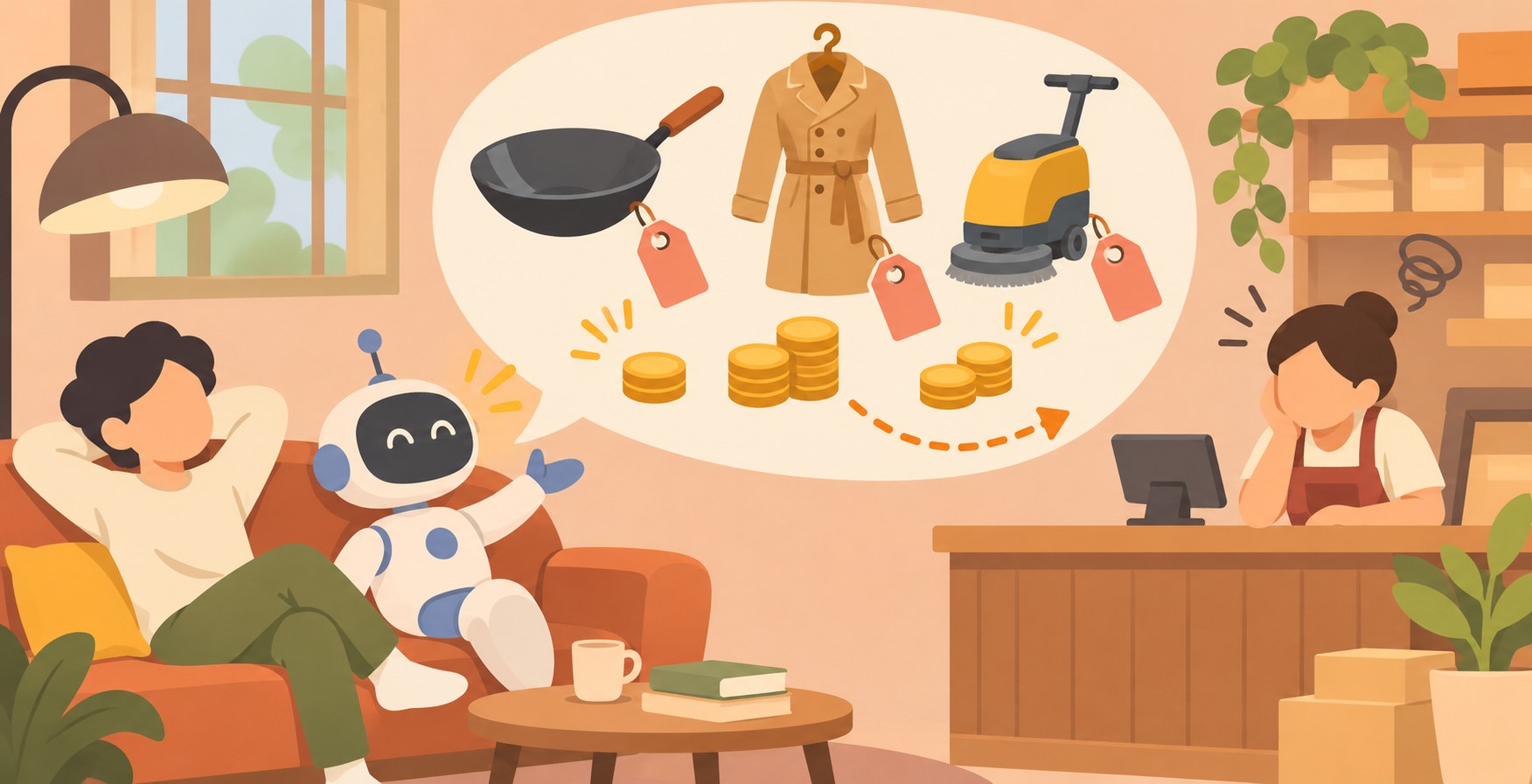
A plea from Chinese online sellers asking customers not to use AI to haggle has become a trending topic. Young shoppers have been handing price negotiations to AI assistants, and at least one store has posted a notice asking customers to stop sending AI to bargain over and over again.
The trend has also started an argument online. Is it a waste to use an advanced AI model, and the computing power behind it, to save a few dozen yuan? Or is that exactly what AI is for?
One example that drew attention came from a user in Chongqing who wanted to buy a handmade iron wok priced at 210 yuan. The user gave the job to Qwen, Alibaba’s AI assistant. For nearly half an hour, Qwen flattered the store’s customer service agent with lines such as “Boss, you’re the best” and “Boss, may you get rich.”
The user, a self-described introvert, said it was cringe-inducing to watch the AI “keep acting cute with customer service.” But Qwen did win a sizable discount.
Sellers raise the white flag
As more people discovered AI haggling, some merchants pushed back first. One store posted a notice urging shoppers not to use AI for “loop bargaining.” The notice said AI can keep asking questions without tiring, while customer service staff also have other shoppers to serve, and constant price talks slow down normal replies.
According to Vista, a Chinese magazine, the notice suggests the practice has moved beyond a handful of curious users and into real online shopping.
Hiring AI as a bargaining partner
Users trying AI haggling for the first time often said it felt like a new world had opened. “Serious learning!” one wrote. Another said: “Now shopping is AI versus AI too.”
Some shoppers go further than asking the AI to request a lower price. One user handed over a whole shopping cart on Taobao, Alibaba’s online marketplace, and asked Qwen to work out which items had room for negotiation. After several rounds, Qwen picked out a floor scrubber listed at 2,099 yuan and contacted customer service. The store agreed to refund the price difference and added a free gift.
Another user wanted a trench coat with a final price of 463.9 yuan. Qwen asked the store a long list of questions: Were there hidden coupons? Cashback for ordering? Free gifts? It also gave the store a “project budget” of 350 yuan. Customer service first offered a 30-yuan discount, and Qwen eventually negotiated a 40-yuan reduction.
Some users have even shared ready-made prompts that they say let an AI agent haggle with a single command. Vista reported that as more people use Qianwen Go!, a growing “AI bargaining army” is outsourcing all its dealings with systems and customer service. The shopper states what they want, and the AI handles the talking, checking and pushing.
“Is it worth it?”
Once “Qwen haggling” took off, critics appeared in comment sections. Under the wok post, some asked whether a few dozen yuan was worth bringing in AI at all.
The skeptics made a cost argument. Every AI answer consumes tokens, the units AI models use to process text. Each call relies on servers, computing chips, electricity, networks and other infrastructure. Because many AI services are free, some argued, ordinary users tend to ignore those costs. “People use AI for these small things because ordinary consumers aren’t yet actually paying for each use,” one comment said.
Others said an AI that can do scientific research or write code being sent to grind out a small discount was like having a Ph.D. do primary school homework. They added that people trying it just for fun waste even more computing power and store staff’s time. One question summed up the debate: “Isn’t it a waste to have a high-tech AI that can write code, do research and analyze complex data burn tokens to save 30 yuan?”
More than a discount
Users who rely on AI for chores see it differently. To them, haggling is only the surface, and the AI is really working as an all-purpose personal assistant.
One user had Qianwen Go! track flight prices around the clock and send an alert when fares dropped. By buying at the right moment, the user saved 310 yuan.
Another user had earlier bought round-trip tickets between Hangzhou and Lanzhou and remembered that one flight was delayed, but not the flight number. Qianwen Go! went through four orders with four airlines, used feedback from customer service to identify the flight, and then pressed for compensation by phone and through apps, trying to reach a human agent. It obtained 70 yuan in delay compensation for the user.
Vista argued that the real appeal is the time saved and the information gaps closed. Hunting for discounts or tracking fares means sorting and following up on many scattered pieces of information. People with time, experience and a knack for rules used to benefit most, and AI is lowering that barrier. The magazine said merchants can benefit too: when scattered promotions are pulled together, buyers no longer have to choose between “expensive” and “troublesome,” which may help close a sale.
Cheaper AI, smaller tasks
The magazine compared the debate with mobile data a decade or more ago. When data was expensive, many people saved up what they wanted to say and waited for WiFi before making a video call to family. Today video calls anywhere are routine, thanks to better telecom infrastructure and lower data costs.
The computing costs of large AI models differ from telecom costs, Vista noted, but AI is going through a similar process. It cited Stanford University’s 2025 AI Index Report, which found that for models reaching a comparable level of performance, the inference price per million tokens fell from $20 to $0.07 between November 2022 and October 2024, a drop of more than 280-fold in about 18 months.
The magazine also pointed to Qwen’s free-order campaign during this year’s Spring Festival, which let many consumers use AI to order milk tea and other purchases for the first time. Some users joked at the time that they were “using the newest technology to do the most useless thing.” But a simple request such as “order me a milk tea” requires the AI to open a delivery app, choose a shop and item, and place and pay for the order across several apps.
Haggling works the same way, the magazine said. The AI may need to analyze the product, look for deals, state a budget, check replies and keep following up. For a one-person shop, handing off such chores can free up time for business strategy. Content creators can link tasks that once took several steps across different platforms.
Vista concluded that requests that look like overkill should not be dismissed too quickly. As the technology behind AI grows more complex, it argued, using it can become simpler, and its benefits need not be limited to the people who know the most about technology.