
Aito burst into flames one second after crashing. Why China is asking questions
A fatal single-vehicle crash in Shaanxi province involving an Aito vehicle—a smart-car brand backed by tech giant Huawei—has triggered widespread public scrutiny across China over autonomous driving safety, collision speeds, and how quickly modern electric and hybrid vehicles catch fire after an impact.
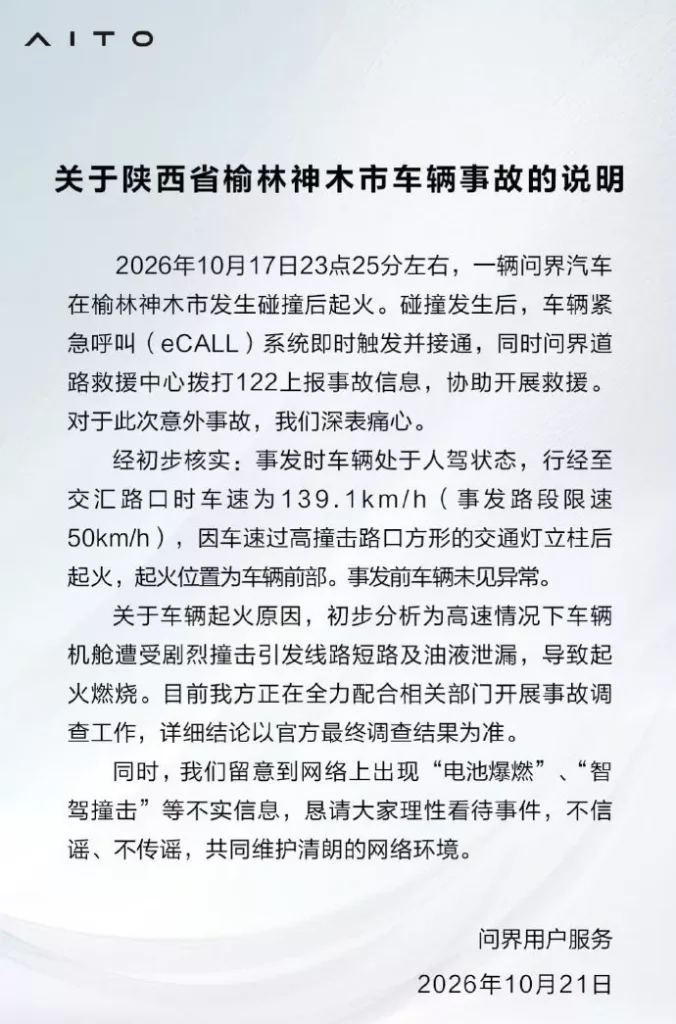
The accident, which took place in the city of Shenmu, resulted in the death of the sole driver. Four days after the incident, Aito released an official statement claiming that the vehicle was traveling at 139.1 kilometers per hour (86.4 mph) as it approached an intersection—well above the local 50 km/h speed limit—before striking a stationary traffic light pole and catching fire. The company attributed the blaze to an electrical short circuit and fluid leaks in the engine compartment caused by the severe high-speed impact.
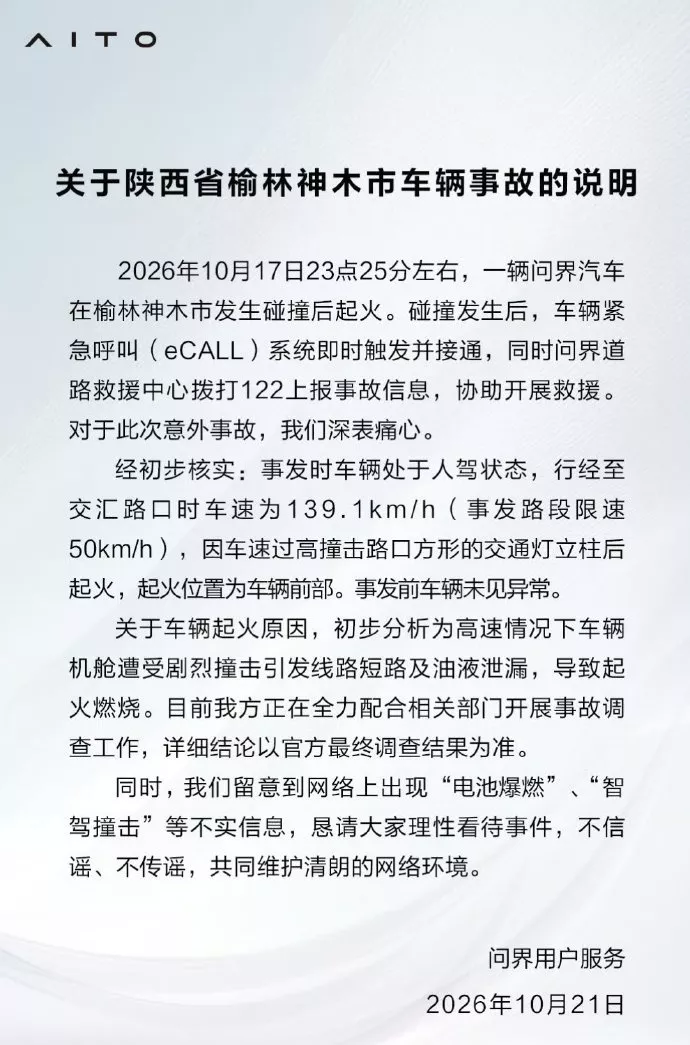
Aito’s official statement detailing the preliminary findings of the accident.
Local police confirmed an investigation is underway, while inquiries directed to Aito’s parent company, Seres, went unanswered prior to publication. To unpack the mounting public skepticism, Chinese media turned to independent automotive experts, including Zhang Kangkang, a Ph.D. holder in automotive engineering from Tsinghua University, and Feng Shiming, a prominent independent auto commentator.
The controversy centers around three major unanswered questions that have gripped Chinese social media.
Mystery One: What was the actual speed at impact?
Feng criticized Aito’s statement for lacking crucial technical details and failing to express basic empathy for the victim’s family. He argued that the company’s claim of 139.1 km/h was ambiguous about the exact timing and location, making it impossible to verify.
Using publicly available surveillance footage and satellite imagery, Feng calculated that the vehicle traveled roughly 58 meters over two seconds before hitting the pole. Based on his reconstruction, the vehicle’s average speed was around 104.4 km/h, with the actual collision speed estimated at approximately 75.6 km/h—significantly lower than the official figure.
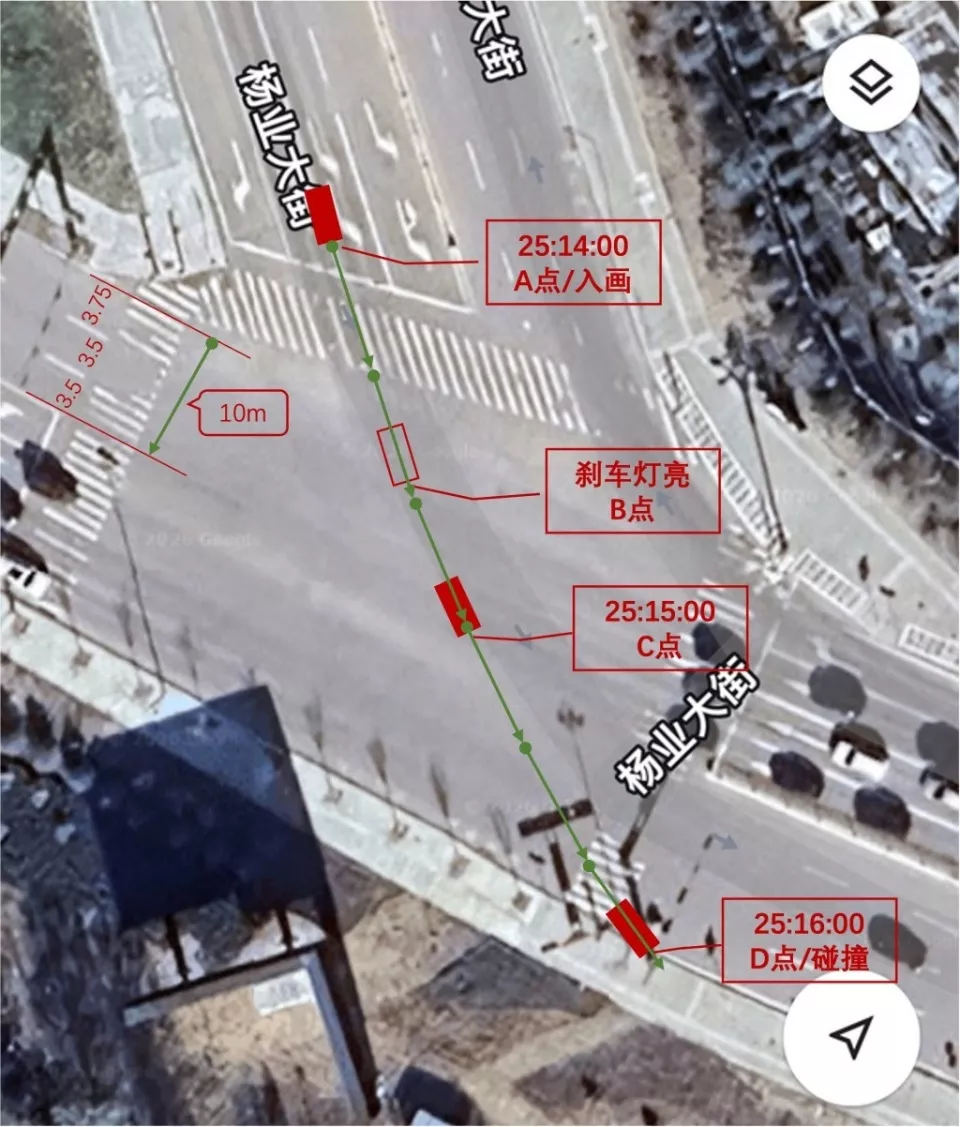
An accident reconstruction map published by an independent automotive blogger.
Other independent analysts and online commentators have produced a wide range of estimated impact speeds, stretching from 60 km/h to nearly 130 km/h, with the majority converging around 80 km/h.
Zhang urged caution regarding crowd-sourced calculations, noting that final speeds must be established by professional forensic investigators using the vehicle’s internal event data recorder (EDR). However, Zhang acknowledged that the 139.1 km/h figure likely represented the vehicle’s speed upon entering the intersection rather than the exact velocity at the moment of collision.
Further complicating matters, surveillance footage shows the vehicle’s brake lights illuminating prior to the crash, yet photographs of the struck traffic light pole showed no obvious structural bending or fracture. Shenmu traffic authorities later clarified that the pole remained structurally intact, and its exterior discoloration was caused by the intense heat of the subsequent fire burning internal electrical wiring.
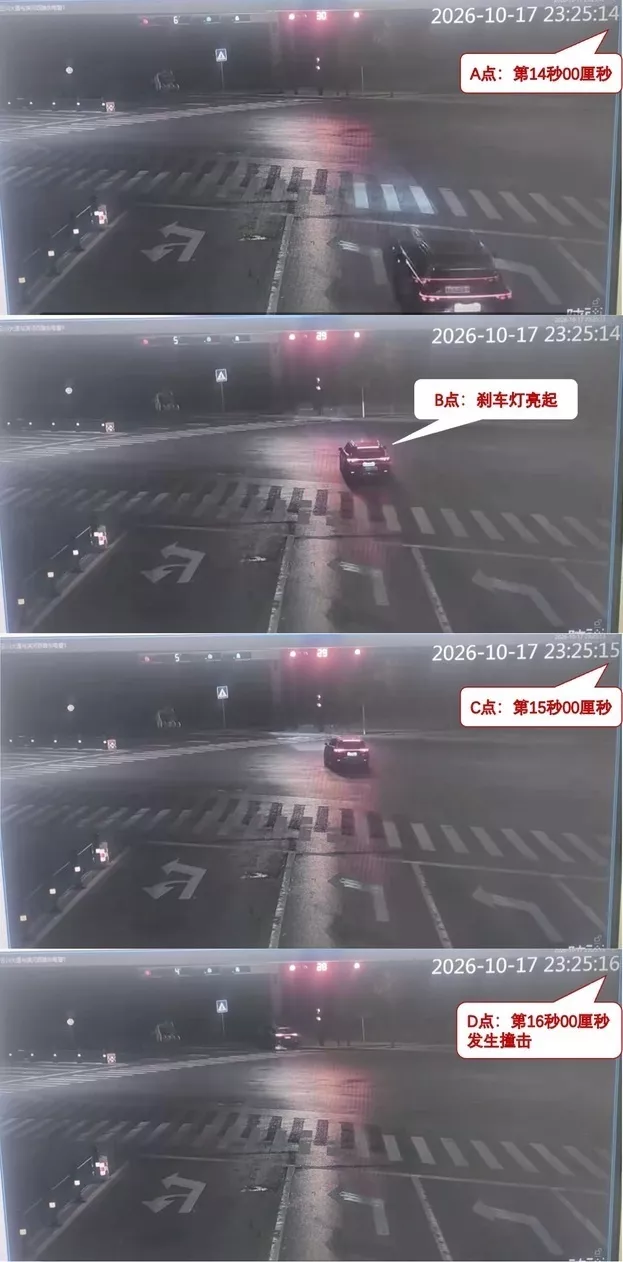
A still image captured from roadside surveillance footage.
Mystery Two: Did the autonomous emergency braking system activate?
Netizens and industry watchers have questioned whether Aito’s Advanced Emergency Braking (AEB) system functioned properly. While brake lights were visible in the footage, observers noted no apparent deceleration prior to impact.
Feng argued that even if a collision could not be entirely avoided, an active AEB system should have significantly reduced the vehicle’s speed and softened the blow. Zhang countered that simply observing brake lights is insufficient proof, as even light pedal pressure activates the brake lamps. Furthermore, Zhang pointed out that current industry testing standards—such as China’s C-NCAP protocols—do not mandate AEB testing against stationary, narrow obstacles like utility poles, noting that disengaging or withholding AEB in certain complex night-driving or high-speed turning scenarios can align with rational vehicle control logic.
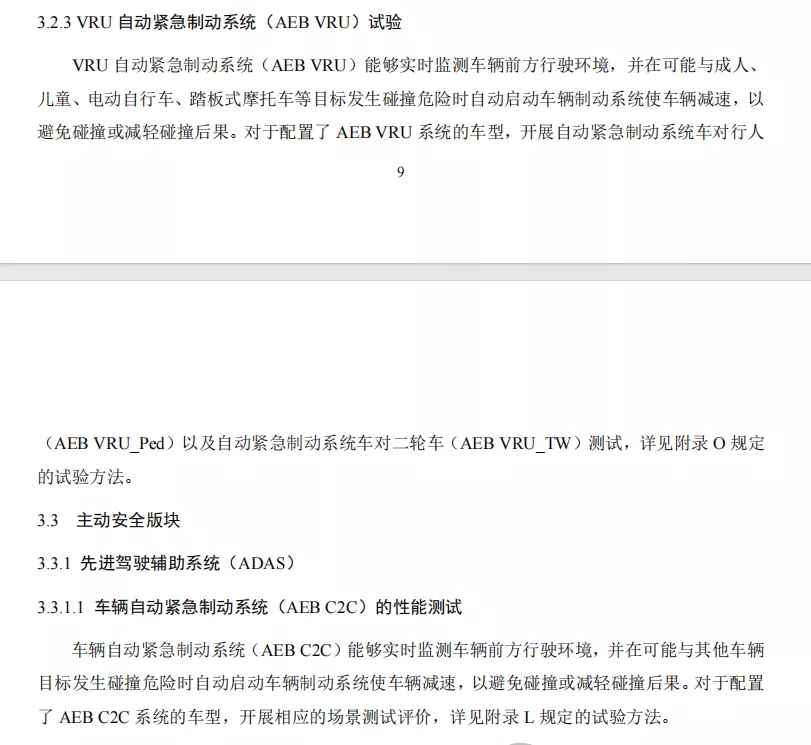
Excerpts from official industry evaluation standards.
Mystery Three: Why did the vehicle catch fire in just one second?
The most alarming aspect of the accident was the speed at which the vehicle erupted into flames. Feng expressed shock that a collision occurring at an estimated 75.6 km/h could result in a full-scale fire within a single second, leaving the driver virtually zero chance of escape and pointing to what he termed a severe lack of safety redundancy.
Reviewing national standards, Chinese regulations for side and rear collisions (such as GB 20071-2025 and GB 20072-2024) strictly prohibit open flames for up to 30 minutes following a test crash conducted at standard speeds like 50 km/h. However, front-collision protection standards (GB 11551-2014) lack explicit time or velocity limits regarding post-crash fires.
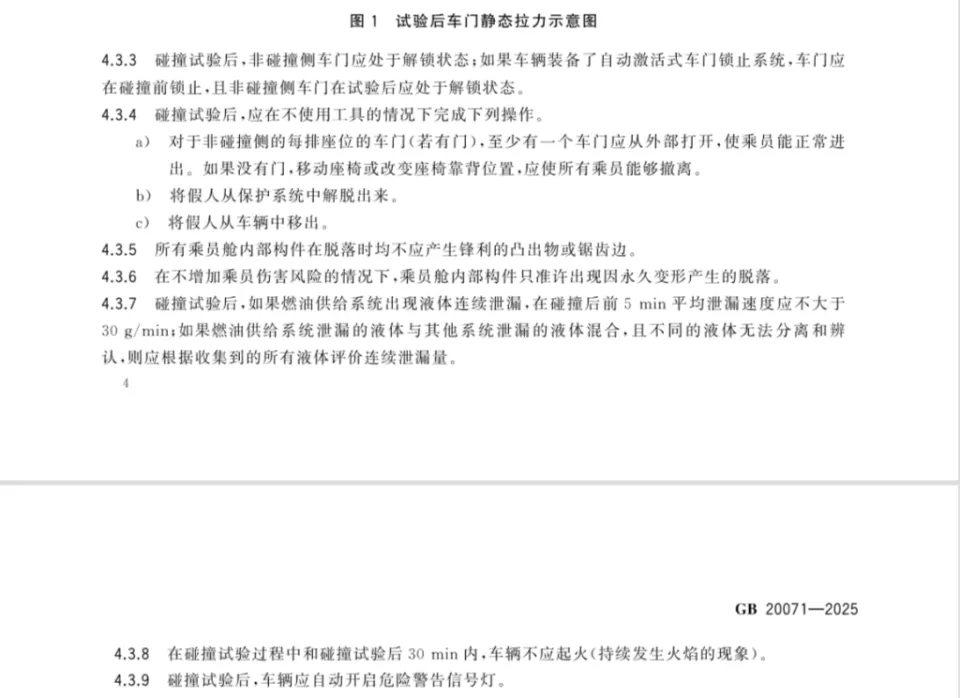
Relevant provisions from the GB 20071-2025 side-collision occupant protection standard.
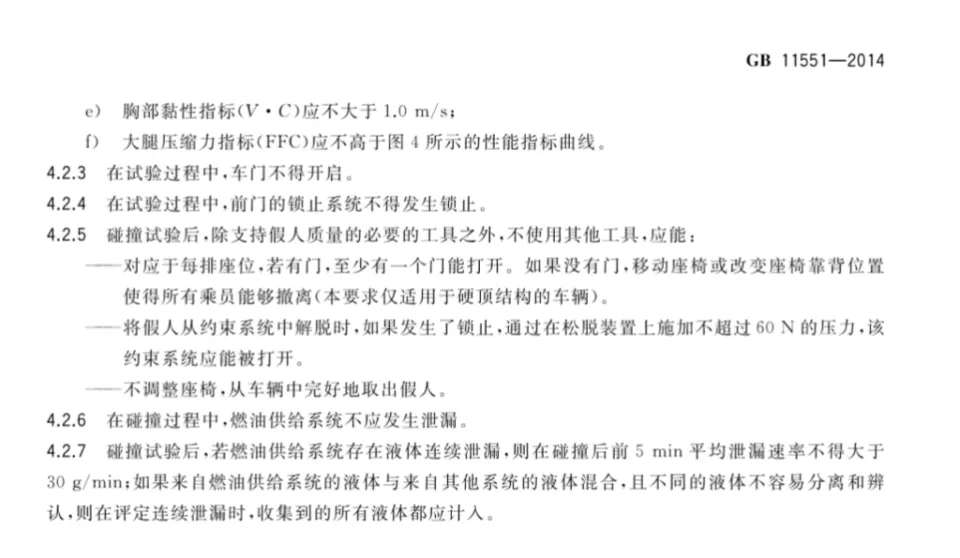
Relevant provisions from the GB 11551-2014 front-collision safety standard.
Zhang maintained that regulatory crash tests are bound by specific parameters and that real-world accidents often exceed those baselines. While acknowledging that extreme high-speed impacts naturally carry a higher risk of fire, he emphasized that the definitive cause of the blaze can only be determined through comprehensive, official forensic investigations.