
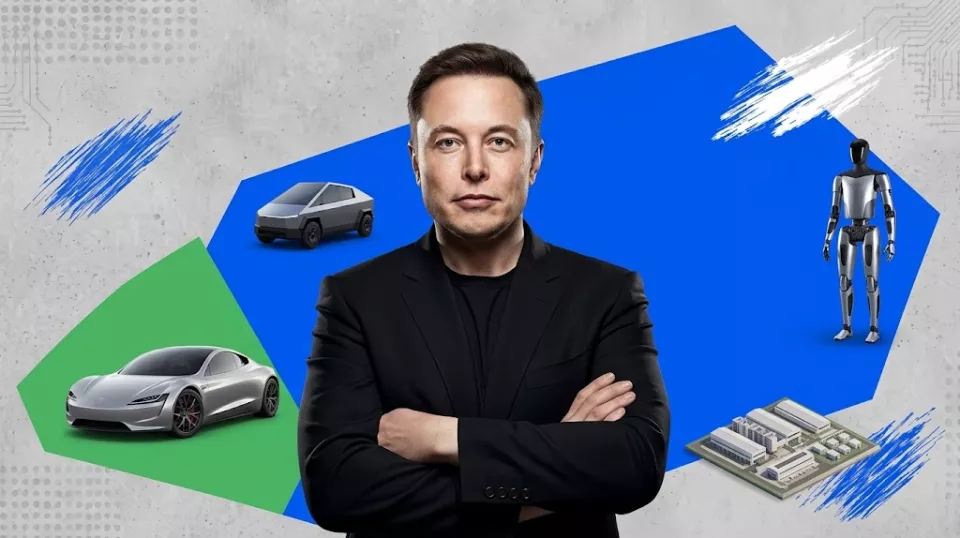
Tesla just passed 10 million cars. Elon Musk wants to make robots instead
Tesla CEO Elon Musk. Image processed by AI
As competition in the electric vehicle market intensifies, Tesla is shifting its strategic focus away from traditional cars and toward autonomous driving, humanoid robotics, and artificial intelligence.
On October 22, Tesla released its financial results for the third quarter, reporting $280.46 billion—wait, $28.046 billion in revenue, remaining largely flat quarter-over-quarter and slightly beating the consensus market forecast of $27.9 billion.
Net income attributable to the company came in at $787 million, down more than 40% year-over-year and slightly below analysts’ expectations of $815 million. Diluted earnings per share stood at $0.22, or $0.48 on an adjusted non-GAAP basis, beating the market’s $0.45 forecast.
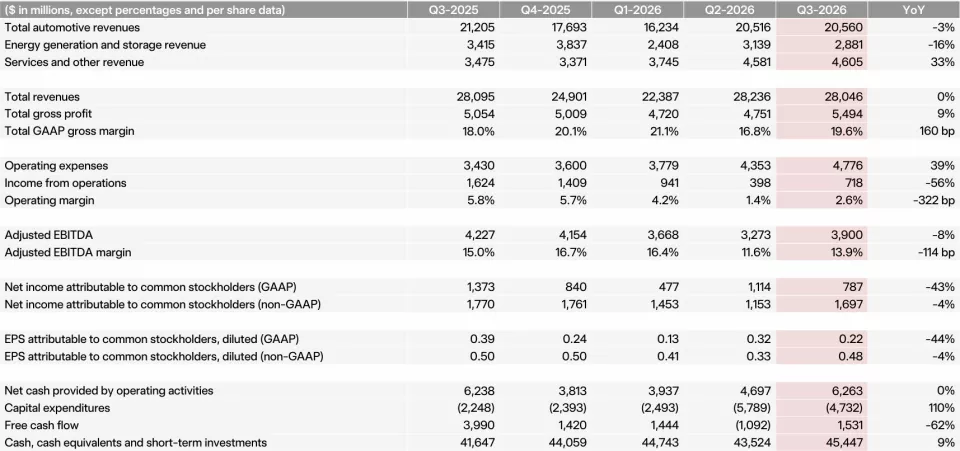
Gross margin reached 19.6% for the quarter, up 1.6 percentage points year-over-year from above 18.0%. Operating margin stood at 2.6%; while up from 1.4% in the previous quarter, it remained 3.22 percentage points lower than the same period last year. Operating income fell 56% year-over-year to $718 million.
Notably, operating expenses surged 39% year-over-year to $4.776 billion. Research and development spending saw the most dramatic increase, soaring 69% to $2.76 billion, an expense growth that effectively offset the gains from improved gross margins.
Despite pressure on net income, free cash flow improved. Free cash flow for the quarter reached $1.531 billion, and cash reserves and short-term investments totaled $45.447 billion at the end of the period. Capital expenditures hit $4.732 billion—more than double the $2.25 billion from the same period last year—though still below earlier industry estimates of around $7.5 billion.
Breaking down revenue sources, auto sales remain the primary earnings driver, but software subscription revenue continues to grow, autonomous taxi services have officially launched, and commercial transport models and humanoid robots are entering mass production. New growth engines are gradually taking shape. Musk is counting on these emerging businesses, paired with proprietary chips and AI computing, to power the company’s long-term expansion.
The challenge is that these new ventures will take time to commercialize and cannot yet fundamentally alter the company’s financial reporting structure. This period is likely to be a prolonged transitional phase.
On the day of the earnings release, Tesla shares rose 3.41% to close at $386.47, though they pulled back in after-hours trading, dropping more than 3% at one point.
01 The Disconnect Between Sales Growth and Revenue Gains
The automotive segment brought in $20.56 billion in revenue for the quarter, down 3% from a year earlier. On the manufacturing side, the company produced 464,391 vehicles globally and delivered 486,532 units, up 4% and down 2% sequentially, respectively.
Deliveries exceeding production indicated faster inventory turnover. Global vehicle inventory days dropped from 15 days in the second quarter to 11 days, signaling improving sales momentum.
The Model 3 and Model Y remained central to the lineup, with 457,387 units produced—up 5% quarter-over-quarter—and 478,237 units delivered, down 1% year-over-year.
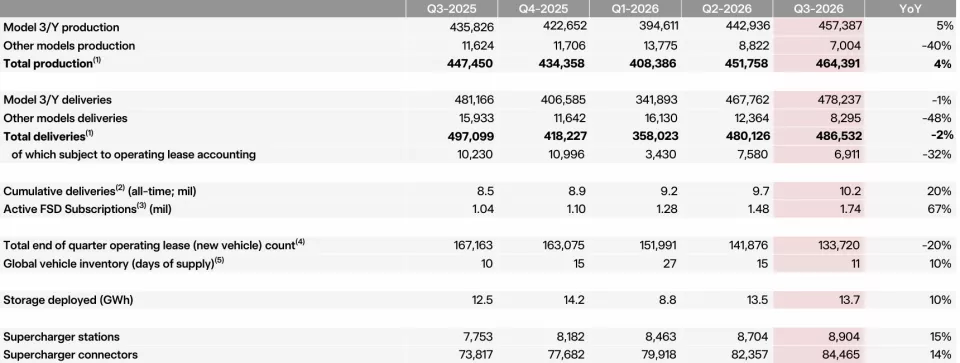
It is worth noting that during this period, Tesla’s cumulative global deliveries surpassed the 10 million milestone.
The company stated that future order reserves have reached a nearly four-year high, and it is actively expanding battery supplies while working to maximize capacity utilization at existing production hubs.
The earnings report also noted that declining average selling prices, lower sales volumes, and shrinking regulatory credit subsidies weighed on revenue performance.
Regulatory credits contributed just $113 million, a 73% plummet from the same period last year. Once a vital supplement to Tesla’s profits, these credits now play a significantly diminished role in bolstering overall financials.
Excluding regulatory credits, the gross margin reached 18.1%, up from 16.3% in the second quarter and 15.4% a year earlier. The company attributed the improvement to regional and product mix adjustments and an increase in paid FSD users, though the hit from lower average selling prices persisted.
In terms of manufacturing capacity, the annual design capacities for Model 3 and Model Y at the Fremont and Shanghai plants exceed 550,000 and 950,000 units, respectively, while Berlin and Texas factories both boast capacities of over 375,000 units for the same models. The Texas facility also handles production for the Cybertruck and Cybercab, with annual capacities for both set above 125,000 units.
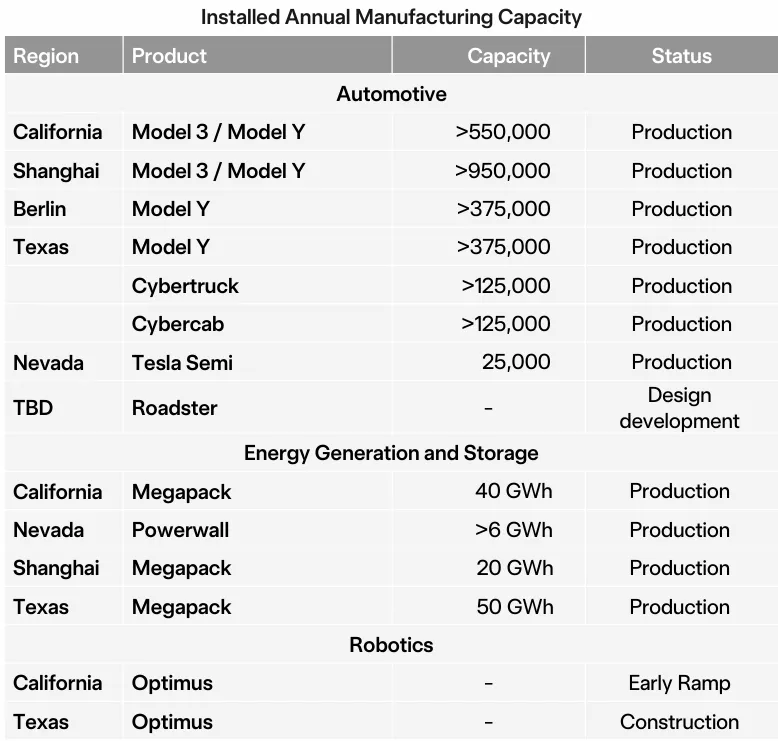
In the commercial sector, production of Tesla’s Semi heavy-duty truck has officially kicked off on the high-speed line in Nevada.
While the automotive business remains the foundation for cash flow and revenue, facing capped delivery growth and pricing pressure, the company must open up new revenue streams and product lines to support a larger investment blueprint.
02 Autonomous Driving Gathers Steam as Robotaxis Enter a New Phase
Autonomous driving is emerging as Tesla’s most definitive growth bright spot in the third quarter.
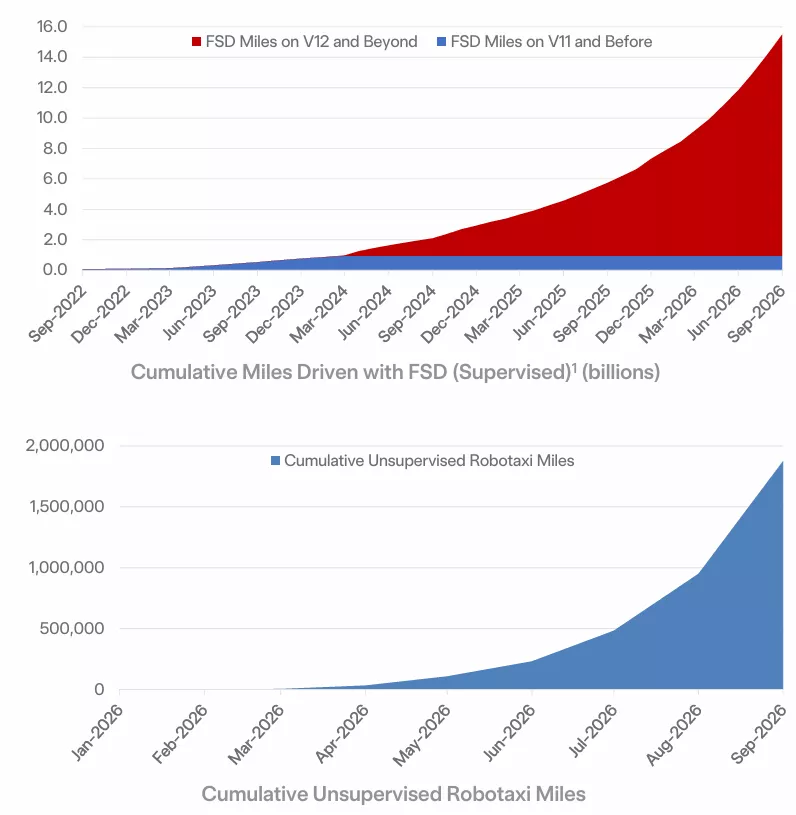
Active subscriptions for Full Self-Driving (Supervised) reached 1.74 million, marking a 67% quarter-over-quarter growth rate. In the North American market, more than three-quarters of newly delivered vehicles were equipped with the FSD software package, up nearly 20 percentage points from the second quarter. The company stated that demand for FSD is rising in permitted regions while it maintains dialogues with regulatory authorities to secure operational permits across broader areas.
In Europe, the software recently won approval for use in four new countries: Croatia, Slovenia, the Czech Republic, and Slovakia. FSD services now cover nine EU member states with hundreds of thousands of cumulative users, having logged more than 160 million kilometers since initial regulatory approval.
The rise in paid subscribers marks progress in software productization, though its long-term revenue scale will ultimately depend on consumer expansion, pricing strategies, and regulatory openness.
Tesla rolled out its Cybercab robotaxi service in Austin in early September. By the end of the third quarter, the fleet’s cumulative autonomous mileage approached 3.2 million kilometers—an 8x increase compared to the previous quarter—while maintaining double-digit weekly growth rates.
Cybercab has integrated Grok and other connectivity tools. The company hopes these vehicles will serve multiple scenarios including commuting, work, and leisure; however, whether the service can generate stable revenue ultimately depends on fleet size, utilization efficiency, operational expenses, and regulatory conditions.
On the regulatory front, the U.S. National Highway Traffic Safety Administration (NHTSA) issued 21 requirements regarding Cybercab’s self-certification process. Tesla requested an extension but was granted only a 30-day grace period, setting the response deadline for October 30.
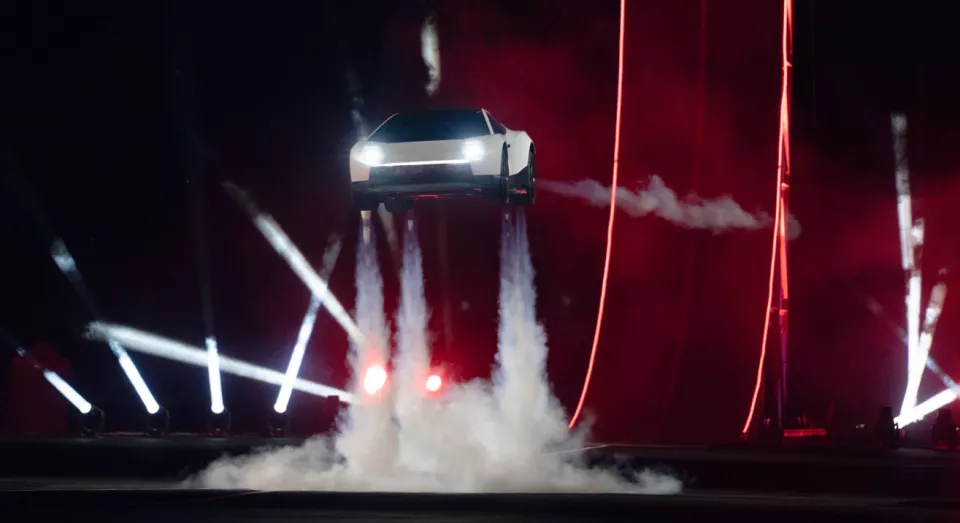
The Roadster adds a new point of interest to Tesla’s product lineup. In mid-October, Tesla unveiled the next-generation Roadster in Texas, announcing a 2028 mass production target. The event also showcased a version equipped with cold-gas thrusters and revealed test acceleration figures.
Investors and analysts have largely maintained a cautious stance on the six-figure, limited-run vehicle.
A Forrester chief analyst suggested that in its current form, the Roadster is a resource-distracting product that offers no substantive help to Tesla’s broader production lines. Deepwater Asset Management head Gene Munster termed it “engineering flexing,” while Morningstar projected annual sales of fewer than 2,000 units.
03 Humanoid Robots Roll Off the Line as Computing Power Expands
Tesla initiated commercial production of its Optimus robot at its Fremont high-speed production facility during the quarter. Initial units will be deployed internally while gathering real-world data for model training.
The company stated that newly rolled-off units meet mass-production quality specifications and existing manufacturing processes have been adapted for commercial-grade products, though hardware details and assembly steps still leave room for optimization.
p>Right now, construction in Fremont has entered the initial capacity ramp-up phase, while work in Texas is ongoing. However, Tesla still needs to overcome challenges in robot stability in unstructured environments, multi-task flexibility, production cost control, and maintenance before achieving wider scale rollout.
Computing power represents another major strategic investment.
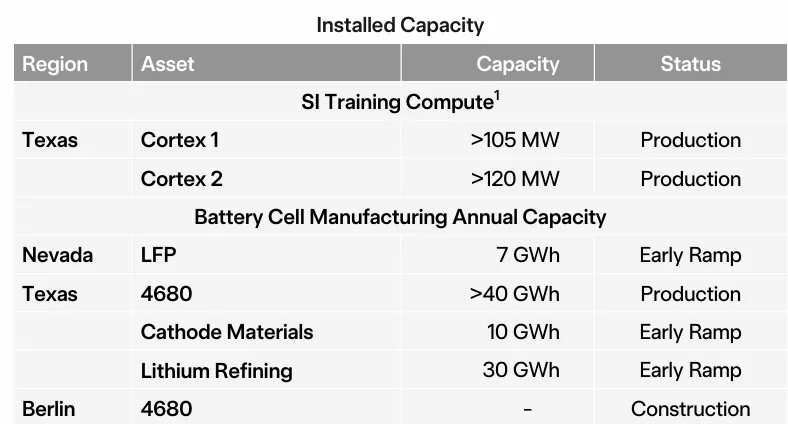
Tesla announced plans to scale its supercomputing training capacity to 400 megawatts within the year to support autonomous software development for both vehicles and robots. Currently, Cortex 1 in Texas is operational with over 105 megawatts of installed computing power, while Cortex 2 has exceeded 120 megawatts and entered production.
The Terafab semiconductor and computing manufacturing project in Austin is also moving forward, with initial equipment validation expected in 2027.
This semiconductor and compute project aims to supply chips for Tesla’s autonomous driving and Optimus units while supporting compute and data center needs for SpaceX. Musk hopes to leverage this to strengthen operational synergies between the two entities in chip engineering, basic computing infrastructure, and robotics.
Simultaneously, the companies are exploring potential integration options. Musk stated during a SpaceX financial call that “merger is a good path,” citing collaborative potential across software systems, chip development, Terafab, humanoid robots, space-based data centers, and Starlink.
However, integration remains in the exploratory phase and has yet to be implemented.
For Tesla, Terafab and potential M&A remain long-term strategic visions that cannot immediately translate into current operational earnings.
04 Energy Storage Revenue Diverges From Deployment
The energy generation and storage segment brought in $2.881 billion in revenue in the third quarter, down 16% year-over-year. Yet storage deployment capacity reached 13.7 GWh, a 10% increase from the previous year.
To explain the inverse trend between revenue and installations, Tesla pointed to tariff-related customer back-payments, among other factors.
Gross margin for the division hit 33%, up from 20% in the second quarter, though total gross profit dipped to $954 million from $1.073 billion a year earlier.
Nonetheless, the company remains optimistic about market demand for storage. Tesla noted that the proportion of new orders and undelivered order backlogs both hit historic highs this quarter, predicting that rising electricity demand from cloud computing data centers will continue to stimulate Megapack demand.
In terms of manufacturing scale, the Texas Megafactory has commenced operations with an annual design capacity of 50 GWh; the Shanghai Megafactory has a 20 GWh annual capacity; and the California Megapack plant boasts 40 GWh.
This quarter, Tesla shipped its first Megapacks entirely powered by proprietary lithium iron phosphate cells out of its Nevada facility. Meanwhile, Texas is advancing work on 4680 battery cells, cathode materials, and lithium refining to support both vehicle and energy storage production lines.
The company added over 2,100 Superchargers this quarter, a 14% year-over-year increase, bringing the total global charging network to 84,465 stalls, also up 14% from a year ago.
05 Capital Expenditures Slow Down as Investment Momentum Continues
In the third quarter, Tesla’s capital expenditures totaled $4.732 billion, down roughly 18% sequentially but double compared to the same period last year. While lower than earlier industry expectations, the spending pullback helped the company turn free cash flow positive, raising a question: Can planned investments proceed on schedule?
During its third-quarter earnings call, Tesla announced a revision to its 2026 capital expenditure target to approximately $20 billion, driven primarily by gains in investment efficiency, though future annual investment scales are expected to keep expanding.
The company stated it will focus on unlocking production capacity at existing sites while maintaining robust cash reserves to lay the groundwork for subsequent line expansions. For Tesla, balancing investment timing affects both cash reserve safety and the speed at which new projects launch.
At the same time, a potential merger with SpaceX adds a new layer of uncertainty to this investment plan.
Both enterprises are engaged in major infrastructure projects. While integration could generate operational optimization, it involves complex issues such as equity valuation, shareholder rights, and governance structures. Musk emphasized during the call that a merger should not be taken as a foregone conclusion. Even if the deal eventually moves forward, its specific contents and impact on Tesla shareholders require urgent clarification.
Moving forward, Tesla must juggle two major tasks: managing investment pace and asset utilization efficiency while reserving adequate funds for long-term construction. The company forecasts that hardware profits will grow alongside earnings from supercomputing, software, and fleet operations, though it gave no specific timeline for when these new ventures will achieve relevant scale.
This quarter’s cash flow improvement provides a buffer for Tesla to continue ramping up investments, while the substantial year-over-year expansion in capital expenditures indicates that the infrastructure buildout cycle still has a way to go. Ahead, the industry will be watching not just how much Tesla spends, but whether those funds successfully translate into production potential and whether new ventures can sequentially generate actual revenue.
The following are key highlights from Tesla’s Q3 financial analyst communications:
Elon Musk opened with his views:
This quarter, we are aggressively scaling vehicle output, targeting an annual production rate of 5 million vehicles by around 2030. The Tesla Semi has officially entered production, and market demand for the energy division is scorching hot, with 2027 Megapack capacity practically fully booked. We are ramping up capacity as quickly as possible and expect energy gross margins to improve dramatically.
In autonomous driving, fully autonomous mileage is growing rapidly. Austin’s autonomous fleet has expanded tenfold in the month since its launch. As the fleet grows, we expect autonomous mileage to continue surging.
Optimus has begun initial production on the Fremont high-speed line. Most of the equipment required for million-unit annual production has arrived, but reaching a rate of 20,000 units per week will likely take at least another year or longer. Right now, product designs still need adjustments, supply chains and manufacturing need fine-tuning, and AI computing, mechanical dexterity, safety, and reliability present numerous hurdles. I estimate these challenges will be resolved around late 2027, at which point we plan to begin selling Optimus to external customers.
Construction of the Terafab wafer fab in Texas is progressing, with equipment testing expected to start in the first half of 2027, aiming to produce initial sample chips by May or June. Our direction is to achieve mass production of viable chips around the third quarter of 2028. Terafab will help us ease bottlenecks across storage, finished goods, and logic circuits, laying a solid foundation for the expansion of self-driving and robotics.
Chief Financial Officer Vaibhav Taneja further detailed spending and capital allocation:
He noted that Tesla’s free cash flow exceeded $1.5 billion this quarter, with cash and marketable securities topping $45 billion. The company has revised its annual capital expenditure target to about $20 billion, funded primarily by operating cash flow, and has secured up to $30 billion in credit facilities for future capital investments, though it does not expect to draw on new facilities this year. Tariff refunds will also be reinvested into U.S. factory construction.
Over the next few fiscal years, capital expenditures will continue to climb, directed primarily at expanding the robotaxi fleet and Optimus capacity, building solar manufacturing facilities, procuring AI computing hardware, and advancing semiconductor plant construction. Meanwhile, R&D for AI and trial production costs continue to drive up operating expenses, a dynamic expected to persist until the corresponding products are commercialized.
Tesla is in the midst of a massive investment cycle focused on pre-building capacity for autonomous driving, robotics, and energy expansion. The company expects to support these efforts through operating cash flow and financing channels, preserving runway for the next growth phase.
Selected Q&A with Industry Analysts:
Q: Is crowdsourced data collection the primary limiting factor for Optimus? How will Tesla improve operational capabilities through Optimus Academy and robot self-learning?
Musk: Crowdsourcing isn’t the primary bottleneck; the main difficulty is that the AI system itself still has many technical hurdles to clear. We plan to build 10,000 to 20,000 Optimus units, letting them self-learn and cross-train in virtual and real environments, mastering massive workloads through Optimus Academy and building a continuously evolving learning loop.
Unlike the automotive industry, Optimus has no existing fleet to provide operational experience data; we must build the robots first and accumulate capabilities through practice.
Ashok Elluswamy (VP of AI Engineering): Robots cannot learn jobs simply by imitating humans; they must practice themselves and draw lessons from their own processes. We are building a reinforcement learning loop: initial human demonstrations provide basic tutoring, followed by massive autonomous practice for Optimus under virtual and real conditions. We believe this system is nearing a major breakthrough.
Musk: We are preparing to release short videos of Optimus in a month or two, demonstrating its ability to execute unscripted actions. Another key milestone is scheduled for around April next year, when we will integrate the AI5 chip into Optimus, providing a multi-fold jump in compute power compared to AI4.
If AI software, mechanical dexterity, durability, and chip integration progress on schedule, we anticipate starting product shipments to customers in about a year, achieving mass production. Initial focus will be on dangerous, repetitive, and 24/7 industrial tasks before gradually expanding to home applications.
Q: When will consumer electric vehicles achieve unsupervised FSD?
Elluswamy: Cybercab and the Model Y share the same software stack, and we will roll out this software to consumers via version V15 very soon. Consumer EVs also need to connect to Tesla’s geofencing and fleet control systems. We expect the first batch of consumer vehicles to be integrated into the autonomous fleet around the second quarter of next year.
Q: When will Cybercab deliveries to consumers begin?
Lars Moravy (VP of Vehicle Engineering): Our direction is to begin customer deliveries of Cybercab before the end of 2026. Right now, vehicles rolling out of the Texas plant are allocated entirely to expanding Tesla’s official self-driving fleet. Initial supply volumes will be small, allowing us to gain experience in customer vehicle delivery, application, and fleet management before gradually scaling up.
Musk: Cybercab is geared primarily toward Transport-as-a-Service (TaaS) models, where the vast majority of vehicles will be owned and operated by Tesla. Models like the Model 3, Model Y, and Roadster are targeted at individual consumers looking to purchase and own vehicles.
Q: What is the unit cost and profit outlook for Optimus?
Taneja (CFO): As the planning matures, we are getting better at tracking Optimus’s internal costs, but we are still undergoing massive design updates, making it too early to judge whether targets will be met. Cost trends suggest Optimus is approaching the ultimate cost level of the Cybercab we discussed earlier.
Q: How is the manufacturing throughput across Tesla’s four factories? Are you still expanding new plants?
Moravy: In the third quarter, production operations at existing facilities hit new records, though specific output remains constrained by the slowest processing steps and parts supply. Over the past year and a half, we have continuously stepped up capacity improvement investments in existing plants, which are starting to bear fruit and will become even more apparent in the coming quarters.
Meanwhile, we are upgrading robotaxi production capacity in Texas, filing for permits to expand the Berlin plant, and have launched a new heavy-duty truck facility in Reno. We will steadily increase manufacturing capacity with the goal of hitting 5 million passenger cars annually by 2030.
Q: In China, autonomous driving technology seems to have become a standard feature. Does Tesla’s competitiveness still hinge on having superior FSD technology, and will pricing policies differ?
Musk: Right now, in this technology space, we possess a disruptive lead that other manufacturers lack. We are striving to secure approval for broader FSD rights in China; although progress is difficult, select models are already capable of running FSD.
Those who have tested it, including Chinese industry leaders who visited the U.S. to try FSD, have been stunned by its performance. We are actively collaborating with Chinese regulatory authorities and believe FSD and autonomous driving safety data can demonstrate the value of this technology.
Q: If autonomous robotaxi mileage grows at roughly 15% per week, when will this service make a noticeable contribution to revenue and earnings? What mileage is required to break even on gross margin?
Taneja: Viewed from an exponential growth perspective, the robotaxi fleet will become a key component of corporate revenue and profit by 2027.
Musk: We won’t see obvious financial benefits before the end of the year, but I estimate we’ll see clearer performance starting in the second quarter of next year, becoming a key business driver by the third or fourth quarter.
Q: How does Tesla view its role in distributed power and distributed computing? What is the status of the previously discussed Megapod product?
Musk: It’s still early days; we haven’t fully sorted out our strategic direction in this space. We expect to form a more concrete idea in the first or second quarter of next year, but the potential is massive and hard to quantify right now.
Q: How much capital support will Terafab require? What are the key construction milestones?
Musk: Terafab requires tens of billions in investment, and long-term costs could exceed $100 billion. By early 2028, corresponding capital equipment inputs will reach the tens of billions range. How Tesla and SpaceX will split expenses remains to be negotiated. The real chip mass-production timeline is late 2028, which, given semiconductor fab construction cycles, is a very fast pace.
Q: Where is Optimus’s biggest design challenge right now? Is the hand still the primary bottleneck?
Musk: Palms and fingers are the central difficulty. The robot requires a highly flexible form factor and rich sensor components to grip delicate objects while withstanding the wear and tear of long-term repeated use. We will also enhance Optimus’s local computing power by equipping it with the AI5 chip. A robot’s utility depends on the combined advancement of mechanical flexibility, AI software, and chip hardware. As these potentials upgrade, the robot will also be able to help build more robots.
Q: How is Tesla driving Optimus manufacturing and learning while hand designs are not yet finalized?
Musk: We are pushing out robots with unfinalized hands while simultaneously driving learning, supply chain establishment, production system building, design iteration, and AI software progress. The massive Fremont production line, supply chain, and engineering improvements are driving forward together. We are moving as fast as possible, anticipating the start of customer deliveries for Optimus by the end of next year.
Q: How is Tesla cooperating with chip companies to prepare for upcoming capacity increases? How will related expenditures be reflected in capital expenditures?
Taneja: Currently, such expenditures make up a small share of capital expenditures, and total capex will ultimately come in lower than early expectations. Such investments are expected to become more prominent starting next year, reaching the tens-of-billions scale by 2028.