
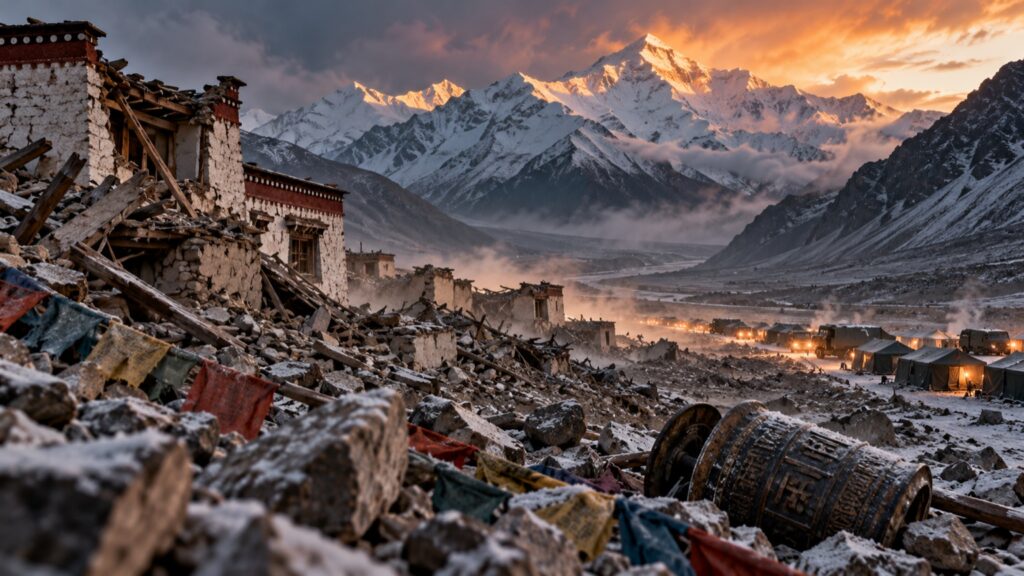
Magnitude 7 quake strikes Tibet at 4,500 meters. Over 10,000 evacuated in freezing cold
A magnitude 7 earthquake has struck a remote mountainous area in Tibet, leaving dozens of casualties as President Xi Jinping orders an all-out rescue operation. Temperatures in the disaster zone plunge to minus 6 degrees Celsius at night, posing severe challenges for emergency responders. https://t.co/bbSZQzRjcJ
— RFI Chinese (@RFI_Cn) October 23, 2026
A powerful magnitude 7.0 earthquake has struck a remote mountainous county in China’s Tibet Autonomous Region, killing at least 16 people and injuring 76 others. Chinese President Xi Jinping has issued urgent instructions demanding an all-out rescue effort to assist those affected by the disaster.
According to state media reports, the shallow tremor struck Baqen County in the prefecture-level city of Nagqu late Thursday at 10:33 p.m. local time. The epicenter is located hundreds of kilometers away from the regional capital of Lhasa, requiring a round-trip drive of at least 10 hours. The quake damaged or partially collapsed more than 300 residential buildings.
Xinhua News Agency reported that over 12,000 villagers in the disaster-stricken area have been safely evacuated to secure locations. State broadcaster CCTV noted that at least 11 of the injured are in critical condition, compounding the challenges facing emergency medical teams.
In a video clip shared on Sina News, a local resident recalled the terrifying moments when the tremor hit. “I had just laid down to rest when the house started shaking violently and things began falling from the walls,” the resident said. “We rushed outside without time to change our clothes. Our legs were shaking uncontrollably, and we burst into tears after reaching the street.”
The resident added that lingering fears of aftershocks prompted many neighbors to pitch tents by the roadside or spend the night inside cars to stay safe.
Another resident, surnamed Li, recounted a similar escape in a video published by Beijing News. “The building was swaying fiercely in all directions, and everyone rushed out. No one dared to stay indoors,” Li said, speaking from inside a vehicle en route to an evacuation center.
Footage broadcasted on state media and social platforms showed diners and staff fleeing restaurants in panic as goods tumbled from supermarket shelves during the tremor.
Other clips captured rescue workers equipped with flashlights searching through rubble for survivors under the cover of night.
The disaster zone sits at an altitude of over 4,500 meters (14,700 feet), where the population is sparse and communities rely primarily on subsistence farming and animal husbandry.
CCTV reported that hundreds of personnel from fire, rescue, and law enforcement agencies have been dispatched to the area, equipped with search dogs, life-detection devices, and heavy cutting tools.
The People’s Liberation Army also mobilized around 300 soldiers to join the disaster relief efforts, utilizing aerial reconnaissance resources, including drones, to assess the damage.
“Significant Casualties”
Xinhua reported that President Xi Jinping described the casualties from the Nagqu earthquake as “significant.” He urged authorities to “spare no effort in saving lives” and to prioritize the medical treatment of the injured, though specific figures on ongoing rescues remain limited.
He also highlighted the severe rescue hurdles posed by the high altitude and extreme cold, stressing the need to closely monitor meteorological data and stay vigilant against aftershocks and secondary disasters.
According to CCTV, daytime temperatures in the affected region hover around a maximum of 5°C (41°F), while nighttime lows plummet to -6°C (21°F), with occasional snowfall reported in certain areas.
A Seismically Active Plateau
Earthquakes are frequent in China’s western regions. Tibet sits in a volatile seismic zone created by the ongoing collision between the Indian and Eurasian tectonic plates, which is crisscrossed by numerous fault lines.
Earlier in January, a 6.8-magnitude earthquake struck Tingri County near the China-Nepal border, resulting in at least 126 fatalities.
Historically, the region has witnessed catastrophic tectonic events, most notably the devastating 2008 Sichuan earthquake in southwestern China, which killed or left missing an estimated 90,000 people, including thousands of schoolchildren.
Access to Tibet for foreign media and independent journalists remains heavily restricted, with international press typically permitted entry only under tightly managed official tours.
The disaster comes just two months after a deadly glacial collapse and massive flooding hit Tibet on August 26, which claimed 43 lives on the Chinese side and caused an even heavier toll across the border in Nepal, where over 1,400 people were reported dead or missing in related regional calamities.