
China’s top universities now take more graduate students than undergrads. Yet applications keep falling
As the 2026 academic term begins, a striking demographic inversion is playing out across China’s elite higher education system: top-tier universities are now welcoming more graduate students than undergraduates.
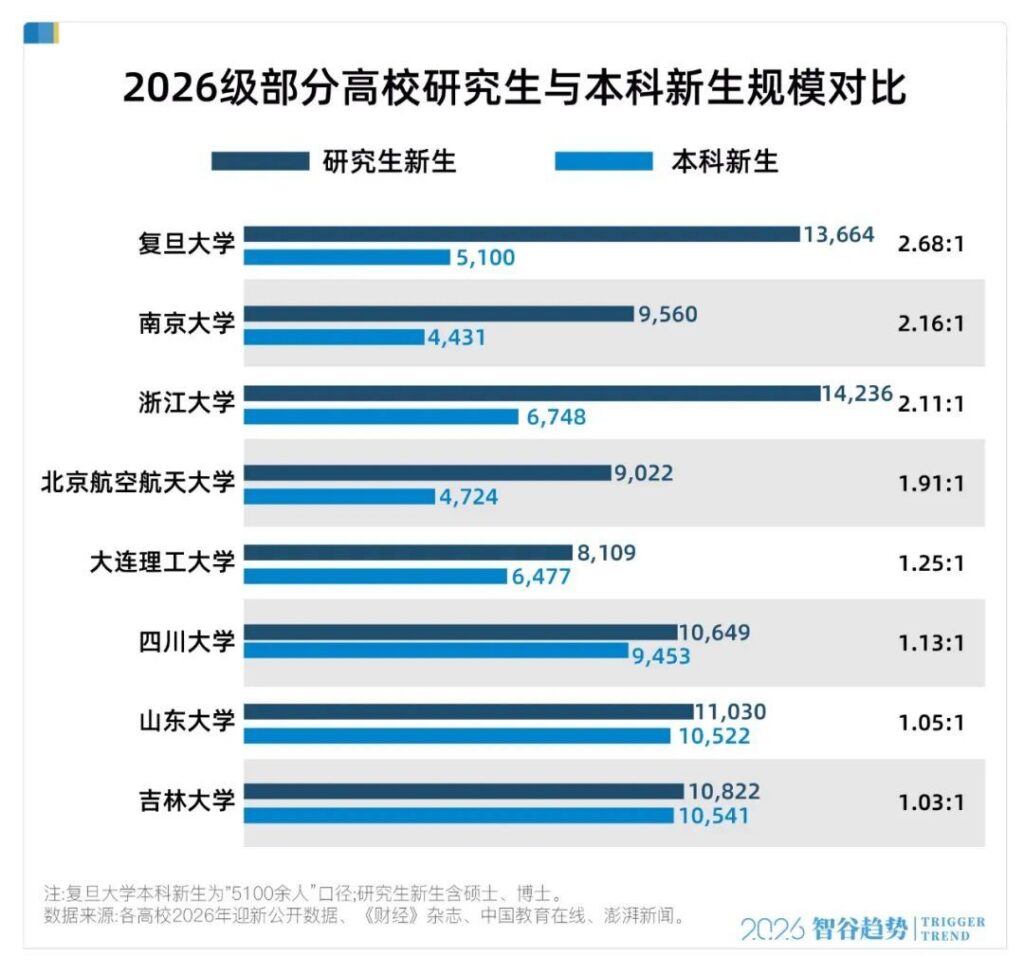
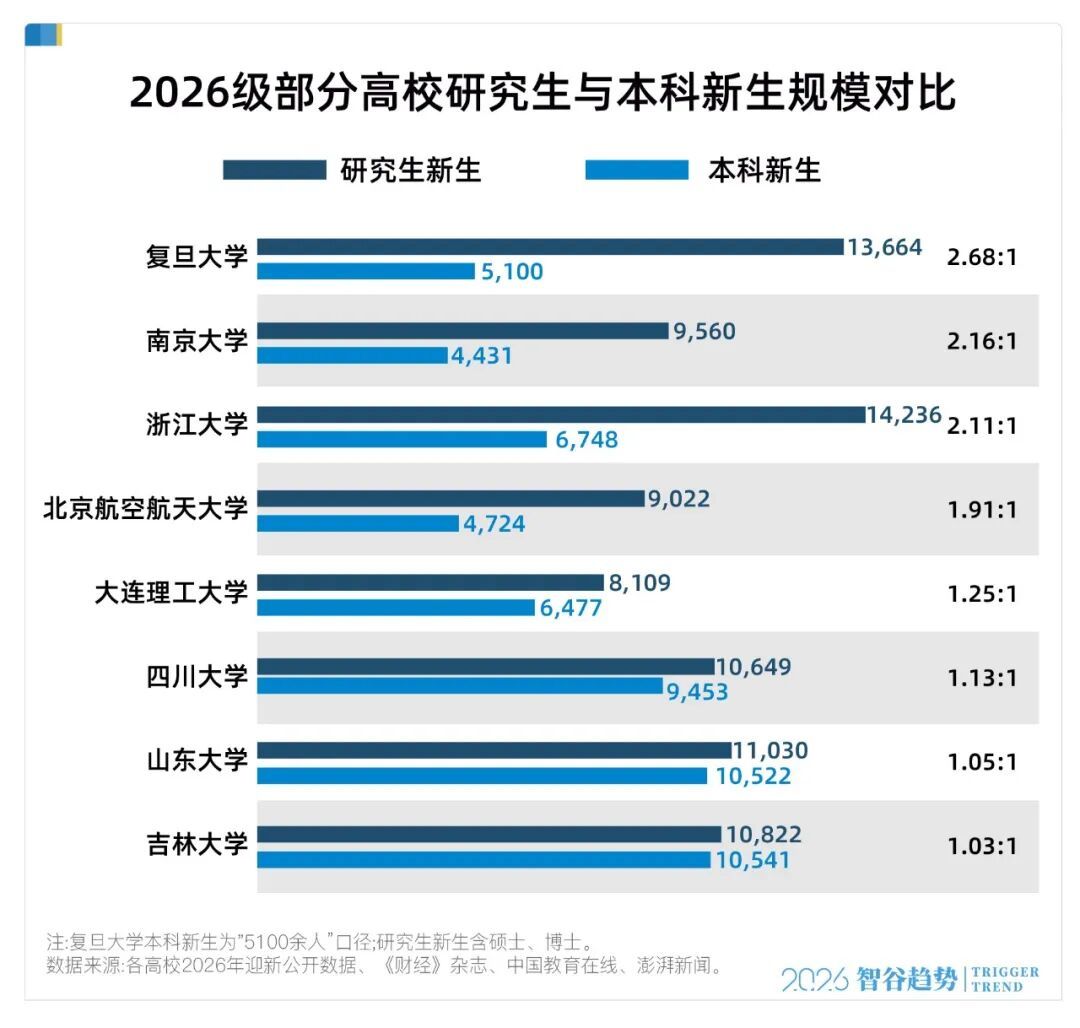
At Shandong University, the incoming graduate cohort reached 11,030 compared to 10,522 undergraduates. Jilin University reported 10,822 graduate newcomers against 10,541 undergraduates, while Zhejiang University enrolled 14,236 graduate students alongside just 6,748 undergraduates. At Fudan University, the ratio of graduate students to undergraduates has surged to 2.68 to 1. According to data compiled by Caijing magazine, nearly all elite institutions in the elite “Project 985” consortium have seen their postgraduate intake eclipse their undergraduate enrollment.
This phenomenon is no longer confined to top-tier institutions like Tsinghua University and Peking University, but is rapidly spreading to comprehensive universities nationwide. In 2023, Beijing became the first provincial-level region where graduate graduates surpassed undergraduate graduates.
Yet paradoxically, the number of applicants sitting for the national entrance exam for graduate school—known as the kaoyan—has dropped for three consecutive years. From a peak of 4.74 million in 2023, applicant numbers slid to 4.38 million in 2024, 3.88 million in 2025, and 3.43 million in 2026, effectively returning to 2020 levels.
This contradiction is driven by a decade-long state-backed expansion of graduate education. Ministry of Education data shows that master’s admissions climbed from 570,600 in 2015 to 1.23 million in 2025, representing an average annual growth rate of roughly 8%. Ph.D. admissions expanded from about 75,000 to 201,600 over the same period, growing at about 10% annually.
This push is propelled by two major forces. First is the looming pressure of shifting demographics. China’s annual newborns dropped sharply from 17.86 million in 2016 to 9.02 million in 2023. While this contraction will not hit undergraduate admissions until the mid-2030s, universities are already anticipating shrinking applicant pools. For elite “Project 985” institutions flush with research resources, expanding upward into graduate education is a pragmatic strategy to maintain their operational scale.
Second, Beijing has made graduate expansion a national priority. The 15th Five-Year Plan for Education Development, issued in June 2026, calls for steadily raising the proportion of graduate students in higher education while vigorously expanding professional degree programs. The Master Plan for Building a Leading Education Power (2024–2035), released in January 2025, elevated the “orderly expansion of graduate training scale” into a ten-year national strategy.

Even as traditional exam applications decline, graduate enrollment continues to grow largely because non-exam pathways are multiplying. Elite universities now rely heavily on recommendation systems exempting top students from the national test. At Tsinghua University, roughly 76% of the class of 2026 secured graduate placement through exemptions, while Peking University’s main campus stood at 69.47%. Across most C9 League universities—an alliance of China’s elite research universities—exemption rates for top majors exceed 70%, with some reaching 85%. While elite students increasingly bypass the exam through direct Ph.D. tracks or combined master’s-doctoral programs, students from ordinary universities still rely on the grueling national test.
The 2026 admissions cycle also reveals a profound structural shift: the prestige and weight of professional master’s degrees have risen dramatically, accounting for 69.7% of unified exam admissions, while academic master’s programs have shrunk to 30.3%. Elite institutions are even phasing out academic tracks altogether. Fudan University’s School of Mathematical Sciences announced it will stop recruiting academic master’s students starting in 2027, and Shanghai Jiao Tong University’s math department has followed suit. More than ten departments at Zhejiang University—including electrical engineering, computer science, and materials science—have restricted admissions exclusively to professional degrees.
Engineering fields are driving the bulk of this professional degree expansion. Data from media outlet澎湃新闻 (The Paper) mapping over 200,000 recruitment listings shows that engineering professional master’s slots grew by more than 13,000, accounting for nearly two-thirds of the total unified expansion. Conversely, academic master’s programs in management saw the steepest cuts across all disciplines, dropping by over 1,300 spots.
Engineering professional degrees are being pushed to the forefront to plug critical gaps in industrial upgrading. In the semiconductor sector, the shortage of engineering talent is projected to reach between 300,000 and 350,000 by 2025, with high-end talent shortages in chip design exceeding 40%. Meanwhile, the job market demand ratio for AI engineers stands at 3.08, meaning there are roughly three open positions for every single applicant.
Wang Qiming, director of the Department of Graduate Education at the Ministry of Education, noted that the 2026 admissions plan added 15,000 new slots. Of these, 3,000 are earmarked for artificial intelligence, 2,500 for integrated circuits, 2,000 for biomedicine, and 1,500 for new energy, alongside frontier fields like quantum information and brain science. These disciplines heavily overlap with critical technological bottlenecks where China is racing for self-reliance.

From a macroeconomic perspective, graduate students account for roughly 8.8% of China’s total higher education enrollment, well below the average of over 20% in developed nations. By this metric, China’s graduate population remains relatively small. Yet a decade of continuous expansion has steadily eroded the traditional scarcity value of a master’s degree.
Between 2020 and 2025, starting salaries for undergraduate fresh graduates grew by about 40%, while master’s graduates saw a raise of just 12.5%, narrowing the wage gap between the two degrees to 22%. Because pursuing a graduate degree demands three additional years and substantial financial costs, career choices have become increasingly pragmatic. “To get a graduate degree or not” is no longer the defining question; “what to study” is.
The economic return on the exact same master’s diploma is diverging sharply across disciplines. Fresh graduates with master’s degrees in chip and semiconductor engineering command starting salaries of around 285,000 yuan ($39,500) a year, compared to 112,000 yuan for undergraduates. AI algorithm roles fetch master’s holders roughly 328,000 yuan annually, versus 135,000 yuan for bachelor’s holders. In fields like journalism, foreign languages, and general management, however, the employment gap between undergraduate and master’s degree holders remains negligible—and virtually none of the enrollment expansion has been funneled into these areas.
Civil engineering offers a stark historical mirror to these changes. In 2002, recruiters from China Railway First Group visited university campuses and handed out 10,000 yuan in relocation bonuses to engineering graduates on the spot, without even checking their transcripts. By 2024, a candidate in Ningxia scoring 438 points on the national college entrance exam could secure admission into Tongji University’s prestigious civil engineering program—just six points above the baseline threshold for top-tier universities. The twenty-year journey from a golden era to rock-bottom reflects a broader national pivot away from massive infrastructure toward high-tech breakthroughs, permanently redirecting where institutional resources flow.

Looking ahead to the next decade, two clear tracks are emerging. The first is hard tech and critical supply chain bottlenecks. The third phase of China’s state-backed Integrated Circuit Industry Investment Fund, capitalized at 344.0 billion yuan ($47.7 billion), is channeling capital entirely into semiconductor equipment, materials, and other critical segments. Disciplines that break technological bottlenecks and support advanced manufacturing continue to capture heavy policy and financial backing.
The second track aligns with demographic shifts. China’s population aged 60 and older has reached 323 million, accounting for 23% of the total. The “silver economy” has already surpassed 10.8 trillion yuan in market scale and is projected to hit 30 trillion yuan by 2035, driving long-term demand in elderly care, medical wellness, biomedicine, and smart nursing.
Ultimately, choosing a major and a university in China today is a high-stakes bet on the cycle of the times—requiring a map of the new world, not the old one.