

Beijing’s Gen Z is terrified of throwing away trash. Blame the neighborhood garbage hunters
Residential compounds across Beijing are patrolled by dedicated communities of resident scavengers whom locals jokingly call “garbage hunters.” These individuals, often financially comfortable, harbor an unflagging passion for every single salvageable item tossed into public bins. They rifle through rubbish bags, intercept unwanted goods straight from neighbors’ hands, and have even been known to trade heated words over a stray cardboard box.
Faced with this bizarre phenomenon, newly arrived young tenants are often left utterly bewildered, with some taking to social media platforms to plead for emergency advice: “How on earth do I stop older neighbors from rummaging through my garbage?”

(Source: Social media)
When Trash-Picking Becomes a Psychological Burden
On Beijing streets, cargo tricycles operated by independent recyclers are a ubiquitous sight. They pedal through compounds to collect discarded household items, paying roughly 0.70 to 0.80 yuan ($0.10 to $0.11) per kilogram before offloading the haul to professional recycling stations.
In theory, the volume of recyclable waste generated within any given housing estate is relatively fixed, meaning whoever reaches the loot first reaps the profit. Consequently, recyclable goods—especially cardboard boxes and large plastic bottles—have transformed into coveted “strategic assets” among residents. Newcomers fresh off a move or home renovation naturally become prime targets for these undercover garbage hunters.
Back in July, a young man named Xiaopan moved into an apartment complex near Beijing’s Fourth Ring Road. Having purchased various small appliances and household goods, he had accumulated a towering stack of cardboard boxes. As he carried five or six flattened boxes toward the front door to take out the trash, an elderly woman materialized before him with a beaming smile. “You don’t need these anymore, right? Give them to me,” she said.
Since the communal bins were a two-building trek away, Xiaopan agreed just to save time. Little did he know, the woman would instantly up the ante: “Young man, next time you have boxes, just bring them straight to me. My tricycle is parked right downstairs by Building X—just toss them directly into the cart.”

(Still from the TV series *The Ideal City*)
In the local vernacular of Beijing, trash circulation operates strictly under a “first-come, first-served” doctrine. The proactive grandma staking out her territory was actually a relatively mild specimen of the garbage hunter class, relying on relationship-building and creeping monopolies. Yet many internet users recount far more aggressive encounters bordering on outright daylight robbery.
A social media user posting under the handle @Yikeshu shared a harrowing routine: an elderly woman perpetually paces around the base of her building’s trash chute. The moment anyone approaches to dump refuse, she swoops in to “snatch the garbage directly out of your hands.” Thinking about arguing feels pointless since the items are destined for the bin anyway, leaving residents to swallow their frustration.
For young urbanites who fiercely guard their personal boundaries, handing over clean cardboard boxes voluntarily is no big deal. But when strangers intercept property without asking, a routine domestic chore turns into an exercise in social awkwardness.

(Source: Social media)
Should multiple hunters set their sights on the same piece of trash in your hands, you risk sparking a full-blown neighborhood turf war: one elderly gentleman insists he arrived at the scene first, an older woman claims that specific bin has belonged to her territory for years, and a third bystander chimes in that the young lady always used to give her boxes to *him*.
Simply carrying a single cardboard box past a cluster of gossiping seniors seated in the courtyard is enough to completely disrupt their intelligence network.
Stranger still, some scavengers have refined their focus down to the level of household refuse. Xiaowei, who lives in an aging government-affiliated residential compound along Beijing’s Third Ring Road, froze one night under the dim amber glow of a streetlamp as she watched a neighbor tear open a communal garbage bag. “Finding a box is one thing, but why on earth are you untying my tied-up trash bags and rummaging through them?”
The elderly gentleman belonged to the hardcore faction of permanent trash-bin sentinels, turning up faithfully rain or shine as if clocking into an official shift. Unable to take it anymore, Xiaowei eventually snapped: “There’s cat litter in there, you don’t need to look.”
While her garbage indeed frequently contained cat litter, what truly horrified her was the prospect of personal items like feminine hygiene products or soiled paper towels ending up exposed. “I feel mortified just thinking about those things, but he doesn’t bat an eye.” Sometimes the elderly man would even critique the contents aloud: “Such a decent item, why would anyone throw this away?”
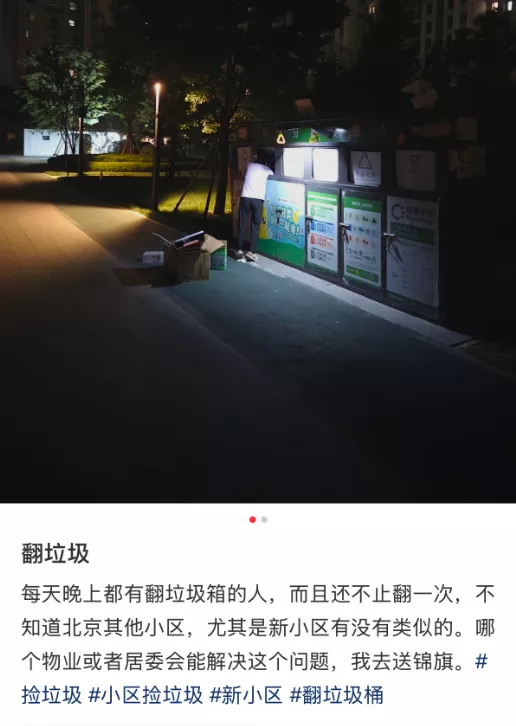
(Source: Social media)
This intrusive habit of picking through general household waste has spawned a peculiar psychological affliction among younger residents: “trash-disposal shame.” The mere thought of personal lifestyle details being unspooled and scrutinized by strangers proves deeply distressing. Xiaowei confessed, “Now, whenever I throw away undergarments or intimate apparel, I have to mutilate them with scissors first just to feel safe.”
This crushing sense of shame has driven thin-skinned youngsters to adopt the stealth tactics of nocturnal guerrillas. Xiaowei has memorized the patrol schedules of the compound’s most stubborn hunters, deliberately timing her garbage runs for 8:55 PM. “That’s when most of them are tucked inside putting their grandchildren to sleep. By precisely 9:00 PM, the municipal sanitation truck arrives to haul the entire dumpster away.”
She catches herself laughing at the absurdity of it all: “I haven’t committed a crime, I’m just taking out the trash, yet I feel like I’m running a counter-surveillance operation.”


(Source: Social media)
Many garbage hunters possess endless reserves of free time and ironclad willpower, standing guard “even during bitter winter gales with gale-force winds.” Some internet users joke that escaping these hawks requires waiting until midnight to dump refuse. Yet even at that ghostly hour, one is liable to stumble upon lingering phantoms haunting the wheelies.
Shortly after moving past the Fourth Ring Road, Xiaopan briefly wondered if his humble housing complex was simply an outlier, drawing an unusually high concentration of scavengers.
That hypothesis vanished the moment he discovered countless kindred spirits online spanning every stratum of society—whether living in older downtown alleyway housing worth 30,000 yuan per square meter or luxury school-district compounds commanding 100,000 yuan; whether working entry-level nine-to-five jobs or drawing a 10,000-yuan monthly pension as a retired state-owned enterprise executive. When faced with the magnetic pull of cardboard salvage, social classes dissolve into eerie equality.
Can Smart Tech Block Hands Reaching for the Bin?
Fortunately, technological innovation is beginning to hand a few wins back to self-conscious youngsters.
Over the past couple of years, select Beijing residential communities have introduced automated smart recycling kiosks equipped with digital scales. Users simply scan a QR code with their smartphones, unlock the compartment door, deposit their goods, and instantly finalize the transaction.
The most widely deployed infrastructure is developed by Infore Environment’s recycling arm, backed by Chinese e-commerce giant
Using automated recycling stations bypasses human interaction entirely, restoring a sense of agency to residents. Xiaoxu, a lifelong Beijinger who used a smart kiosk for the first time in May, noted, “I used to skip selling recyclables because it was too much hassle, and I’d just hand boxes over when people asked. Now, I march right up and dump them into the machine while the hunters watch.”
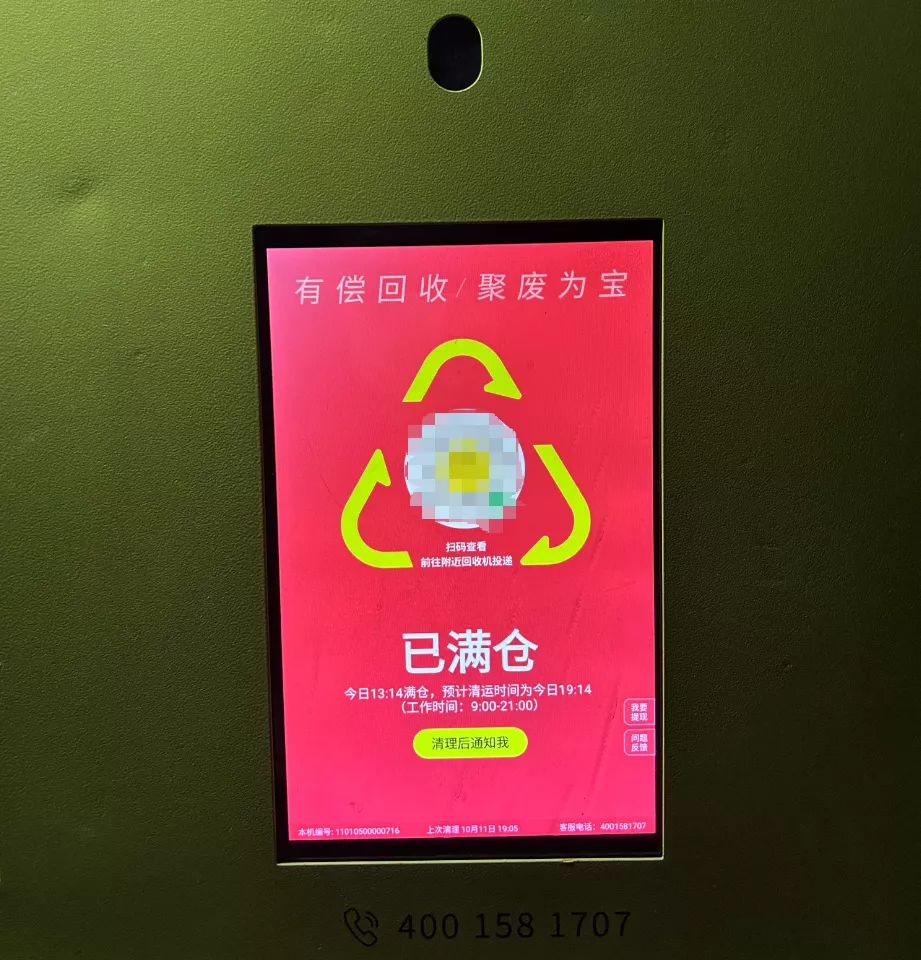
(Provided by interviewee)
Yet high-tech solutions inevitably breed novel frictions. Xiaoxu observed that within two months of her compound installing a smart recycling bin, its operational reliability plummeted. Returning home at 7:30 PM, she frequently found the unit packed to capacity and flagged for clearance, with system prompts indicating it would remain offline until 5:00 AM the next morning—only for it to be jammed full again by the time she left for work.
Xiaoxu recalls reading online theories that disgruntled neighbors intentionally stuff heavy ballast into the intake ports to trigger weight-limit safety shutdowns, locking others out of depositing recyclables. While she suspects similar sabotage is occurring in her compound, a lack of concrete evidence leaves her carrying her cardboard boxes crestfallen back up to her apartment.
Of course, automated kiosks merely give residents the backbone to keep cardboard out of neighbors’ hands; they do nothing to resolve the broader nightmare of everyday garbage rummaging.
Property management offices and neighborhood committees theoretically hold responsibility for intervention, but reality often mirrors the old adage: “As the masonry climbs a foot, the devil rises ten.” Online forums overflow with creative counter-tactics tested by management companies—such as purchasing heavy, interlocking square iron dumpsters equipped with lower-access locks, leaving only a narrow upper slit so the depths of the bin remain out of arm’s reach. Yet scavengers invariably find ways to break the padlocks, sparking an endless cycle of damage, repair, and renewed vandalism.
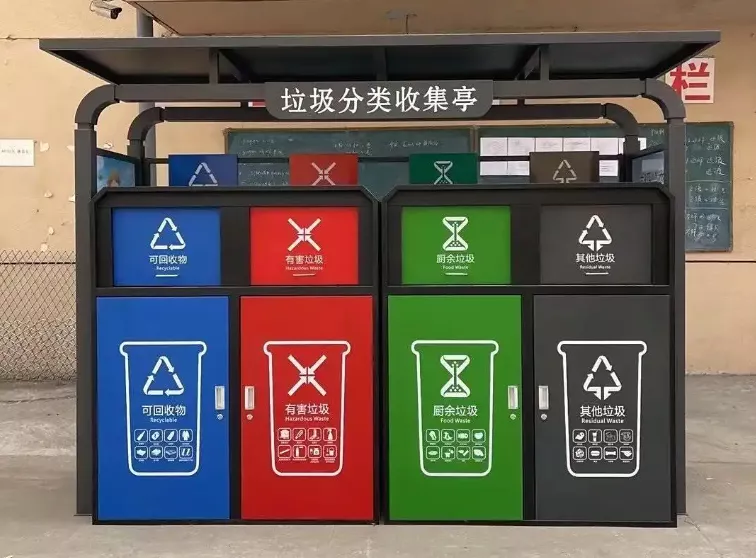
(Source: Internet)
Other neighborhood committees have taken a radically pragmatic approach, treating garbage collection as a municipal franchise right. They formally carve up compound dumpsters among the neighborhood’s warring factions, instituting a localized “contract responsibility system for trash.” As one bewildered resident remarked, “I’ve lived this long, and I never thought I’d witness the collectivization of garbage collection.”
In the rare residential compounds where waste management runs smoothly, success typically hinges on two pillars: first, abundant bin allocation—such as providing dedicated disposal points on every floor or apartment block accompanied by rapid clearance frequencies—which drastically minimizes opportunities for loitering and scavenging, albeit at the cost of higher management fees borne by residents.
Second, strict enforcement of municipal waste sorting protocols requires monitors to verify whether recyclables are genuinely segregated from general refuse, cutting off scavengers at the source. Yet in Beijing, compounds capable of rigidly maintaining such sorting standards remain few and far between.
To be fair, garbage hunters who extract valuables to sell represent a relatively benign outcome. The true headache for residential communities lies among hoarders suffering from obsessive compulsive hoarding disorders. These individuals not only stockpile recyclables aggressively but also encroach upon shared public spaces like stairwells and entryway lobbies, severely compromising sanitation and neighborly harmony.
Beijing Television once broadcast a documentary exposing a two-year hoarding saga in the Desheng sub-district of Beijing’s Xicheng district, where an elderly resident completely blocked off the seventh-floor stairwell and spilled onto the sixth floor with discarded trash, driving neighbors to distraction. Ultimately, local authorities mobilized a joint task force comprising fire safety, urban management (Chengguan), and public security police to command property management in executing a forced clearance, hauling away 17 woven sacks packed tight with debris.
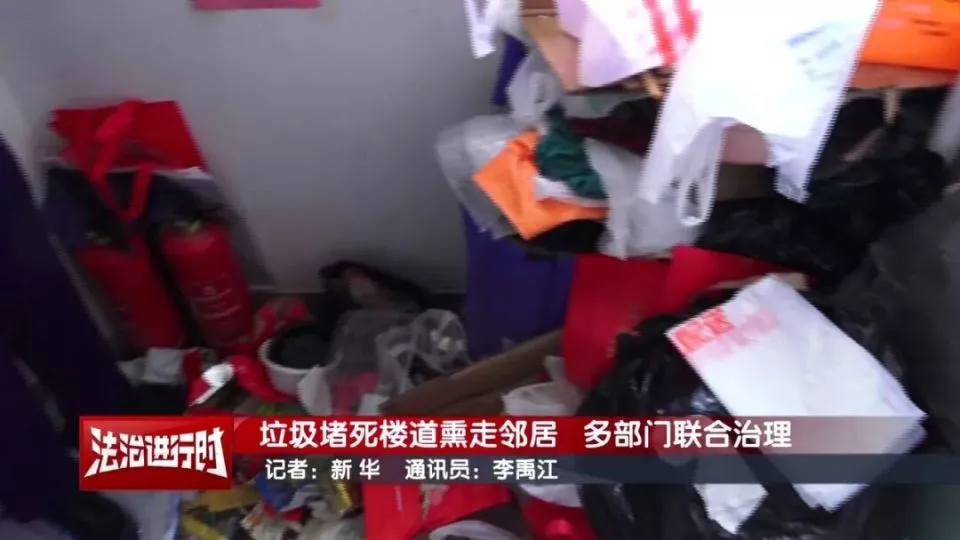
Beijing Television reporting on the forced clearance of stairwell hoarding in a residential compound. (Source: Video screenshot)
More often than not, however, household hoarding fails to cross the legal threshold for mandatory municipal intervention, leaving neighbors to endure years of cumulative misery.
The Silver-Haired Wave and Intergenerational Friction
In Xiaoxu’s childhood memories, the door-to-door waste collectors and the neighbors who indulged them exuded a deep sense of communal warmth.
p>
She recalls a particular married couple in her old neighborhood who both lived with mild disabilities. Operating a tiny convenience store from a cramped back room near the estate gate, the family of three earned their living while the couple cycled a flatbed tricycle through the lanes twice a day to collect recyclables. Everyone knew them, and residents happily handed over their spare boxes and bottles.
Xiaoxu reflects that if her current compound featured such familiar faces, she wouldn’t feel compelled to lean on smart machines just to claim her 0.80 yuan. But growing up brought exposure to urban legends about elderly scavengers secretly owning multiple apartments acquired through urban redevelopment demolitions. Combined with her own encounters with well-dressed seniors demanding handouts with abrasive entitlement, her patience for uninvited scavenging evaporated.
In the contemporary urban landscape, waste recycling is no longer synonymous with financial destitution. Especially in sprawling metropolises like Beijing, characterized by dizzying demographic complexity, it is impossible to guess whether an elderly gentleman stepping out of a luxury SUV has a trunk packed with cardboard, or whether a seemingly docile grandmother is simply biding her time before staking claim over established neighborhood turf.
The neighborhood friction catalyzed by garbage hunters serves as a micro-cosmic reflection of the generational disconnect playing out across China’s megacities. As society accelerates into an aging demographic curve, Beijing’s residential compounds have emerged as the ultimate crucible for these structural frictions.
By the end of 2024, Beijing’s permanent resident population aged 60 and above reached 5.14 million, accounting for 23.5% of the city’s total. Within this cohort, seniors who migrated to the capital alongside their “Beipiao” (migrant worker) children constitute a vital demographic segment. According to China’s seventh national census data, roughly one-sixth (around 16.7%) of Beijing’s elderly population in 2020 originated from outside the municipality. Extrapolating from those ratios, Beijing currently hosts a migrant senior population scaling approximately 850,000, cementing its status as one of China’s primary destination hubs for the phenomenon known colloquially as *laopiaozu*—aging migrants trailing their adult children.

(Still from the TV series *All Is Well*)
Why are elderly residents overwhelmingly the ones driving the relentless pursuit of trash, generating such friction with younger generations? Multiple psychological and socioeconomic drivers are at play.
First, many older adults grew up conditioned by deep-seated frugality, viewing any functional or residual economic value going to waste as intolerable. Compared to younger generations with punishing work hours, seniors possess vast reserves of discretionary time. If they are willing to queue for hours outside supermarkets to claim promotional free eggs, staking out garbage bins for economic yield is a natural extension of that calculus.
Second, most migrating seniors relocate to Beijing to help care for grandchildren, inherently wishing to alleviate the financial pressures weighing on their children. Under the crushing cost-of-living burdens of multigenerational urban households, the mentality that “every little bit helps” guides elder behavior. Over the course of a year, accumulated recycling yields can generate several thousand yuan in supplementary household income.
Finally, elderly individuals thrust into entirely unfamiliar metropolitan environments urgently crave renewed purpose and validation. Mundane chores like sorting and selling scrap metal offer a tangible avenue for self-actualization. As psychological professionals note, “Subsidizing household finances through scrap collection delivers a deep sense of self-worth that eventually hardens into compulsive behavior.”
When these compounding factors converge, they forge a social phenomenon that violates no laws, defies municipal governance, yet reliably exasperates young urban workers.
Some internet users venting their frustrations online ultimately surrender with a wry chuckle, conceding that perhaps they too are beginning to understand the eternal human struggle against the cost of living: “Maybe I’m getting old myself—lately, I sometimes find myself wanting to pick up someone else’s discarded box just to feed it into the smart recycling kiosk for a few extra cents.”}