
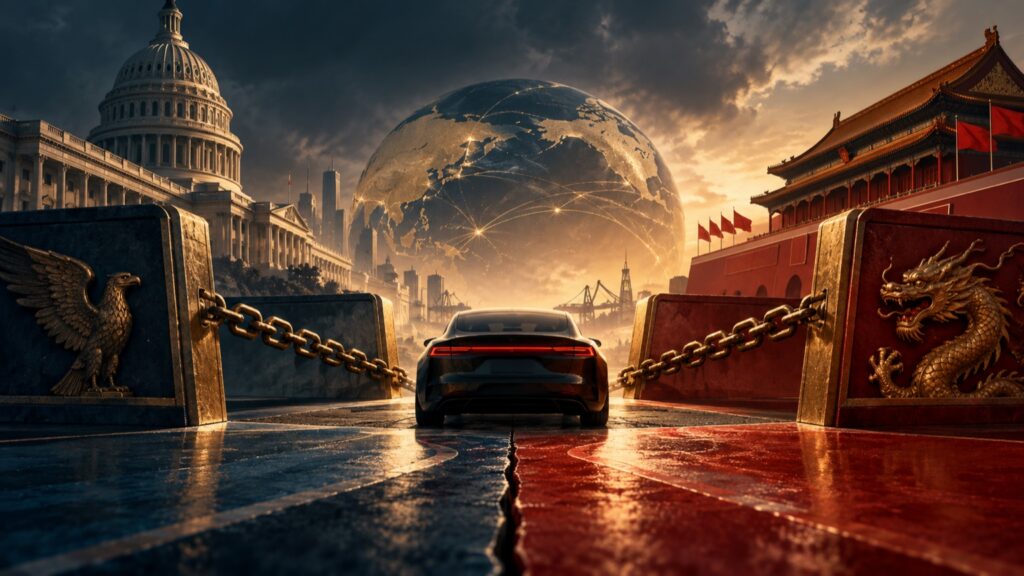
Musk Merger Faces Dual US-China Regulatory Trap Over Tesla Future
If Elon Musk presses ahead with his ambitious plan to merge two of his crown-jewel enterprises into an mega-scale tech empire, he is on a collision course with both Washington and Beijing. Regulators on both sides of the Pacific are poised to throw up roadblocks, driven by overlapping national security anxieties, defense sensitivities, and strict cross-border data controls.
According to Reuters, the billionaire entrepreneur recently revealed that special committees at both companies have been formed to explore a merger, calling the move a “smart” strategic play. Yet, bridging the gap between an electric vehicle giant deeply reliant on Chinese supply chains and a rocket maker entwined with classified military contracts remains a regulatory labyrinth.
As SpaceX deepens its ties with the US defense apparatus through sensitive national security agreements, any corporate restructuring encompassing Tesla’s sprawling operations in China will inevitably draw intense scrutiny from American security watchdogs.
Meanwhile, regulators in Beijing have drawn a firm red line: all driving and user telemetry gathered within China must remain strictly onshore, shielded by airtight isolation mechanisms to prevent sensitive technology or data from leaking across borders.
To navigate the minefield laid by Washington and Beijing, Musk and his corporate lieutenants are weighing several high-stakes strategies:
Can Tesla’s China Operations Survive the Fallout?
One viable path forward involves building a digital “Great Firewall” around Tesla’s Chinese operations, severing data pipelines to ensure SpaceX and other defense-linked entities cannot access sensitive local information. Transportation directors at major consultancy firms note that corporate precedents already exist for this kind of structural decoupling.
Industry analysts point to aerospace and industrial giants that routinely manage to safeguard their mainland market share while ring-fencing sensitive defense portfolios overseas.
SpaceX’s defense portfolio includes the secretive “Starshield” program, which builds dedicated reconnaissance and military satellites for the US Department of Defense.
Insiders suggest that erecting a “two-way firewall” to guarantee that EV customer data stays trapped within China will be the baseline demand from Beijing. Tesla has already complied with Beijing’s vehicle data localization mandates since 2021.
The chief executive of an automotive think tank noted that Tesla could theoretically maintain autonomous operations in China for years to come, anchored by an independent domestic R&D ecosystem and strict data-localization agreements.
However, supply chain experts at the University of California warn that simultaneously satisfying Beijing and Washington is a near-impossible tightrope walk. Beijing could well weaponize the merger approval process as a geopolitical bargaining chip, piling on stringent conditions.
Antitrust scholars at the University of London suggest Beijing might demand a dual concession: granting local players access to strategic technologies while forcing the firm to maintain high capital investment and industrial output.
Conversely, any mandate to share sensitive SpaceX technology with foreign entities would instantly trigger a clash with US export controls and national security laws.
What Happens If a Divestment Becomes the Only Way Out?
Should the cross-border friction prove insurmountable, industry watchers outline three potential exit strategies: carving out the subsidiary while retaining financial equity, spinning off assets via long-term licensing agreements, or executing a wholesale sale to local automakers.
Yet every exit path is fraught with friction, primarily due to the glaring lack of viable buyers. Automotive research associations point out that China’s domestic EV market is already plagued by severe overcapacity, leaving local competitors with little appetite for pricey acquisitions.
At the same time, overseas automakers are grappling with their own liquidity crunches, making a foreign buyout unlikely. Consultants lean toward the view that Musk would opt to spin off his Chinese assets rather than surrender outright control.
Even so, analysts emphasize that unless the billionaire signals a genuine desire to exit the automotive sector altogether, Tesla is most likely to preserve its current ownership structure and double down on the Chinese market.
The China Market: An Irreplaceable Revenue Engine
Completely severing ties with China is easier said than done. Heads of automotive advisory firms stress that local supply chains are deeply baked into Musk’s broader business ecosystem, with the Shanghai Gigafactory accounting for more than half of Tesla’s global production.
Still, some institutional investors argue that these deep roots may not necessarily torpedo a merger.
Senior investors tracking both companies note that while Tesla’s footprint in China is colossal, the company has aggressively ramped up domestic US manufacturing capacity in recent years—particularly in humanoid robotics and autonomous robotaxis. Wall Street’s gaze is increasingly fixed on Musk’s long-term roadmap for these nascent product lines.
These investors contend that corporate leadership will likely argue to US authorities that Tesla’s Chinese operations operate at arm’s length from SpaceX. But if Washington proves unpersuaded, Tesla could face a scenario where it has to downsize or shutter mainland production.
In their view, the resulting shockwaves would be short-lived and manageable, a cost the corporate titan could readily absorb.