
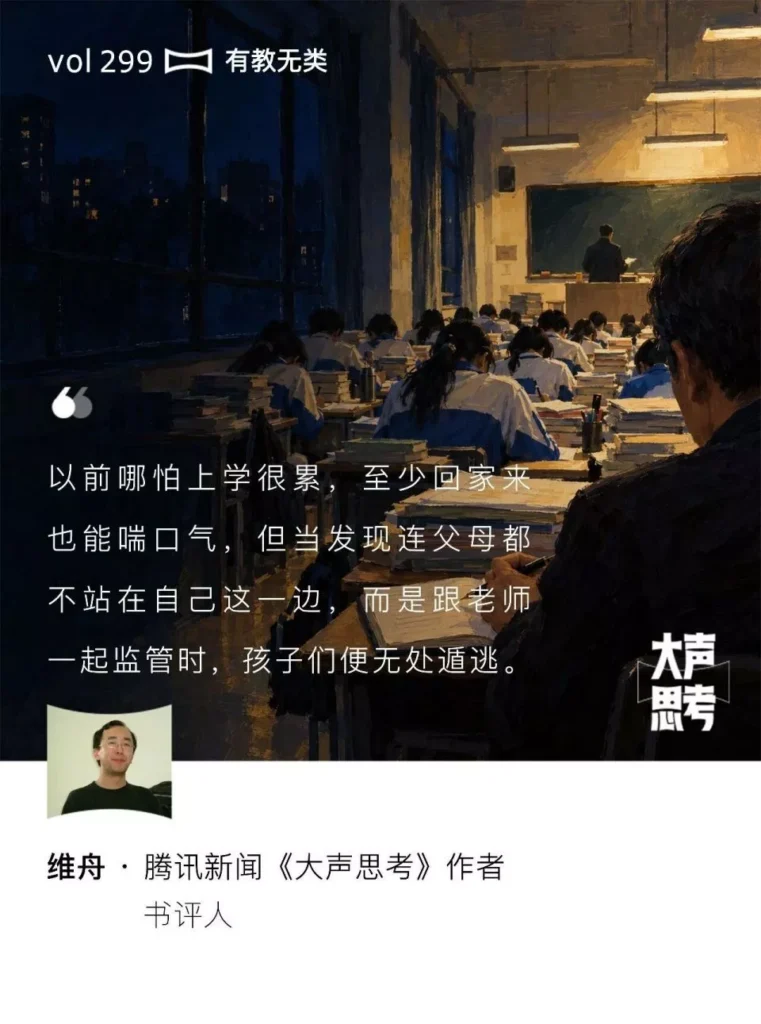
When Parents Became School Guards, China’s Education Crisis Hit a New Low
A middle school in Wuhan recently touched a raw nerve across China by rolling out an unconventional after-school policy: parents were ordered to take shifts monitoring evening study sessions from 7:40 PM to 9:00 PM. The rules were uncompromising. Only biological parents could serve, with no substitutes allowed. Once on duty, parents were banned from using smartphones, required to meticulously log any student misbehavior, and even forced to document bathroom breaks.
Facing a torrent of online backlash, the school defended the measure as a voluntary form of “home-school interaction” designed to relieve exhausted teachers who endure grueling 14-hour workdays. Officials insisted participation was optional.
The explanation did little to soothe public anger. Critics pointed out an obvious hypocrisy: exhausted parents, already drained by intense workdays, were being drafted to perform duties that clearly belonged to professional educators. “Who is going to lighten the load for the parents?” asked one viral online commentary.
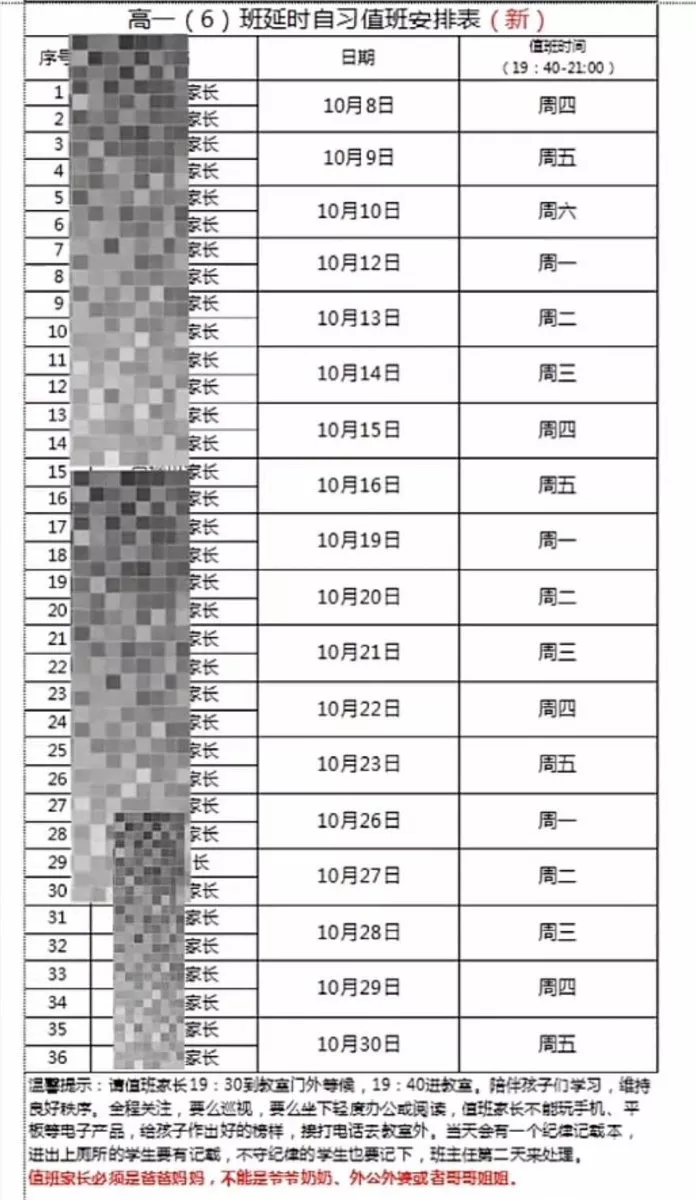
An unverified schedule of parent patrols circulating online.
Partnership or Punishment?

This is far from an isolated incident.
Over the past year, a high school in Luoyang, Henan province, sparked a similar outcry when it mandated that parents sit through evening study sessions. When confronted by bewildered families asking whether the school had run out of teachers, authorities defended the practice as a longstanding tradition meant to let parents witness their children’s progress firsthand.
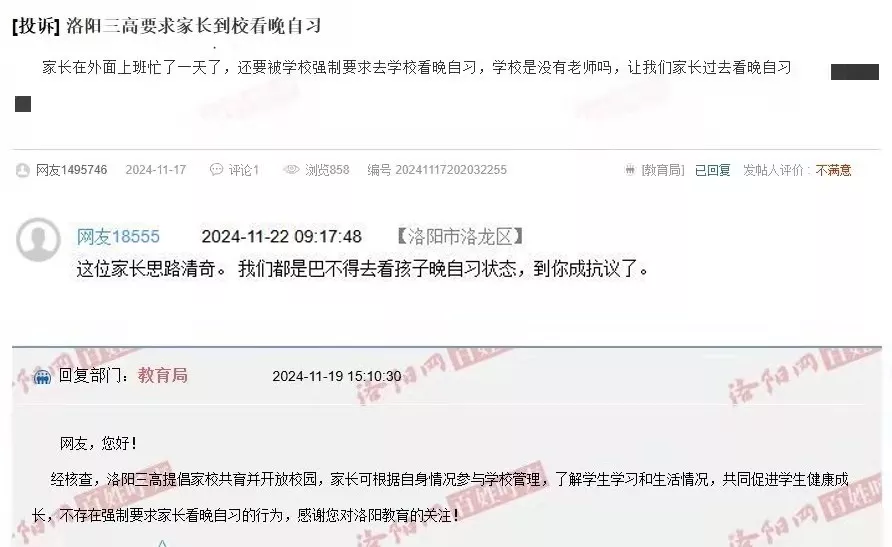
Parents’ complaints and school responses in Luoyang circulating online.
While some parents supported the move—arguing it kept students focused—others recognized it as a troubling erosion of professional boundaries. In practice, the line between “voluntary” and “mandatory” quickly dissolves in China’s high-stakes education system. What begins as a polite invitation often metastasizes into an unwritten administrative obligation, leaving parents too intimidated to refuse.
One woman who spent six years participating in classroom monitoring programs in western China recalled how quickly the dynamic soured. What was billed as a rotating schedule devolved into her lone, permanent vigil because other parents quietly backed out. Her own daughter felt humiliated, especially because the school initially singled out underperforming students, effectively sending a message to parents: We cannot control your child; you watch them yourself.
The Imported Ideal That Lost Its Way

The concept of school-family partnerships is not native to China. It traces its roots to Western academic frameworks, most notably Joyce Epstein’s overlapping spheres of influence theory developed in the late 1980s, which posits that a child’s success depends on coordinated efforts between schools, families, and communities.

Elementary school parents and students participating in a joint science activity in the US.
When Beijing formally introduced these concepts into modern school administration guidelines—culminating in a 2024 Ministry of Education blueprint aiming to establish nationwide education communities by 2027—they collided with a very different institutional reality.
In Western societies with deep traditions of civic autonomy, parent-teacher associations often operate as independent entities. In China’s top-down education ecosystem, however, independent civil structures are weak. Parent committees routinely morph into administrative subcontractors for the school. Programs billed as volunteer services quietly become mandatory tasks, deployed not to foster holistic development, but to solve institutional labor shortages.
The Wuhan middle school at the center of the recent storm is a provincial model school, yet it sits outside the elite tier of top-ranked institutions. Driven by intense pressure to improve college entrance exam (Gaokao) pass rates—which directly impact institutional prestige and teacher bonuses—the school prioritized strict discipline over student well-being. When internal teaching resources fell short, parents were drafted to fill the gaps.
The Overzealous Parent Trap

The dysfunction cuts both ways. While some parents are coerced into compliance, others actively demand even harsher restrictions.
When several prominent schools recently attempted to implement a genuine two-day weekend break for high school freshmen and sophomores, fierce resistance came not from administrators, but from anxious parents. Fearing their children would fall behind peers whose parents kept them studying, families flooded chat groups with protests. One viral comment declared: “Giving high school students a weekend break is pure sabotage of their future.”
This hyper-competitive impulse traps students in an unyielding cage. With parents and teachers united in around-the-clock surveillance, children lose any psychological buffer zone. Home is no longer a sanctuary from school stress; it is simply an extension of the panopticon.
The irony of this hyper-policed environment is that it often backfires. Excessive surveillance breeds deep resentment, alienation, and rising rates of adolescent depression. When adults signal total distrust in a teenager’s ability to self-regulate, students inevitably abandon their own agency, treating education as a hostile imposition rather than a personal pursuit.
True educational partnership requires respecting boundaries, not blurring them. Until schools remember that students need space to breathe—and parents remember that they are caregivers, not wardens—China’s education system will remain a pressure cooker bound by mutual entrapment.