
China’s children are being pre-packaged for school before they even start kindergarten
As learning shifts away from public school classrooms and into lucrative cram schools, regular lessons risk becoming little more than recycling bins for material already memorized. Parents hope that jumping the gun will pave a smooth path ahead. But when preemptive studying becomes the baseline, a supposed advantage quickly mutates into a grueling new starting line for everyone.
01 The advance payment on school grades
This phenomenon goes far beyond casual previewing. Children are expected to digest advanced subject matter well ahead of their age group, a trend that has steadily crept down from primary and middle schools into kindergartens.
Data from an incoming student assessment at a primary school in Beijing’s Haidian district—a notoriously cutthroat educational hub—revealed a striking baseline: 65% of children entering the first grade had already undergone preparatory training in pinyin, character recognition, and math calculations.
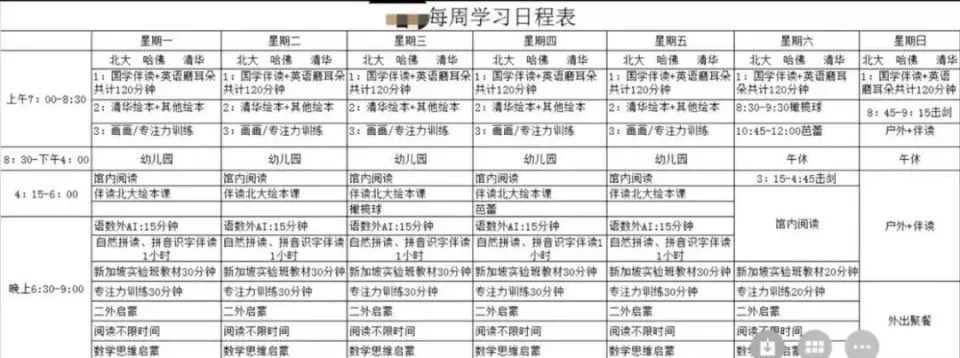
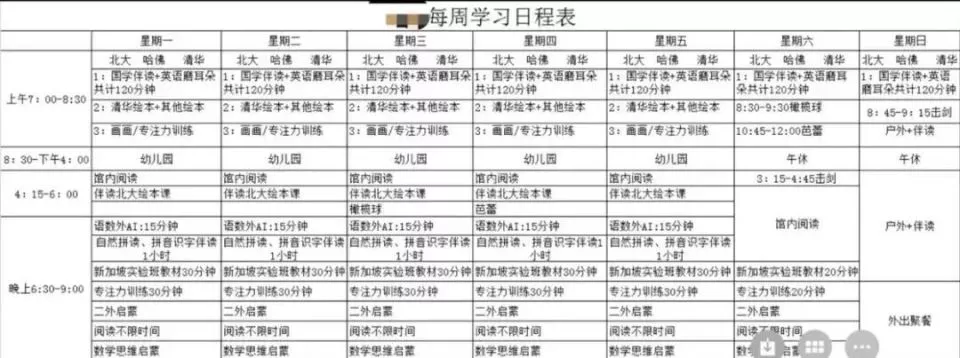
Social media feeds overflow with grueling schedules curated by anxious parents. Days begin at 6:30 a.m. with English listening practice, followed by kindergarten, art classes, children’s books, and late-night math and logical reasoning drills.
English holds a special psychological weight for many parents. Toddlers barely two years old are immersed in English animations and audio to cultivate linguistic sensitivity. By primary school, the focus shifts to vocabulary accumulation and grammar, targeting prestigious Cambridge English qualifications like KET (Key English Test) and PET (Preliminary English Test). Many parents set their sights on conquering the entire high school English curriculum before primary school graduation.
In the eyes of these parents, Chinese language arts offer little room to pull ahead, and mathematics relies purely on logical deduction, leaving English as the one subject where long-term accumulation pays off. Securing this early edge frees up cognitive bandwidth for physics and chemistry later in secondary school.
This educational arms race carries a heavy financial toll. The first and most immediate cost is exorbitant cram school tuition.
According to a middle-class consumer survey published by Tencent’s Guyu Data, over 70% of families pour money into tutoring and training during the summer break, with barely 20% escaping unscathed. While summer spending across various income brackets initially showed signs of rationalization, that trend shattered. Families earning under 200,000 yuan annually saw their summer tutoring expenditures surge from roughly 6,000 yuan to 17,872 yuan, blowing past figures from two years prior.
Drilling down into individual subjects reveals staggering price tags. Parents report that beginner English modules cost 120 yuan for a 40-minute session, while formal classes jump to 180 yuan—requiring an upfront lump-sum commitment of 25,000 yuan. More extreme still are elite college-preparation counseling packages tailored for high schoolers, ranging anywhere from 98,000 to 400,000 yuan depending on the prestige of the target university.
Beyond financial drain, the toll on time and energy is immense. Terrified that their children might miss a concept, many parents sit through the tutoring classes themselves or lean on AI tools to untangle homework problems.
Children are trapped in a perpetual state of preparing for the next hurdle, stripping families of any capacity to simply enjoy the present.
02 Why parents cannot afford to quit
Dismissing this phenomenon as mere parental anxiety ignores the systemic pressures that make opting out impossible.
The most immediate push comes from the classroom itself. Once a critical mass of students in a given class has already mastered the material, teachers naturally accelerate their pacing. Children who lack prior preparation are instantly left playing catch-up.
Comments across lifestyle platform Xiaohongshu paint a vivid picture of this reality. Some parents note that teachers race through pinyin instruction in less than two weeks, actively inquiring whether incoming students attended transition kindergartens. Many educators now assign next semester’s preview work as summer homework, turning what should be fresh classroom material into an exhausting household tutoring burden.
Entrance examinations further amplify the tension. China’s high-stakes senior high school entrance exam, or *zhongkao*, serves a dual purpose: it measures compulsory education outcomes while acting as a brutal sorting mechanism for elite high schools. Alongside basic questions, exams feature highly complex, situational problem-solving items designed to separate the tiers, demanding that students apply knowledge flexibly in unfamiliar contexts.
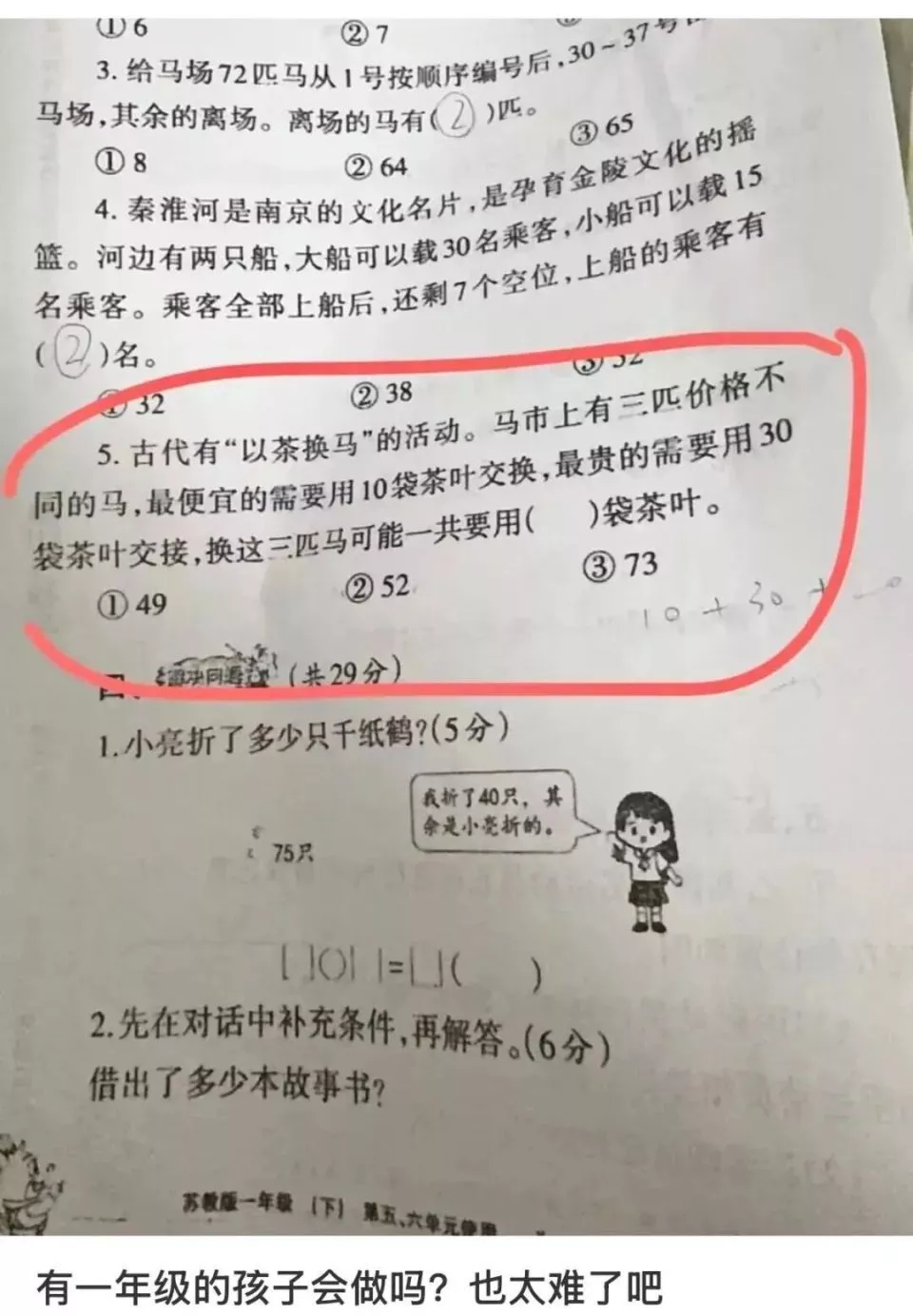
A primary school math exam in Shenzhen previously went viral for its punishing difficulty, featuring dense word problems loaded with real-world scenarios that bore little resemblance to straightforward arithmetic. Many adults attempting to help second-graders with homework quickly realize that modern application questions have far outgrown simple calculations, requiring intense verbal comprehension just to decode what the question is asking.
At the same time, certain cities have actively reined in classroom instructional hours. In Guangzhou, official plans cut weekly class hours for lower primary students (grades one and two) from 28 to 26. Given the growing limitations of official school hours, parents feel compelled to make up the deficit through commercial tutoring.
Deeper still is the existential dread surrounding educational stratification. With the ceiling of public educational resources strictly limited, parents live in terror of their children falling behind, being funneled into vocational tracks, or watching a single moment of laxity close off their future.
Academic research on vocational tracking reveals a stark correlation: lower socio-economic status maps directly to higher rates of vocational school placement, while higher-income families largely bypass these tracks. In megacities like Beijing, Shanghai, and Shenzhen, structural sorting pressures amplify the anxieties of lower-income households.
This stark reality prevents parents from viewing extra tutoring as a harmless extracurricular hobby. Every cram school session purchased and every textbook previewed is an attempt to carve out a foothold in a fiercely constrained resource landscape.
03 The treadmill of diminishing returns
Yet, parental financial sacrifices do not automatically translate into superior academic outcomes.
A summer education survey by Phoenix New Media revealed widespread dissatisfaction among parents regarding the efficacy of cram schools, with over 70% feeling the results failed to justify the cost. Complaints centered on oversized classes incapable of addressing individual weaknesses and an over-reliance on rote memorization and endless test drills rather than critical thinking.
Parents turn to cram schools hoping to patch up public school deficiencies, only to find themselves trapped on a parallel treadmill, forced to keep pace with an escalating collective rush.
Even when test scores climb, parents find little psychological relief. The rules of academic competition care little about an individual’s raw score; success is relative to how much higher everyone else’s score has climbed.
Recent exam statistics in Guangzhou illustrate this vicious cycle. The total number of test-takers scoring above 750 points surged by 80.8% year-on-year, while those scoring above 700 jumped 24%. By contrast, the baseline growth for all test-takers scoring above 400 points crawled at just 8.2%.
While tutoring cannot take sole credit for this inflation, it explains why parents feel high scores offer no insulation against failure. The same numerical grade no longer guarantees the same academic destination.
As one parent bitterly remarked, “When one child studies ahead, they improve their own score. When every child studies ahead, they only drive up the admission cutoffs. The children caught in the middle are left with nowhere to turn.”
No parent enters this rat race willingly. The endless stacks of practice tests and back-to-back cram sessions are simply shields forged by ordinary families trying to protect their children’s futures.
Yet, once early prep transforms from an optional choice into an inescapable mandate, children lose their fundamental right to grow at their own pace.
Parents hoped that studying ahead would lighten their children’s future loads, but it has only succeeded in forcing kids to bear tomorrow’s academic burdens today. How far in advance must a child learn before a family can finally feel safe?