

China Puts Strict Export Brakes on Advanced AI and Chip Technologies

An in-depth, materialist observation of China’s semiconductor and tech industry.
On October 16, a sweeping new regulatory move by two of China’s top state ministries sent shockwaves through the global technology sector. Under Announcement No. 48, the Ministry of Commerce (MOFCOM) and the Ministry of Science and Technology (MOST) jointly unveiled plans to tighten export controls on 40 critical technologies spanning artificial intelligence, biomedicine, and photovoltaics. Among them, 14 technologies face an outright export ban, while 26 others will be subject to strict regulatory restrictions. Even before the official rollout, authorities launched a preliminary export registration system.
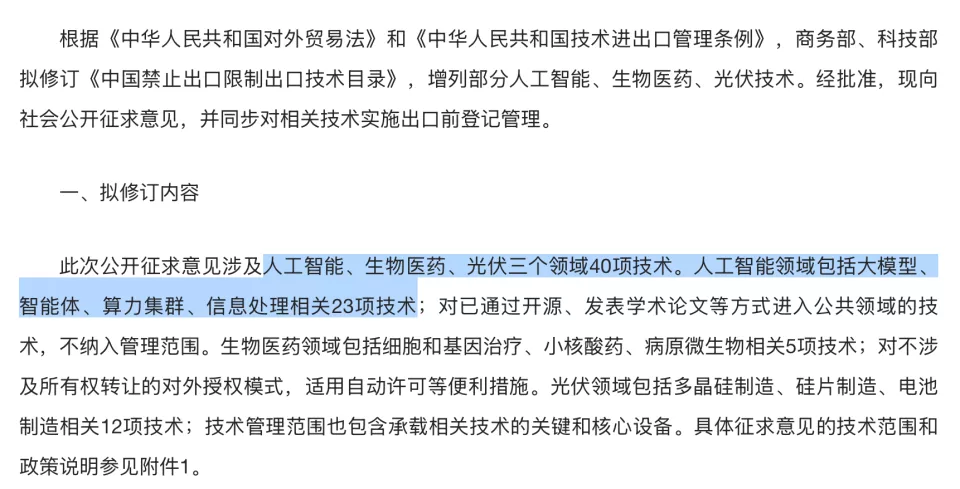
Excerpts from the proposed regulatory revisions.
The policy has ignited intense debate across the industry, raising three central questions: Will everyday users and companies expanding overseas take a hit? Which specific technologies have been designated as “national core assets”? And how are policy architects weighing these moves to reshape the US-China tech rivalry? Ultimately, this marks a new chapter in China’s AI governance, anchored firmly in the principle of technological self-reliance.
01
An Exercise in Prevention
The two ministries announced revisions to the Catalogue of Technologies Prohibited and Restricted from Export, soliciting public feedback on 40 newly added technologies across three strategic industries.
The 14 banned technologies target sensitive domains such as AI-driven, self-generating, and mutating malicious software. Meanwhile, the 26 restricted technologies encompass AI-assisted security vulnerability identification tools.
A spokesperson for the Ministry of Commerce noted that updating such lists is a routine function of technology trade management—designed to establish both defensive guardrails and operational channels. As AI’s footprint in highly sensitive applications expands, China is simultaneously adopting international best practices to fend off potential risks while remaining committed to open international technical collaboration.
Officials clarified that everyday AI applications used by ordinary consumers will remain entirely unaffected, and overseas expansion will not be hindered. Large language model (LLM) services delivered via APIs, application interactions, web interfaces, cloud services, and lightweight local deployments are all exempt from the controls. Whether domestic consumers travel abroad to use local AI tools or foreign developers invoke domestic LLMs via APIs, they retain full exemption.
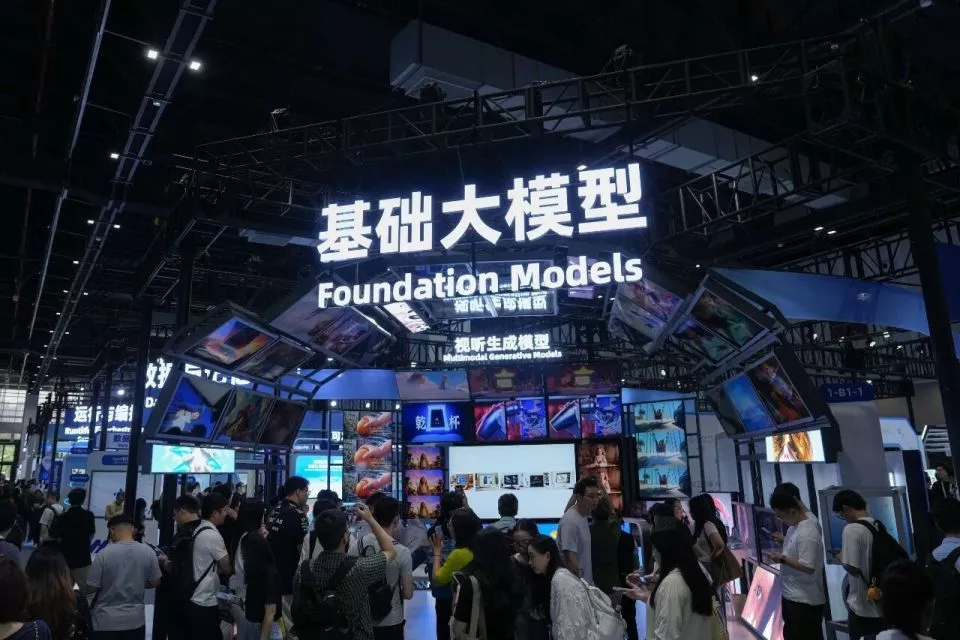
Visitors explore the foundational large model exhibition area at the 2026 Yunqi Conference in Hangzhou on September 22, 2026. / Xinhua News Agency photo by Huang Zongzhi
Fears of “self-isolation” are unfounded. Official statements explicitly state that technologies entering the public domain through open-source code or academic publications are exempt from regulation.
The true constraints apply to the international transfer of intellectual property, overseas licensing, equity transactions involving foreign capital, and large-scale localized overseas deployments of non-public, restricted-tier LLMs.
Viewed chronologically, the high-profile Manus case acted as a major catalyst for these regulations.
In the spring of 2025, Manus—a leading AI agent—captured widespread attention, showcasing the immense promise of AI assistants before the open-source project “Lobster” emerged. By mid-year, the core team relocated its headquarters to Singapore. By late year, Meta announced a $2 billion to $2.5 billion acquisition of the company, aiming to integrate its core agent technology into its global ecosystem, including Meta AI.

Mobile interface of the open-source AI agent “Lobster.” / Xinhua photo by Yifan
Just over ten days after the news broke, multiple domestic government bodies initiated a joint review. In April, the National Development and Reform Commission’s (NDRC) investment security review division officially blocked the transaction, forcing the parties to scrap the acquisition agreement.
By August, the company issued a statement announcing it was abandoning plans to join Meta and would resume independent operations.
The underlying playbook was straightforward: domestic R&D, establishing a shell company in Singapore, and packaging the asset for sale to the US. This maneuver was heavily criticized by academics as “whitewashed emigration.”

Manus issues a formal statement in August 2026 terminating its planned acquisition by Meta.
Following the rollout of the newly revised Measures for the Administration of Overseas Investment in early July and the sweeping October overhaul of the MOFCOM-MOST technology lists, China’s state “technological sovereignty” has been firmly safeguarded.
By comparison, the new investment rules focus on “curbing actions” by restricting corporate entities and share flows, whereas the export lists focus on “defining boundaries” to clarify what constitutes a “national strategic asset” for preemptive defense.
02
What Counts as a “National Core Asset”?
Following these revisions, which AI technologies have been elevated to “national policy-protected status”?
Categorized by core AI domains, they span large language models, AI agents, semiconductors, and computing power clusters.
Among the prohibited items are “LLM services trained using national databases” and “AI agents customized for sensitive scenarios like critical infrastructure, defense, and government administration that meet high-performance thresholds (reaching performance metrics of 266505X).” Chips and computing power are notably absent from the outright ban list.
Restricted items, however, touch upon all four major domains.
Model restrictions target LLMs “trained using critical domestic databases,” using data sources as a restrictive metric distinct from the “core data” phrasing above. Any model hitting a core technical threshold falls under control: computational scale reaching 10^26 floating-point operations or higher; a parameter count exceeding 2 trillion; or global top-tier performance ranking (top 10).
Products such as Moonshot AI’s Kimi K3, Alibaba’s Qwen3.8-Max, and Baidu’s ERNIE 5.0 all exceed 2 trillion parameters. ERNIE 5.0, being a closed-source solution, cannot claim the “open-source exemption.”
Although DeepSeek-V4-Pro features only 1.6 trillion parameters—falling short of the threshold—it has fully released its weights on Hugging Face under the MIT license, entering the public domain. Despite ranking in the global top 10, its total open-source nature exempts it from substantive constraints under the new rules, putting it on par with open-source versions of Kimi K3 and Qwen3.8-Max.
AI agent controls are split into two tiers. Tier one triggers restrictions if any of the following are met: autonomous task planning capable of breaking down sub-chains into over 20 steps with over 80% accuracy and single-step success rates above 90%; multi-agent collaboration driving over 60 concurrent collaborative units without taking more than twice the time of a single unit, with consistency above 85%; tool integration invoking over 200 external tools with over 90% accuracy and cross-category collaboration success rates above 90%.
Tier two requires simultaneous compliance: decision-making depth of 20 layers or more, or concurrent management of 10+ agents; complex real-time decision response times under 200 milliseconds with 10+ control modules; and gaming benchmark performance surpassing 90% of human players.
Tier-one restrictions primarily target agent platforms operated by tech giants. Platforms built by Tencent, Alibaba, Moonshot AI, and Zhipu AI could face controls if they undergo “cross-border transfer or large-scale localized deployment overseas.”
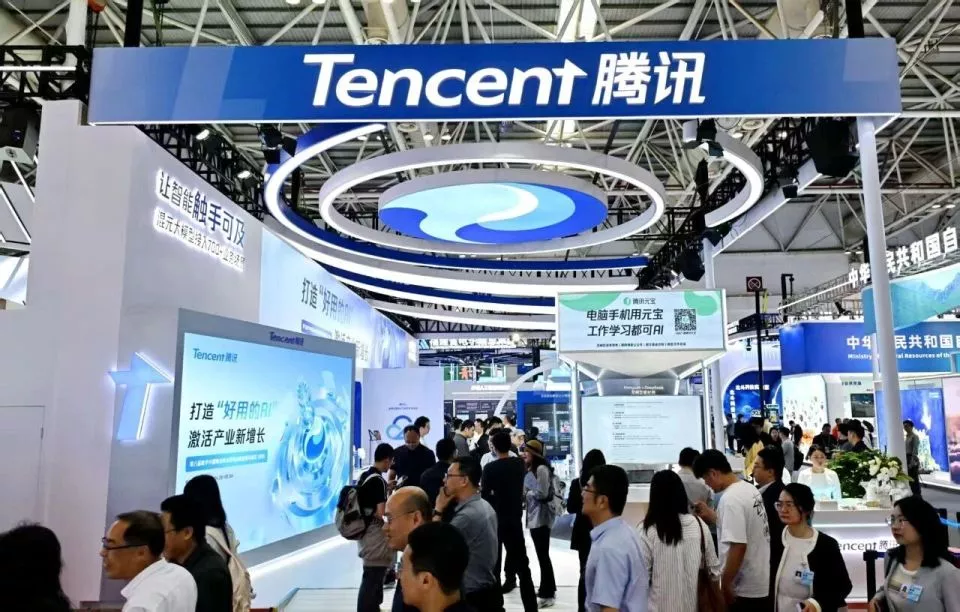
Tencent’s exhibition area at the 8th Digital China Construction Summit. / Xinhua News Agency photo by Lin Shanchuan
Tier-two restrictions guard civil-military fusion and defense-grade sectors. Real-time competitive gaming AI may also fall into this category. The strategic gaming bots developed by NetEase (Fuxi), Tencent (JueWu), and Qiyuan Platform in environments like *Honor of Kings* and *StarCraft II* have outperformed 99th-percentile human elites. While the games themselves are consumer entertainment products exempt from export worries, their core “real-time decision-making confrontation engines” remain key targets for review.
Semiconductor controls cover three sub-segments: processing chips, memory chips, and memory chip design. Broadly speaking, advanced manufacturing processes (14nm or smaller), support for floating-point calculations, and cutting-edge packaging integration and interconnect technologies all fall under regulatory scope.
In practice, the thresholds are set low: the underlying design blueprints, patent assets, and tape-out customization plans of domestic chip leaders such as HiSilicon, Cambricon, Horizon Robotics, and ChangXin Memory Technologies (CXMT) are prohibited from being transferred or sold abroad. This move primarily prevents foreign capital from poaching homegrown computing and memory infrastructure technologies under the guise of “cooperation,” though it does not impede the overseas sale of finished chips.
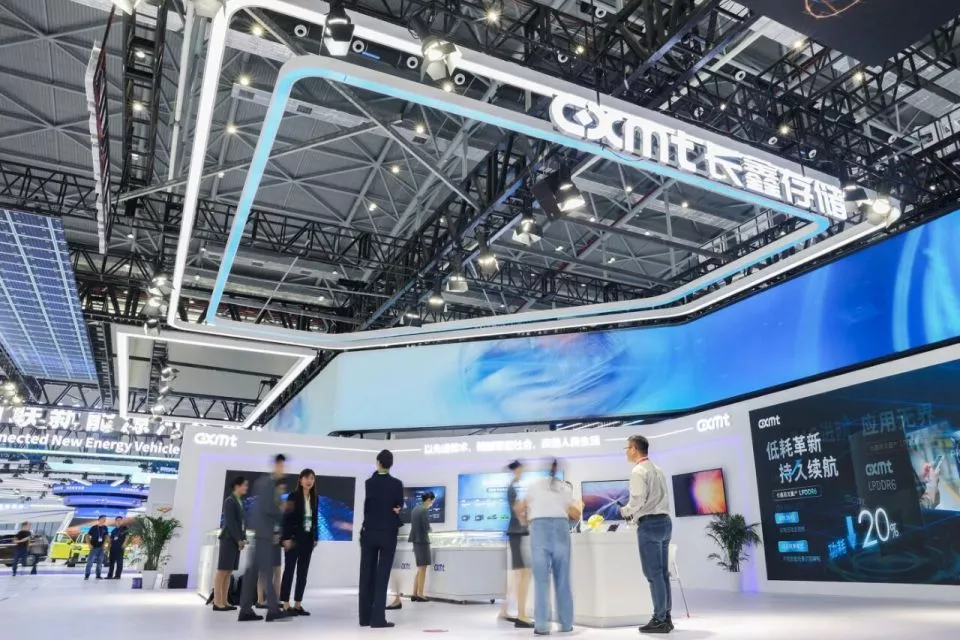
The ChangXin Memory Technologies (CXMT) booth at the New-Type Information Technology and New Energy Exhibition. / Xinhua News Agency photo by Chang Nengjia
For computing power clusters, regulations target scales exceeding 10,000 cards, encompassing high-speed interconnects, distributed fault tolerance, communication scheduling, and heterogeneous integration technologies.
The core criterion here is that if a company intends to export complete 10,000-card intelligent computing center solutions to regions like the Middle East and Southeast Asia, or transfer cluster management system code and software copyrights, government licensing will be required.
03
Full Speed Ahead Within Red Lines
Before this decree was issued, the global and domestic AI landscapes had experienced massive shifts across capital, regulatory, and technological dimensions. Over the past year, US semiconductor restrictions have expanded from choking off high-end chips to comprehensive containment and extraterritorial jurisdiction.
Washington has not only scrutinized “compliant” chips to block high-end computing power inflows, but also prepared restrictions on optical components and power module imports, continuously driving up the cost of domestic AI supply chains entering North America.
As autumn arrived, four major US tech giants launched intensive waves of new models. In a race for dominance, OpenAI and Anthropic vied to break classic mathematical problems using cutting-edge LLMs to demonstrate superior capability, prompting reflections from mathematicians. Yet, AI surpassing top human cognitive benchmarks is no longer a novelty.

OpenAI CEO Sam Altman speaks at the high-level meeting on “Artificial Intelligence and International Security” on September 23, 2026. / Xinhua News Agency photo by Zhang Fengguo
Domestic AI unicorns have sparked waves of financing and initial public offerings. According to industry data, funding rounds for leading startups have surged into the tens of billions of yuan. Moonshot AI has completed its pre-IPO funding round and plans a Hong Kong listing in the first quarter of 2027, while Keling AI is preparing a $1 billion IPO in Hong Kong.
On the regulatory front, China rolled out its broadest and strictest regulations to date on “AI companions and anthropomorphic chat”: strictly prohibiting minors from interacting with virtual companions and requiring adult users to receive reminders every two hours that their interlocutor is non-human, thereby preventing collective emotional dependency or self-harm inducement. This underscores Beijing’s decisive approach to managing the social externalities of AI.
Furthermore, codifying an “export list” into law represents an essential component of AI governance and establishes critical leverage and bottom lines for Beijing in international negotiations.

Children interact with a robot at the Science and Technology Museum in Bijie, Guizhou province. / Xinhua photo by Luo Dafu
From an industrial perspective, amid exploding parameter scales, high financing volumes, and proliferating domestic computing power, the state needed to draw clear lines around its “strategic assets” on the eve of corporate globalization, enabling companies to “go all out” safely within designated boundaries.
For the global AI ecosystem, this move raises the friction costs of technology flows, cementing China’s voice in vertical tracks where it holds engineering advantages and supply chain control.