
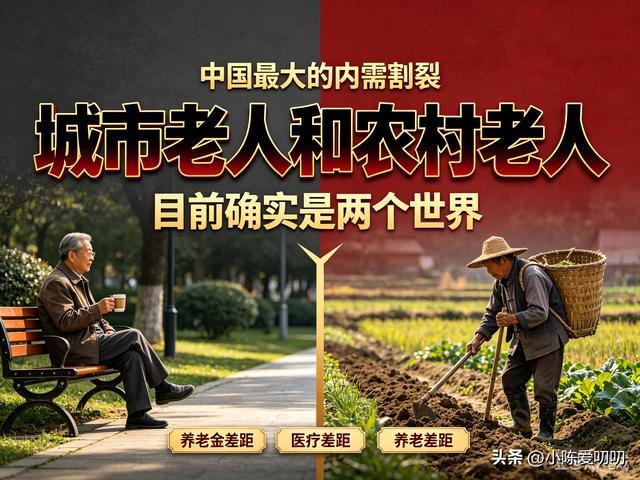
China’s hidden divide. Why rural retirees live on 300 yuan while city officials draw 6,000
Urban government and institutional retirees in China receive a monthly pension of roughly 6,000 yuan, while rural residents relying on the basic urban-rural resident pension receive merely 200 to 300 yuan a month. Observers argue this stark disparity has created two fundamentally distinct old-age experiences across income, labor, healthcare, housing, and retirement models.
Analysts suggest that the most pronounced wealth gap in contemporary China does not lie between urban areas and the younger generation, but rather in the contrasting twilight years experienced by urban versus rural seniors.
According to reports, urban retirees enjoy steady pensions and comprehensive medical insurance coverage, spending their days tending flowers, strolling in parks, traveling, or helping raise grandchildren—a lifestyle often characterized as “enjoying retirement.”
Conversely, the majority of rural seniors lack adequate pensions and survive on meager monthly incomes. Many continue farming well into their sixties and seventies, rationing their spending and avoiding medical treatment out of fear of financial ruin, enduring what is termed “survival retirement.”
Critics view this as China’s most concealed and profound internal demand fracture, with the retirement gap representing an extreme class divide.
I. Data Comparison
These figures draw from recent official statistical releases and elderly care industry research.
In terms of aging severity, rural areas outpace cities. Residents aged 60 and older account for 23.8% of the rural population, compared to 15.8% in urban centers—an 8-percentage-point difference.
Analysts note that with vast numbers of able-bodied younger workers migrating to cities for employment, rural communities are left primarily with aging populations and unattended children, resulting in severely depleted eldercare resources. Urban aging is characterized as “funded retirement,” while rural aging is defined as “retirement without money or support.”
Pensions represent what commentators consider the core divide:
– Urban government and public institution retirees: Monthly pensions reach approximately 6,000 yuan, supplemented by full welfare benefits and subsidies.
– Urban enterprise retirees: National monthly pensions stabilize above 3,200 yuan, covering daily food, medication, and leisure expenses.
– Rural elderly nationwide: The basic urban-rural resident pension averages only 200 to 300 yuan a month, with minimum standards in many central and western counties dropping as low as 143 yuan, pulling the national average below 290 yuan.
Commentators note that a monthly income under 300 yuan falls short of covering a single group dinner, a box of imported medicine, or a month’s supply of basic provisions like rice, flour, and cooking oil. While urban pensions fund leisure, rural stipends barely stave off starvation.
Regarding income and consumption, urban disposable income per capita far exceeds rural levels, with the gap widening further among older demographics. Urban seniors possess savings, pensions, and real estate, securing steady purchasing power; rural seniors command virtually negligible passive income and minimal savings.
Observers argue that while urban seniors possess the confidence and means to consume, rural seniors hoard cash merely for self-preservation, fracturing the consumer market along an urban-rural axis.
II. Living Realities
1. Labor Conditions
Urban seniors typically step away from formal work at retirement age, spending their days visiting parks, practicing square dancing, playing chess, drinking tea, taking short trips, or assisting their children with childcare.
Rural seniors experience no true retirement age. Research indicates that roughly 80% of agricultural labor in villages is sustained by individuals over 60. Tending fields, growing vegetables, and raising livestock remains routine for those aged 60 to 70, while healthy individuals in their late seventies continue to toil. Lacking pension safety nets, ceasing labor means zero income, and abandoning farming strips away basic food security.
2. Medical Health
Urban seniors benefit from higher reimbursement rates under employee medical insurance, securing robust coverage for outpatient care, hospital stays, and chronic disease medications, alongside regular health checkups and prompt treatment for major illnesses.
Rural seniors contend with narrow coverage and low reimbursement rates under resident medical insurance, compounded by fragile grassroots healthcare infrastructure. Reports indicate many elderly individuals “endure minor ailments and drag out major illnesses,” skipping essential medications for hypertension or diabetes, or forgoing treatment entirely upon receiving a critical diagnosis out of dread over burdening their children with medical debt.
3. Living Environments
Most urban seniors reside in well-equipped residential communities featuring elevators, property management, parks, clinics, supermarkets, and convenient public transit.
Conversely, the vast majority of rural seniors inhabit aging farmhouses amid severe rural depopulation, marked by sparse neighbors, missing infrastructure, and difficult transport. Lacking professional eldercare services, rehabilitation facilities, or emergency safeguards, sudden illnesses or household accidents frequently go unnoticed, amplifying the risks of living alone.
4. Retirement Models
Urban seniors frequently live in the same city as their adult children, offering mutual daily support where parents retain the capacity to aid their offspring while receiving nearby care in return.
As rural youth settle in urban areas and rarely return home, millions of rural seniors are left behind as “empty-nesters.” When healthy, they manage alone; when infirm, they either face confinement in bed or must move to cities to depend on their children—a dynamic critics describe as stripping late-life dignity and agency.
III. Structural Roots
Analysts argue these disparities stem not from individual failures, but from the convergence of historical context, social security frameworks, and resource allocation imbalances.
1. Historical Disparities in Social Security
Urban employee pensions were co-funded by employers and individuals through long contribution histories and higher wage bases, yielding elevated retirement payouts.
Older generations of farmers lacked contributory social security frameworks during their working years, spending their lives farming, paying taxes, delivering public grain quotas, and supporting national development without accruing matching contribution records. Current urban-rural resident pensions function as basic inclusive allowances lacking individual account accumulation, resulting in low disbursements—a legacy gap left by history.
2. Persistent Imbalances in Resource Allocation
High-quality medical, educational, recreational, and eldercare resources have long clustered in cities, which boast nursing homes, rehabilitation centers, senior universities, and community support services. Rural areas largely make do with basic village clinics, leaving professional eldercare nearly non-existent and forcing rural seniors to rely exclusively on land and offspring.
3. Depopulation Driven by Urbanization
During rapid urbanization, rural labor flowed unidirectionally toward cities, siphoning away workforce vitality and consumer demand while fracturing traditional family-based old-age support systems. Observers note that failing family care, absent social welfare, and incapacitated self-reliance trap hundreds of millions of rural elderly in a threefold predicament.
IV. Five Common Misconceptions
Commentators note that 90% of the public misunderstands these dynamics, debunking five prevalent myths:
Myth 1: Rural seniors are unhappy simply because they are too frugal. Observers counter that urban frugality is a lifestyle choice, whereas rural frugality is a survival instinct, as monthly incomes of 200 to 300 yuan cannot sustain basic daily expenses.
Myth 2: Unfilial children cause the hardships of rural old age. Reports indicate that most rural offspring struggling to buy urban homes and raise families face overwhelming economic pressures, rendering them financially unable to provide substantial recurring subsidies to their parents.
Myth 3: The urban-rural pension gap can be quickly eliminated. Analysts argue the divide accumulated over decades of institutional and structural evolution. Current state efforts to continuously raise rural basic pensions and expand rural care services can only gradually narrow the gap.
Myth 4: Rural seniors have land and grain, so they need not worry. Experts emphasize that land secures basic food supplies but cannot cover medical care, emergencies, or institutional eldercare; when seniors lose mobility or face catastrophic illness, land offers no financial cushion.
Myth 5: All urban seniors are affluent while all rural seniors are impoverished. While exceptions exist—cities harbor uninsured, low-income residents, and some rural households enjoy prosperity—overall structural polarization remains undeniable.
V. Domestic Demand Bottlenecks and Policy Directions
Citing economists, reports suggest China’s primary domestic consumption bottleneck is not youth reluctance to spend, but rather the structural inability of rural seniors to participate in the consumer market.
While urban seniors spend on health, leisure, and comfort, millions of rural seniors remain trapped in “survival savings” mode, reserving all reserves for emergencies.
State policies in recent years have sought to address these gaps by incrementally raising rural basic pension standards, building rural mutual-aid care stations, enhancing medical insurance reimbursement frameworks, and establishing welfare floors for vulnerable seniors. Observers maintain that while gaps persist, achieving pension equity and universal safety nets remains central to future public welfare development.
Authors emphasize that acknowledging these realities neither diminishes the lifelong labor of urban seniors nor overlooks the historical contributions of rural populations. The comfort enjoyed by urban retirees stems from institutional dividends, generational opportunities, and lifelong accumulation, while rural hardship mirrors structural resource deprivation and delayed social protections. Bridging these divides remains an enduring challenge of China’s dual economic structure.
Observers conclude with the hope that every hardworking senior—whether residing in metropolis or village—may secure adequate sustenance, dependable healthcare, fair remuneration, and a dignified retirement.