
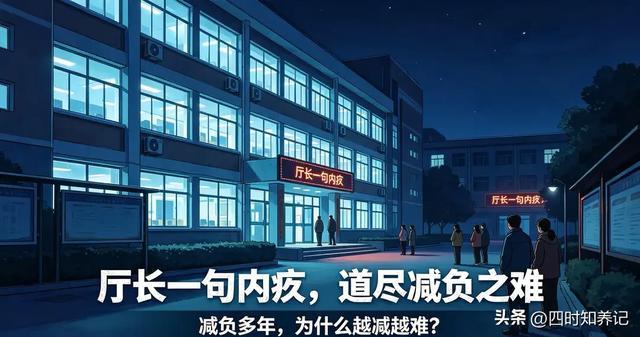
China’s high school students spend 15 hours a day at school. One official’s apology changed nothing
When Jiang Yong, head of the education department in China’s prosperous eastern province of Jiangsu, went on a live-streamed talk show to address parents complaining that local high schools were forcing teenagers to spend 15—and sometimes 16—hours a day on campus, his response stunned viewers: he admitted he felt “profound guilt.” Within a week of his public confession, multiple high schools in cities like Nanjing and Jiangyin shifted their morning arrival times from before 7:00 AM to 7:20 AM, and moved evening self-study dismissal up to 9:30 PM.
Jiang did not use bureaucratic boilerplate or deflect blame. The schools moved with a swiftness that suggested their schedule adjustments had been drafted and filed away, waiting entirely on a senior official’s public signal.
Seventeen Years of Weight Loss, and School Days Grew from 8 Hours to 15
Back in 2009, Jiangsu issued a strict five-point mandate stipulating that high school students should not spend more than eight hours a day in centralized study. Seventeen years later, that ceiling has completely collapsed. A 15-hour day is now standard, with senior high school seniors pushing past 16 hours.
The regulatory paper trail is extensive. In 2021, China’s Ministry of Education demanded that high schoolers get at least eight hours of sleep, and Jiangsu introduced its own updated compliance framework in 2024. Yet inspection teams are greeted with relaxed schedules that vanish the moment the inspectors leave, replaced by the familiar 6:30 AM wake-up bell.
The mountain of educational reform documents is taller than a student’s desk, yet children still struggle to keep their eyelids open. The problem is that administrative rules can control a timetable, but they cannot stop the relentless competition raging behind it.
The Rain Outside Nanjing No. 1 High School Six Years Ago
This dynamic mirrors a tense protest six years ago outside Nanjing No. 1 High School. Following the release of China’s grueling National College Entrance Examination (Gaokao) scores in 2020, a crowd of frustrated parents stood in the pouring rain holding banners demanding the principal step down after their children underperformed.
The math behind their anger was stark: while Nanjing No. 1 High School had a high entry threshold, accepting students who ranked third in the city’s middle school exams in 2017, only 20 students scored above 400 points three years later. By contrast, Nanjing No. 29 High School, which admitted students with much lower entrance scores, produced 68 students above the 400-point mark.
Parents accused the school of sacrificing academic rigor for the sake of experimental “quality-oriented education.” Buckling under the pressure, the school issued an open letter to parents, extending evening study sessions to 10:00 PM, implementing tiered classes, and gathering elite students into specialized tracks—effectively marching right back onto the treadmill of rote memorization.
At the time, many viewed the episode as a defeat for progressive education and a triumph for test-prep drudgery. Six years later, the reality is even more sobering: the exact force that compelled the school to “apologize” back then remains intact, hardened and even more unyielding.
The Theater Effect: Why No One Dares Sit Down First
Economists often point to the “theater effect” to explain rat-race dynamics: if patrons in the front row stand up to see better, those behind them must stand as well. Eventually, the entire audience is standing on tiptoe, nobody gains a better view, and everyone’s legs ache. Chinese education has become this exact theater.
If one school dismisses its students on time, parents panic. If neighboring kids are grinding through practice exams while their own child sleeps, a single point on the Gaokao can cost hundreds of ranking spots. If a local education bureau slashes classroom hours, its test score outcomes will be scrutinized under a magnifying glass the following year. School administrators face severe career risks if scores drop, but zero accountability if they pile on two extra hours of grueling study.
The structural bottleneck lies in supply and demand. In 2026, Jiangsu expects roughly 40,900 students to score above 600 points, yet elite Project 985 universities offer fewer than 10,000 general admission slots for the province. Four to five high-scoring teenagers are fighting for a single elite seat. Extra hours of drilling do not guarantee admission; they merely prevent a student from being pushed out of the race.
It is a desperate calculation, but nobody dares to break formation first.
Nanjing No. 1 High School’s Alternative Path
Nanjing No. 1 High School, which was once forced to cave to parental demands and extend evening study, eventually charted a different course. It turned off the lights for evening study by 10:00 PM, capped homework at 90 minutes, and replaced rote drills with debate clubs and science laboratories.
By the 2023 Gaokao, the school’s average score outpaced Nanjing No. 29 High School—the institution that had previously eclipsed it—by 21 points. Internal tracking data showed that student memory test scores rose 13%, while emotional breakdown rates dropped by 40%. Giving children two extra hours of sleep did not sink their scores; instead, a well-rested brain boosted overall learning efficiency.
While an elite institution with top-tier faculty cannot serve as a universal prescription for every struggling school, Nanjing No. 1’s experiment shattered a stubborn myth: lightening the load and performing well on exams are not inherently at odds. Returning time to children can yield sharper minds and higher efficiency.
The core dilemma is not whether to reduce student stress, but who will dare to sit down first in a crowded theater—and ensure they are not penalized for doing so.
After the Official’s Apology
Jiang’s expression of guilt was genuine, and the 20-minute delay in school arrival times is real. But a parallel sentiment circulating in parent chat groups is equally true: “Lighten the load at school, and the burden shifts to after-school tutoring. Soften the classroom schedule, and the internal anxiety tightens.”
Pushing back morning arrival by half an hour simply means an extra set of practice papers gets squeezed into the evening routine. Cutting an hour of homework at school prompts parents to enroll their children in cram schools; total time spent studying remains unchanged, but household expenses soar.
As long as policymakers tweak clocks without reforming the evaluation system, altering university enrollment quotas, or easing the crushing weight of a single high-stakes entrance exam, every official campaign to lighten student burdens will simply redirect the pressure elsewhere.
Seventeen years ago, the mandated limit was eight hours; today, it has ballooned to 15. The education chief has apologized, schools have adjusted their bells, and parents have applauded. Over the next seventeen years, will another official have to stand up and say sorry all over again?