
How five ordinary people outsmarted China’s AI face-swapping scam wave
When deception dons the cloak of technology, photographs, audio recordings, and videos are reduced to mere fabrications.
Convenience and risk walk hand in hand. While artificial intelligence empowers modern life, it simultaneously blurs the boundaries of fraud.
In earlier times, when receiving an unfamiliar phone call or a suspicious text message, people could verify identities through video chats or direct phone calls. Today, however, those very tools once relied upon for verification have become shortcuts for scammers to gain trust.
According to China’s Ministry of Public Security, authorities handled over 258,000 telecommunications and online fraud cases nationwide. Among them, a surge in novel AI face-swapping scams has triggered widespread alarm. Data released by the Ministry of Public Security in September 2026, cited by the Economic Observer, shows that police have solved more than 300 such cases nationwide, with total financial losses exceeding 500 million yuan ($70 million), and a single case peaking at 20 million yuan.
Photo / Pexels
Behind these staggering figures lie the harrowing experiences of ordinary people.
Photos publicly shared on social media platforms are hijacked and manipulated via AI into tools for fraud; a voice requesting a loan comes through late at night from a friend who has supposedly gone offline; a video call with an online acquaintance lasting over ten days features a person who stubbornly refuses to turn their head; extortion letters appear in a workplace reception room; traps lurk quietly behind private messages in financial account comment sections… Technology has armed fraudsters with novel criminal methods, while traditional scam tactics—exploiting familiar relationships, stoking emotional needs, setting up investment lures, and applying reputational pressure—remain alive and well, made all the more deceptive with the help of AI.
AIX Finance interviewed five individuals who found themselves entangled in AI-driven scams through various means, tracing how these traps steadily closed in on them and how they ultimately unmasked the truth.
Here are their stories.
01. My face was hijacked for a scam, and a woman nearly lost $50,000
Xiao E | Post-90s generation, lawyer based in Australia
Living long-term in Australia, I work as a lawyer and am by no means an online content creator. My combined follower count on Xiaohongshu and Instagram barely clears 10,000, where I casually share moments from my daily life—gym snapshots, travel photos, and professional attire.
Over the past two years, strangers on both platforms have frequently notified me that my photos were stolen and posted on overseas dating websites for romance scams.
An incident in July left a deep impression on me. A woman tracked me down through Xiaohongshu, claiming that someone had stolen my identity across multiple platforms including WeChat, Douyin, and WhatsApp, and had even engaged in video calls with her using my face.
The scammer used my photographs to construct a successful male persona online, claiming to be an executive at SF Express’s overseas headquarters with access to abundant industrial resources.
The victim recalled meeting this person while sharing photos of a trip to London. The stranger initiated a conversation, claiming to be a tourist visiting London from France. Because she was slightly older, the scammer consistently addressed her as “elder sister,” showing immense warmth and continuously recommending entertainment spots.
Soon after, the scammer began frequently professing affection, claiming she did not understand his true feelings while painting a picture of a shared future. He hinted at possessing numerous businesses and resources he wished to share with her, eventually urging her under the guise of romance to invest alongside him.
Initially, the woman was unmoved. During a brief acquaintance, such sudden warmth coupled with demands for investment was obviously abnormal.
Yet the scammer did not give up, continuing to win her trust through photos and voice notes. Growing suspicious, the woman demanded a video call for verification. To her surprise, the scammer agreed and spent nearly an hour preparing for the call.
Once the video connected, the face on the screen matched the photos. When she sent me the screenshots, I was startled too. That was indeed my face, but the person in the video was not me.
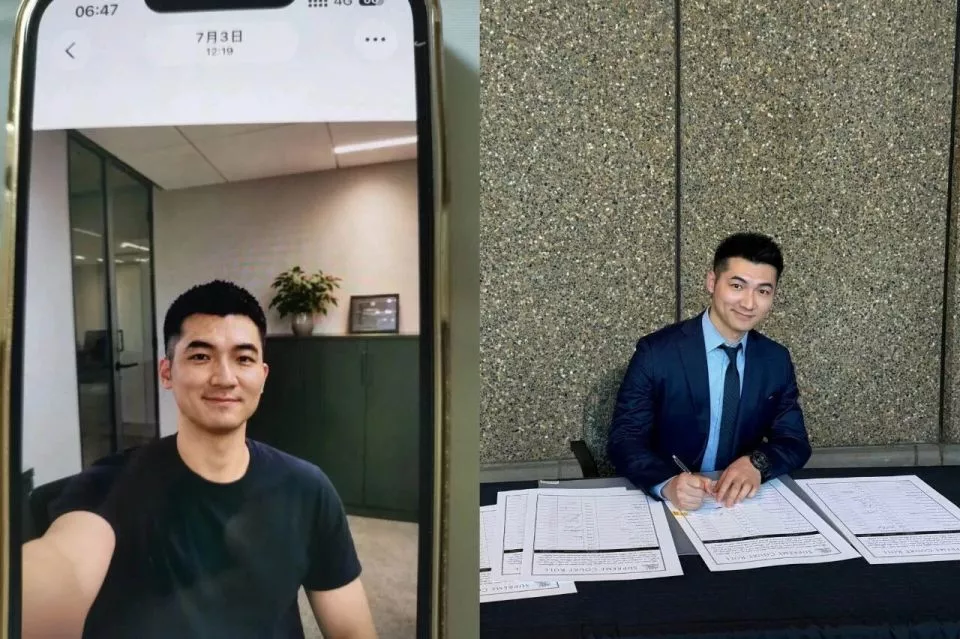
AI face-swapping video screenshot (left); photo shared by Xiao E on social media (right)
According to her description, the scammer employed AI face-swapping technology, though the exact tool remains unknown to me. She noted that at the time, she sensed a mismatch between the facial contours and the vocal tones, with stiff and unnatural expressions, prompting her to question him repeatedly. Harboured doubts persisted after the call; recalling that the scammer could steal photos publicly available online, she used reverse image search to find my account.
What terrified me even more was that he had been guiding her to download a foreign investment app in an attempt to trick her into sinking $50,000 into it. Fortunately, lingering doubts kept her from ever transferring any money, and she eventually tracked down the real me.
She also revealed that both the scammer’s WeChat and Douyin accounts had been newly registered in April, using my photos as avatars. After she flagged the issue, the Douyin account was promptly banned by the platform.
This experience made me realize that the playbook of AI fraud is far more complex than it appears on the surface. Fraudsters first harvest real people’s photos from the internet, use these materials to forge fake personas, build emotional bonds, and then deploy AI face-swapping videos to further dispel doubts.
As someone whose identity was hijacked, though I suffered no direct financial loss, knowing my portrait was used to defraud others still fills me with fear. A single photograph on social media can easily become someone else’s tool for deception.
02. A friend’s voice was cloned, and I almost lost 5,000 yuan in a video game
n
Qiu Jie | Post-90s generation, merchant from Quanzhou, Fujian
Around May and June of last year, I encountered a bizarre incident: while gaming online, a stranger used a voice identical to my friend’s to ask me for a loan, and I nearly transferred 5,000 yuan ($700) on the spot.
I am a businessman running an aromatherapy factory. I rarely deal with AI on a daily basis, occasionally using e-commerce platform AI tools to generate product images and asking questions to Doubao. Playing online multiplayer games with friends during my spare time is my biggest hobby.
To facilitate communication during gaming, we use voice chat software. These applications require users to set up their own channels, and if no password is set, anyone can wander in. If the “entry notification” feature is disabled, you won’t even notice when an outsider steps inside. When gaming, the voice chat app runs in the background, and nobody stares at it.

Photo / Unsplash
That night, I was gaming late into the night with my friend. He went to bed first, and feeling too lazy to close the voice channel, I left it open. Shortly afterward, a stranger who had stolen my friend’s nickname entered the channel. I remained completely oblivious until he suddenly called out my name, saying his wife and child were asleep, making it inconvenient to speak aloud, and that he wanted to tell me something via text.
Judging solely by those few words, the voice was indistinguishable from my friend’s, and I detected zero flaws.
He then sent a message through the voice app, roughly asking me to transfer 5,000 yuan to him—warning me not to use WeChat to avoid his wife seeing his phone, but to wire it directly to a bank card.
That was when things started feeling off. I checked his username; it matched my friend’s down to the exact character, but my friend list showed my friend was already offline. Taking a closer look, I realized it was a counterfeit account. I ignored the request. The next day, I checked with my friend, who confirmed that the person was an imposter.
Reviewing what happened afterward, he likely slipped into our channel while we were gaming, eavesdropped on our conversation, and used some AI tool to replicate my friend’s voice. The opening sentence he uttered bore no difference from my friend’s actual voice. To be honest, had I not grown suspicious at that exact moment, the money might very well have been scammed away.
The 5,000 yuan he demanded is a significant sum for me, instantly sharpening my vigilance. Had he asked for just a few hundred or one to two thousand yuan, I probably would have wired it without a second thought.
n
On voice-based social applications, AI voice cloning is exceptionally easy to pull off. On WeChat or regular phone calls, an unfamiliar number or account naturally triggers your guard. But within these kinds of chat tools, copying your avatar and grabbing an identical nickname is effortless.
n
Moreover, you encounter these situations while relaxed and gaming, leaving your psychological defenses practically at zero.
After that, I locked down my self-built channel and enabled entry notifications, realizing that we must exercise much greater caution in such semi-public social spaces.
03. “She” refused to turn her head on video, and I exposed a face-swapping scam
Lu Ming | Post-00s generation, freelancer from Zhejiang
“Can you turn your head to the side? Let me see your profile.” After interacting for over ten days with a woman claiming to live in Macau, I finally hopped on a video call.
“She” sat before a desk, keeping her body mostly motionless. At first glance, nothing seemed amiss, but a closer look revealed anomalies—the texture of her skin and facial features were blurred, leading me to suspect digital manipulation by AI. Even “her” voice sounded artificially modulated.
I majored in computer science in college and spent some time self-studying AI, making me relatively sensitive to these kinds of irregularities.
n
To verify whether it was AI face-swapping, I asked “her” to turn to the side, preferably a full 90 degrees. Real-time AI face swapping tends to reveal flaws during major movements, whereas fixed postures are much easier to process digitally.
n
Yet “she” stubbornly refused. At that point, I was essentially certain that the “woman” I had been chatting with for more than ten days was a scammer.
This person had added me on Bilibili. I regularly share automotive videos on the platform, discussing issues with cars I’ve purchased and my driving experiences, which led this person to find me through my posts.
Initially, “she” merely asked whether a particular car model was suitable for self-driving trips, what its pros and cons were, and claimed she wanted to recommend it to a best friend while asking for my advice. These were entirely mundane topics, so I didn’t pay much heed. After chatting for a while, “she” began inquiring about my age, occupation, and daily routines. Looking back now, I suspect “she” was evaluating whether I possessed financial capability and whether I was worth the effort to defraud.
Photo / Pexels
Then “she” suggested moving to another communication channel. Framing herself as a Macau native recently visiting the Chinese mainland with her best friend, she claimed her Bilibili account was borrowed and her WeChat account was restricted, leaving WhatsApp or Discord as her only options.
By this point, my suspicions were fully aroused. However, instead of exposing her immediately, I wanted to see what her objective was. Afterward, we communicated primarily through Discord. The other party didn’t immediately broach the topic of money; instead, she slowly built trust, transitioning from daily chit-chat to work, before casually weaving in financial topics. The entire process spanned over ten days.
I felt their scam playbook was meticulously designed. They never bluntly claim there is an investment project waiting for you; instead, they start with side hustles, wealth management, or stocks, sparking your curiosity about “her” money-making methods and hoping you will proactively ask for financial secrets. Once the discussion reaches that stage, she introduces so-called “crypto mining.”
Having encountered digital assets before, the moment I heard that, I knew for certain she was a scammer. Consequently, I proposed a video call. When I unmasked the truth during the call, the other party simply dropped the line, “What are you talking about? I don’t understand,” and abruptly hung up.
Later, I shared this experience on Xiaohongshu to warn others, only to receive a flood of private messages from people recounting similar encounters—some of whom had genuinely been swindled out of their money.
While AI only made an appearance during the video segment, it undeniably amplified the deceptiveness of the scam. Older generations encountering this kind of trickery are even more defenseless.
Emerging from this ordeal, I believe the most critical anti-fraud rule is simple: no matter how lifelike the person is or how long you have chatted, any mention of unfamiliar investments and financial transfers must trigger maximum alertness.
04. I fabricated a “mooncake futures” market to flush out an AI scammer
n
Xiao Yan | Post-95s generation, beauty industry worker from Guangdong
n
Little did I know that leaving a three-character comment under a financial video would attract an AI-style scammer.
Last month, I commented “I’m enlightened” (我悟了) under a video by a financial blogger with tens of thousands of followers. It’s an internet punchline used to express self-mockery after losing money in the stock market. Such comments are common in financial forums, and I promptly forgot about it after posting.
To my surprise, I soon received a private message. People rarely direct-message me, so assuming the person wanted to discuss market trends, I replied.
Looking back now, the entire conversation felt bizarre right from the start.
Instead of talking about stocks immediately, the person initiated casual conversation. Having presumably checked my profile page and seen photos of my cat, they proactively brought it up. I replied that my cat had passed away. The response came back swiftly: “It accompanied you for a long time; just thinking about it makes my heart ache.”
That sentence carried genuine emotion, and the pronouns were used completely correctly. To be honest, at that exact moment, I didn’t suspect AI; it bore no resemblance to the keyword-reply bots I had encountered before.
Yet as the conversation continued, the flaws began to surface. He started steering the topic toward stocks: “You must have traded stocks for many years; you seem very professional.” When I asked how he could tell, he claimed it was because my thoughts on the stock market in the comment section were exceptionally mature and sophisticated.
That was where the red flag popped up. In the comment section, I had only typed those three words: “I’m enlightened.” No real human could possibly glean “professionalism” or “maturity” from three words—especially a joke about losing money. My immediate assessment was that this was likely an AI program; incapable of grasping context, it had merely interpreted the words literally.
To test this theory, I pasted his replies into Gemini, letting the AI analyze them and help draft a counter-scam dialogue. I then set my trap, fabricating a claim that I was following “mooncake futures” and suggesting he look into “salted egg yolk and lotus seed paste concept stocks”—all completely fictional concepts I made up on the spot. To my amusement, he replied: “Extremely helpful.”
Pushing the test further, I suggested he shift his entire position into “salted egg yolk lotus paste” when the market opened the next morning, telling him whether we’d have meat to eat during the Mid-Autumn Festival depended on this play. Not only did he not argue back, but he agreed to take my advice, promising to go all-in. Any genuine stock trader would have cursed me out as a lunatic.
Next, I sent an English prompt asking him to write a poem about mooncakes. If such language models are pushed too close to their base instructions, they typically glitch, refuse to answer, or abort. He didn’t fall for that and pretended not to see it. But as the chat resumed, seemingly running out of material, he began repeatedly asking for my name. When I called him out on it, he made up an excuse: “I just wanted to joke around with you.” After a few rounds, I grew increasingly certain his responses were AI-generated.
Later, he proactively shared his age to narrow the psychological distance and asked for my contact information. His pitch was: “Let’s add each other on another app to share daily life and discuss investment.” But there was a glaring oddity: he refused to add me on WeChat, claiming he ran a brick-and-mortar store tied to WeChat for customer service, making it unsuitable for long-term online communication. He then urged me to download a niche encrypted messaging app.
At that juncture, I stopped replying altogether. I never downloaded that app either, knowing full well that once diverted to a third-party platform, the chat would likely transition to a human handler, sharply raising the risk of getting scammed.
05. Scammers mailed a horrific “bed photo,” and countless others faced the exact same thing
A Tu | Post-90s generation, corporate employee from Beijing
On an evening in late August, my husband came home from work and pulled an envelope out of his bag with a grim look on his face. The letter had been mailed directly to the reception desk at his workplace. It was an ordinary piece of mail, yet my husband’s name and office address were printed with absolute precision.
Upon opening it, the envelope contained a sheet of printer paper and an enlarged photo screenshot. The letter essentially stated: their company had been “commissioned to conduct a tracking investigation,” and through “secret evidence collection,” had obtained proof of his “lifestyle misconduct” and other “disciplinary violations detrimental to you.” It demanded he contact them to handle the matter swiftly, or face public exposure with consequences at his own risk. A phone number and email address were left at the bottom.
Photo / Pexels
The photograph resembled a surveillance camera still—dimly lit, showing a man and a woman lying in a hotel bed. Though blurry, the man’s face was undeniably my husband’s.
My husband flatly denied it. He scrutinized the photo repeatedly, finding it increasingly bizarre. That face originated from his national ID card photo taken many years ago, looking much younger than he does now. Even more absurdly, the face and body were entirely uncoordinated; the transition from his neck to his torso looked exceptionally rigid, resembling someone taking a face cutout directly from an ID card and pasting it onto another man’s body.
I searched social media platforms and was shocked to discover that numerous people had received identical letters. Individuals across Shandong, Jiangsu, Guangdong, and Gansu reported similar ordeals; some received text messages, while others, like us, received physical letters.
Moreover, the photos posted by everyone were virtually identical—the same hotel bed, the same male and female postures, the same hand placements, right down to the identical creases in the duvet. The only variable was the man’s face.
That was when their playbook clicked for me: They likely harvest personal information through certain channels, including names, workplace addresses, and photographs, then use AI to mass-produce face-swapped fake photos and mail extortion letters to various targets. The letters deliberately use vague phrasing like “lifestyle issues” or “disciplinary violations” to exert psychological pressure. Crucially, mailing them directly to office addresses preys on people’s fears of damaging their careers and reputations.
I suspect they are casting a wide net with mass mailings, gambling that victims driven by fear or a guilty conscience will call or email back. Once someone takes the bait, they become a prime target for step-by-step extortion. The best approach is simply not to reply. I saw netizens online saying they had reported it to the police, though it remains unclear how those cases were handled. We never dialed that phone number, and we haven’t encountered any further trouble since.
Although we suffered no financial loss, the whole ordeal left me deeply unsettled. They knew who you were, where you worked, and mailed such things directly to your office. A single photograph that should never have leaked can easily become an instrument to blackmail you.
If you happen to receive something similar, don’t panic. Go online and search—you are definitely not alone. Fakes can never become reality. By refusing to respond or transfer money, and by declining to take the bait, you leave them powerless against you.