
How AI Pets Are Making Chinese Gen Z Creators Six-Figure Incomes
Author | Xiao Yao
Editor | Jiang Jiang
“My obsession with AI might just rival my elders’ fascination with baby dolls.”
In virtual spaces across China, a new breed of digital pets is living lives remarkably similar to humans. They stroll down city streets, bustle around kitchens cooking meals, and sit attentively in classrooms. These creatures retain natural animal traits while exhibiting deeply human psychological and emotional responses, driving screen-glued audiences to frantically like, comment, and share.
On short-video platforms, comment sections for AI pet content are overwhelmingly dominated by twenty-somethings. At first glance, these creations catch the eye with their hyper-cute appearances and childlike voiceovers, prompting young netizens to joke that their fixation on digital animals mirrors the devotion their parents show toward toddlers.
Content centered around custom pet personas has rapidly evolved into a massive traffic magnet. Over the past year, viral accounts and trending posts across major domestic platforms have been overwhelmingly led by virtual cats and dogs.
For instance, on ByteDance’s short-video platform Douyin—the Chinese counterpart to TikTok—an account named “Gan Ma Mao” (Why Cats) racked up over 30 million total views with just five videos. On the global stage, a creator operating the account SuperCatPapa pulled in more than 150 million views on a single AI white cat short drama.
Story-driven AI pet content consistently delivers standout viewership metrics. Leading series like *The Story of Fat Orange Cat* have expanded to 103 episodes, accumulating over 190 million views, while the *AI Cats Acting Out Life* series surpassed the 450-million-view milestone across 127 episodes.
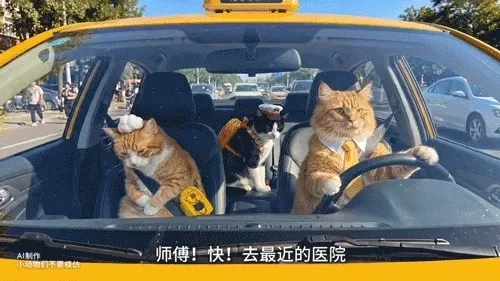
Story-driven AI pet videos boast exceptional performance in viewership.
Today, the creators behind these AI pet videos range from professional multi-channel network (MCN) agencies to amateur hobbyists. According to interviews by *South Reviews*, even novices with zero prior video-editing background can build massive fan bases within weeks through AI pet content.
Take the serialized drama *A Huang and This Village* as an example. Its creator, Zhu Buer, produced his debut video in his spare time and amassed 60 million cumulative views across the internet in just over a month.
Massive traffic has naturally translated into lucrative commercial monetization.
According to statistics from third-party data platform Nox Influencer, a YouTube channel centered around a character named “Damai” published 145 videos over 10 months, attracting 85,000 subscribers and generating around 11,000 yuan ($1,550) in monthly ad revenue.
What about the domestic market?
In reality, the initial wave of content creators launching “cyber fur babies” has turned this niche into a bona fide gold rush.
01 Can Side-Hustle Accounts Outearn Day Jobs?
Zhu Buer, a post-95 programmer who builds digital pet accounts in his spare time, currently commands 200,000 followers for his series *A Huang and This Village*.
Zhu’s creative strategy relies on a serialized format, with each episode revolving around a small yellow dog named “A Huang.” The storylines are closely intertwined with realistic rural settings, delivering remarkably persuasive emotional resonance.
The premier episode debuted on Douyin in late August, pulling in over 7 million views and 138,000 likes within a month. The two-and-a-half-minute video tells the story of a stray puppy wandering into a village home, getting adopted, and being named A Huang. Episode 6, which features A Huang being borrowed by a neighbor to catch a piglet stealing vegetables from a garden, scored 210,000 likes on Douyin.
Soon enough, Zhu’s comment sections were flooded with demands for faster updates. Viewers invested genuine emotional attachment, pushing traffic metrics steadily upward.
Some users expressed awe at the pastoral backdrops, commenting, “This is exactly what my childhood looked like,” while others became hooked on the puppy’s adventures, cheering as it bravely protected its owner or chased wild boars from melon patches.
By late September, Zhu launched a new account named “Jiujin Qiliang” (Nine Catties Seven Taels), featuring an AI-generated Labrador retriever and an American Shorthair cat.
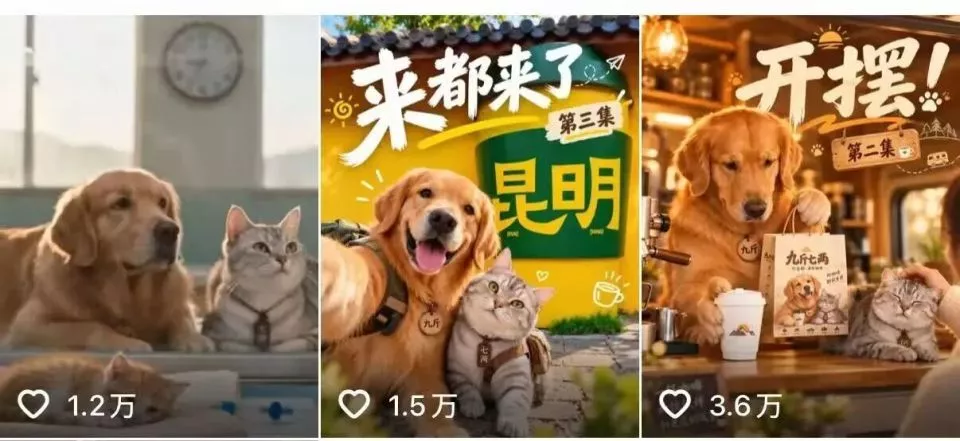
AI dog and cat video content from Zhu Buer’s “Jiujin Qiliang” account.
The debut video, roughly six minutes long, follows a cat-and-dog duo deciding to escape the monotony of daily life by purchasing an RV to embark on an impromptu road trip. Within a single day, the account gained 15,000 new followers, crossing the 30,000 mark a few days later.
Today, Zhu maintains both accounts strictly during his off-hours, yet their earnings already rival or exceed his full-time salary.
On September 29, professional photographer Lao Zhao launched a fresh account titled “Lao Zhao Has a Cat,” starring an American Shorthair kitten and a golden retriever named “Lao Zhao.”
The premier video showed the golden retriever continuously licking the kitten, which irritably pushed the dog away with a squeaky voice protesting, “Stop licking me, go away, I smell bad!”
The video’s view count skyrocketed to six million overnight.
Thrilled, Lao Zhao kept refreshing the page as viewership ticked up by thousands every minute. “It felt amazing; audiences really seemed to love this little kitten character.”
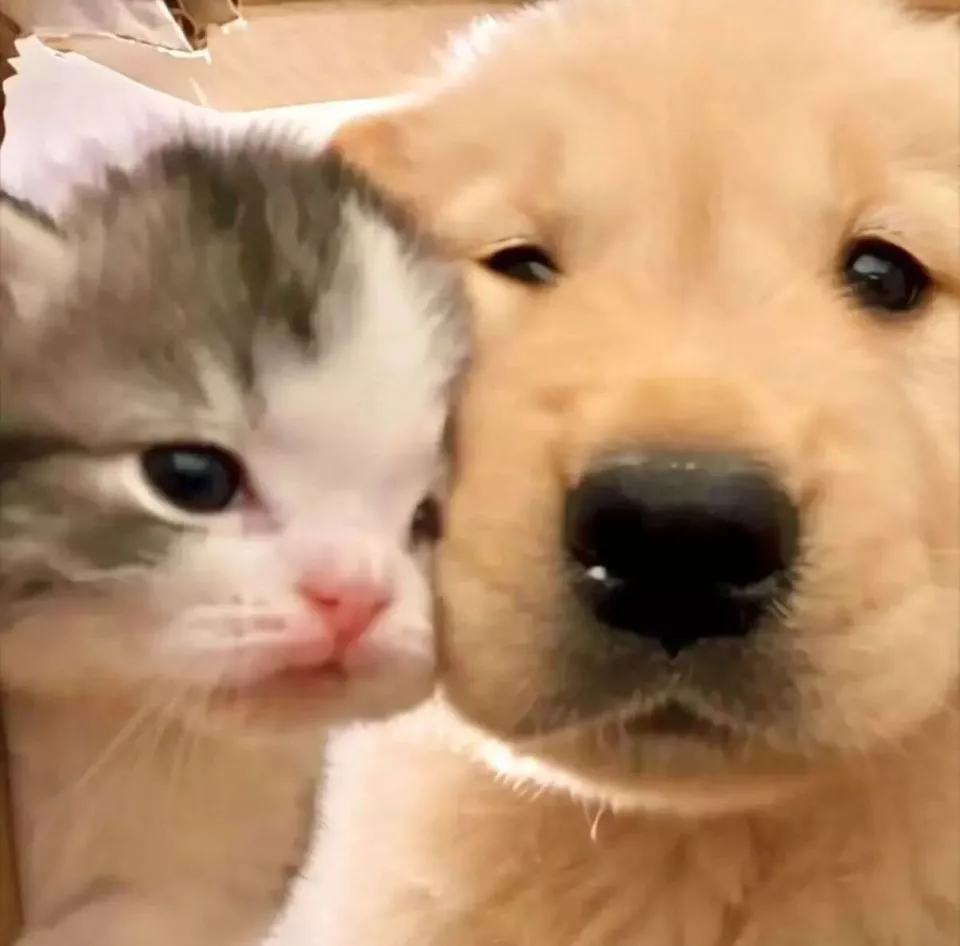
The account “Lao Zhao Has a Cat” stars a baby American Shorthair kitten and a golden retriever.
Lao Zhao believes what resonated most with viewers was the kitten’s vocal pitch. “It sounds like a toddler just learning to speak—a bit impatient, looking both fierce and adorable.” He repeatedly tried recording voiceovers for the golden retriever but remained unsatisfied with the results, ultimately deciding to “leave Lao Zhao speechless.”
Most AI pet narratives place virtual animals and humans within the same physical reality, treating cats and dogs not as beasts of burden, but as equal members of society.
For instance, “Cat Senior” characters frequently appear in campus settings, attending classes with students, lining up in cafeterias, ordering food delivery, and exchanging banter. Similarly, “Cat Masters” pop up across urban corners, lending a paw to heavy labor and earning human praise.
The top-tier creator “Mao Ziqi,” boasting nearly 1.5 million followers, rose to fame with the premise of “two cats cooking food.” Her most famous work features two felines in a courtyard brewing sweet-scented osmanthus wine-infused coffee: against a leisurely pastoral backdrop, a white cat skillfully sifts rice and boils wine while an orange cat wreaks havoc, meddling with ingredients and nearly knocking over pots.
This dynamic of the “troublemaking orange cat” has become a standard content trope across platforms.
The “Fuguimi Mi” account, active since August and boasting 140,000 cross-platform followers, saw its highest-viewed video feature two cats of different coats making mooncakes ahead of the Mid-Autumn Festival. One cat orchestrates the cooking while the other sabotages the effort, deriving humor primarily from the antics of the mischievous orange cat.
Operated by Guangdong-based beverage maker Tengen (Teezone), the account’s operator, Xiao Ti, told *South Reviews* that the company office adopted a stray Jianzhou cat. “It’s well-behaved most of the time, but acts out when playful, and loves food—colleagues just need to rustle a treat and it comes running.”
Xiao Ti, who owns an orange cat herself, based the account’s persona setup of two orange cats and a calico directly on these real-life pets.
Human behavioral traits paired with animal cuteness, anchored by stable narrative consistency, form the core formula used by most AI pet creators to hook fans.
The account “Orange Cat Pangdunk,” centered around two feline “besties” and boasting roughly 350,000 cross-platform followers, is run by an internet product manager named Moning.
This image is suspected to use AI-generated technology; viewer discretion is advised.
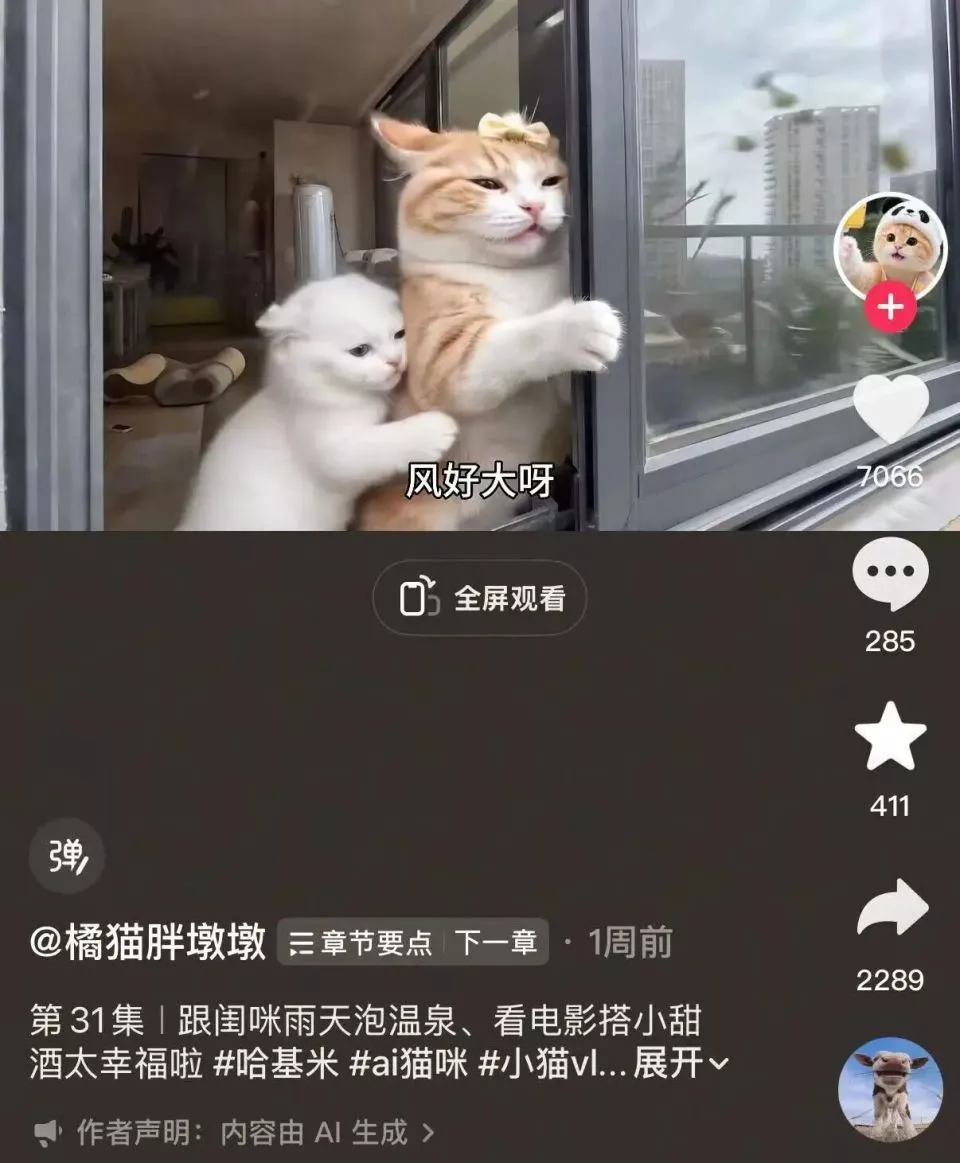
The account “Orange Cat Pangdunk” has amassed about 350,000 followers.
As early as June 2025, Moning began making AI cat videos in her spare time. Her initial creative concept revolved around the then-trending trend of “making cats move” while giving them simple bodily gestures and dialogue.
During the account’s first month, her follower growth stalled at 3,000. Then in July, a vlog themed around “cat besties going to the mall” suddenly went viral, pulling in 13.63 million views and nearly 76,000 likes on Douyin.
Moning began noticing a pattern: the more lifestyle-oriented and closely aligned with real-world scenarios content was, the easier it was to win audiences over.
In daily life, interactions between Moning and her female friends largely revolve around shopping, dining, and taking photos—activities she transplanted onto cats. “Many people watch this and forward it straight to their besties.”
Today, Moning still produces videos primarily in her spare time, though a complete 90-second piece requires roughly three days of effort. Because intricate plots demand precise setups, she frequently has to repeatedly “draw cards”—repeatedly prompting AI generation engines to produce identical scenes and picking the best version from multiple results—bringing production costs per video to between 400 and 500 yuan ($56–$70).
Fortunately, ad revenue now fully covers these expenses. Over recent months, Moning has fielded a steady stream of commercial partnerships, with her “ad slots booked solid through November.”
02 “I Don’t Care About Celebrity Endorsements, But If a Kitty Recommends It, I’ll Buy”
At present, ad sponsorships make up the lion’s share of “Orange Cat Pangdunk’s” income structure. Because the content mimics lifestyle vlogging, prospective advertisers range from pet supplies and dining brands to home appliances and cosmetics.
Fascinatingly, Moning frequently spots comments from netizens reading: “I skip celebrity ads, but I love watching cat ads.”
This image is suspected to use AI-generated technology; viewer discretion is advised.
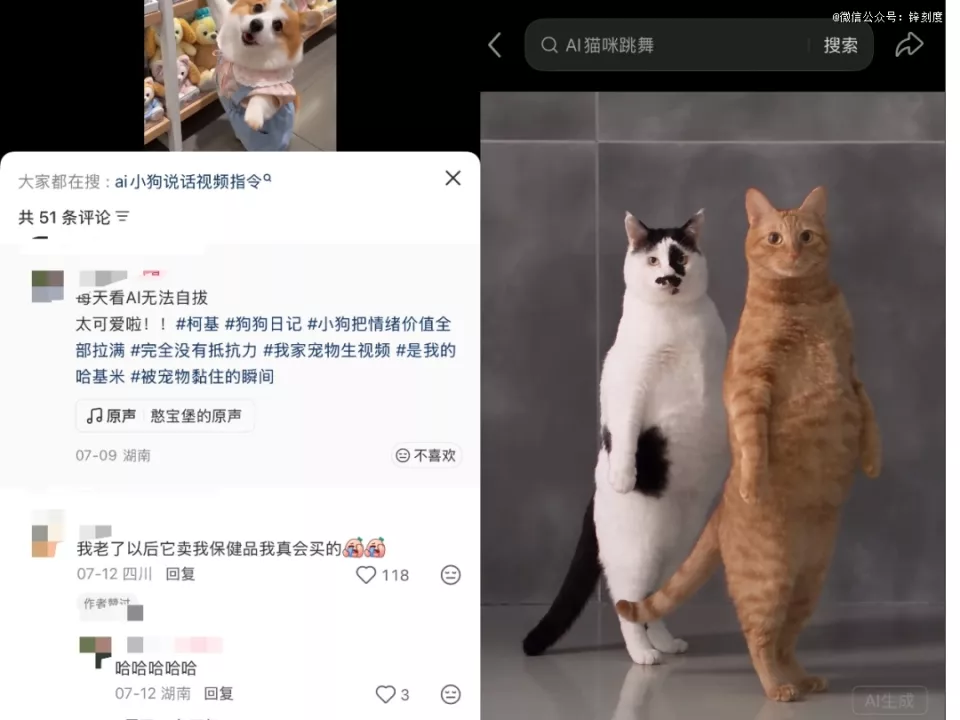
A comment under an AI pet video reads: “Even if it gets old and pushes health supplements, I’ll still buy them.”
Before launching *A Huang and This Village*, Zhu Buer had zero experience with AI video production.
In August, he began binge-watching AI shorts on short-video apps, often lingering for extended periods. “I’ve watched too many live-action dramas; occasionally watching AI content feels surprisingly refreshing.”
Realizing that actual video quality far exceeded his expectations without looking clunky, he decided to build his own AI pet account from scratch after clocking out.
Before arriving at his final formula, Zhu spent about a week fumbling through amateur attempts.
To produce the videos, Zhu subscribed to the top-tier membership of Jimeng (an AI video tool by ByteDance) powered by ChatGPT models. Yet capturing rich details still required constant prompt engineering.
Consequently, Zhu spent time learning how to communicate effectively with AI through prompts. As practical experience accumulated, he discovered that making virtual animals appear more authentic occasionally required “reverse” prompting—instructing the AI explicitly “not to look like a doll” or feeding it examples of “over-processed AI looks” to avoid.
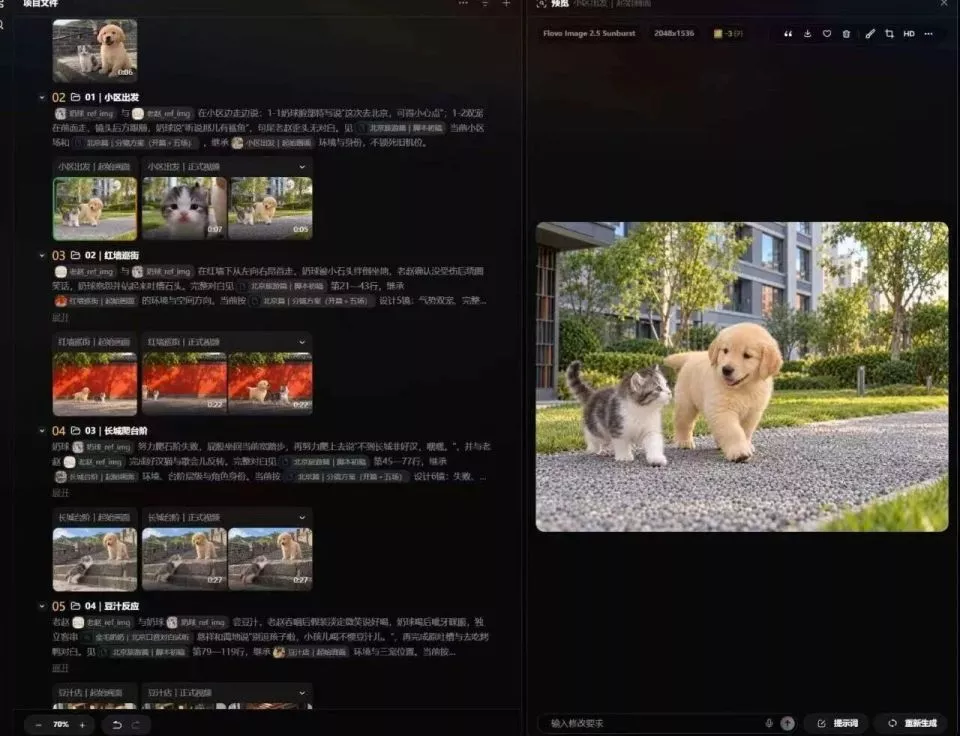
Making virtual pets look realistic requires meticulous adjustment and prompt optimization.
Following initial iterations, the debut episode of *A Huang and This Village* was finally born.
For Zhu, building a pet IP with a distinct personality relies heavily on character delineation as the core hook. When configuring prompts, Zhu prioritizes a pet’s personality traits over its exterior design. “There are plenty of cute characters out there; what matters is serving the narrative.”
By episodes 2 and 3 of *A Huang and This Village*, Zhu started receiving ad inquiries—covering everything from used cars to dog food.
Yet Zhu opted to hold off on accepting sponsorships. “Taking ads right at launch could ruin the viewing experience.”
Zhu has clearly felt the platform’s robust support policies for such content. On Douyin, for instance, videos exceeding 50,000 views earn a 3,000-yuan cash reward, while hitting the million-view mark bags 15,000 yuan.
Lao Zhao’s day job in photography and video editing gave him a natural head start in understanding visual framing and lens language. Just days before recording his first video, he studied basic AI operations from an AI video tutorial by top tech creator *影视飓风* (Lana Media/Storm Media), prompting him to try producing AI pet content independently.
Compared to larger accounts, Lao Zhao feels his production pipeline remains unsystematic. “I mostly pitch ideas to my AI assistant to generate prompts, then use the SD 2.5 (Stable Diffusion) model to render them. The results are already quite lifelike.”
Production costs per video are far from negligible, running roughly 1 to 3 yuan per second alongside frequent card-drawing reruns to secure ideal output.
Lao Zhao once blew over 70 yuan on a single clip when the model failed to understand his instruction for a kitten to look at a tablet computer, “placing the tablet a meter away instead of right in front of it.”
Over half a month of experimentation, Lao Zhao has poured more than 1,500 yuan into the account, though platform creator bonuses have already offset those costs. At present, platform revenue serves as his primary income source, and Lao Zhao notes that “Douyin delivers the best traffic performance, followed by WeChat Channels, and Xiaohongshu (RED).”
Numerous advertisers have approached Lao Zhao, but he has turned them all down. “I currently produce relatively short comedic sketches, which don’t lend themselves well to organic ad integration.”
Companies offering pet healthcare products and cat food have reached out, but Lao Zhao remains cautious, particularly regarding medical ads. “I worry about potential side effects that could hurt my fans.”
MCN agencies have also extended offers, which he has rebuffed in favor of creative freedom: “I entered the self-media space specifically to keep my creative independence.”
03 Lifelike Yet More Relatable Than Real Life
Lifeless yet acting more human than real animals; possessing animal exteriors with personalities surpassing actual pet behaviors—this emotional setup is precisely what drives the appeal of numerous AI pets.
Lao Zhao’s conversation with *South Reviews* was conducted entirely via text; preferring typing over voice calls, he often thinks in daily life, “Can we skip phone calls and just text? I really don’t want to pick up.” After incorporating this sentiment into “Lao Zhao’s Kitten,” an 11-second short pulled in over 110,000 likes.
“With so many introverts out there today, compounded by the inherent cuteness of cats and dogs,” Lao Zhao notes, fusing “humanization” and “animal traits” is what allows audiences to project themselves into virtual pet stories. “AI pets are indeed cuter than real pets, but pure cuteness has limits. What matters more is establishing an emotional connection [with the audience].”
This image is suspected to use AI-generated technology; viewer discretion is advised.
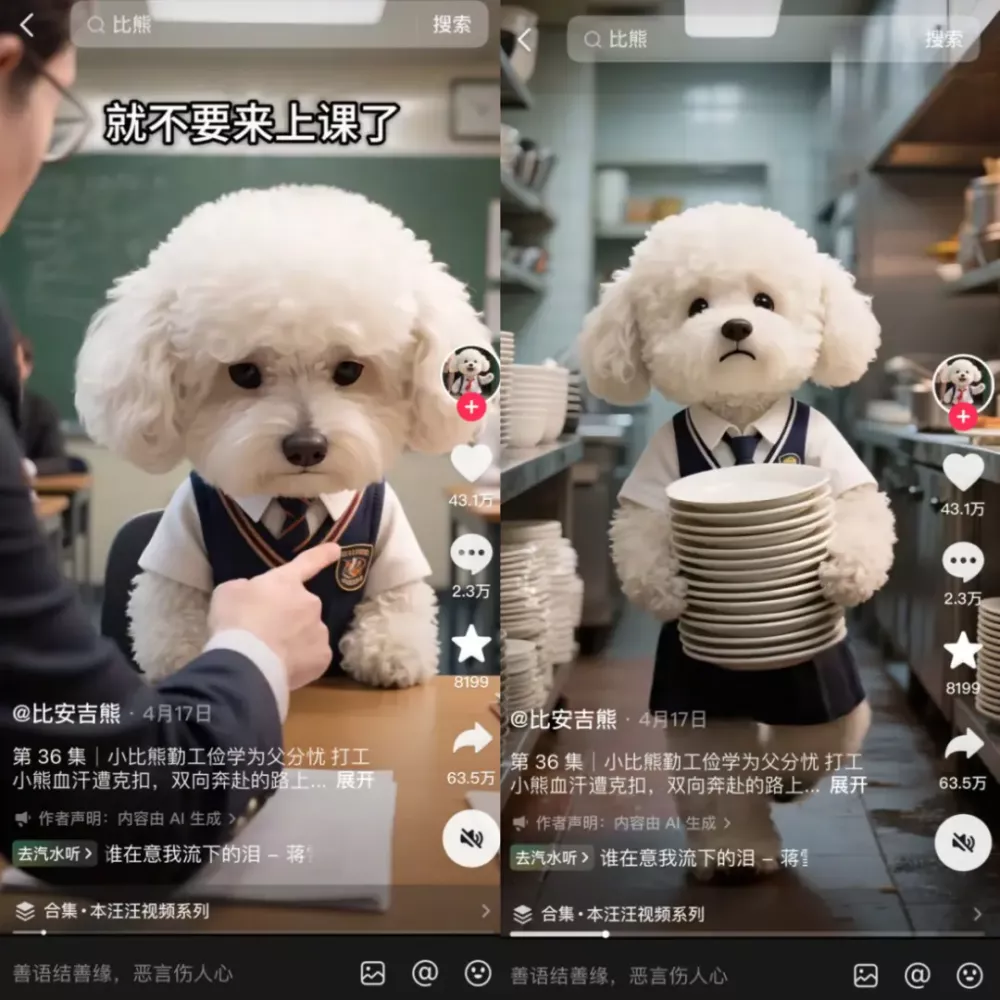
The fusion of “humanity” and “animal traits” helps audiences immerse themselves in virtual pet narratives.
Lao Zhao once considered using his own pet cat as the prototype for his account, but his American Shorthair tabby has grown into a hefty nine-pounder, making it “unsuitable” as a visual model. Besides, real animals refuse to cooperate with human performance demands.
Xiao Ti and her team position “Fuguimi Mi” as a source of relaxation and emotional value. “We don’t anthropomorphize for the sake of it, nor do we strictly copy human societal plots onto cats. We hold ourselves to a simple benchmark: is this story lighthearted, can ordinary people instantly grasp it, and does it make them smile?”
For Xiao Ti, AI has drastically compressed production cycles. “Shooting a commercial ad previously took over ten days from planning and shooting to post-production. Now we can finish in under a week, without worrying about venue rentals, animal management, or high shooting costs.”
Yet higher efficiency places stricter demands on creativity. As tools become ubiquitous, “knowing how to operate tools” ceases to be a competitive edge, leaving creators to duke it out over who better understands content and users.
Unlike real pets, these artificial companions adapt seamlessly to human emotional needs. Beyond consuming “cloud AI pets” on screens, some entrepreneurs are now building physical AI pet products in the real world.
In early 2026, Shenzhen-based smart pet toy startup Hugbibi launched “Joobie,” a portable AI pet plush toy. Equipped with edge computing, sensor arrays, and programmatic logic, the owl-shaped toy features multi-point tactile sensors, posture recognition, and audio modules capable of recognizing human strokes, hugs, movements, and shakes to deliver emotional feedback—such as purring contentedly when petted.
“Growth and nurturing” serve as the primary selling points of AI pet toys. Maxim, Hugbibi’s co-founder, tells *South Reviews* that “growth is interaction and change.”
The company endowed the toy with multiple personalities and emotional states. Much like living animals, younger developmental stages exhibit more instinctive reactions, which gradually evolve into distinct personalities shaped by time and interaction. Maxim hopes that once users awaken its “life,” the influence they exert and experiences they share will be permanently preserved rather than easily reset—meaning the relationship must either endure or be passed along.
From virtual spaces to physical objects, the pursuit of experiential connection and companionship forms the deep psychological driver behind nurturing AI pets. Maxim observes that over the past decade, plush toys have gradually transformed from “bedside ornaments” into “portable companions” carried everywhere by young people. Lifeless physical items paradoxically offer individuals genuine psychological satisfaction through self-expression and companionship.
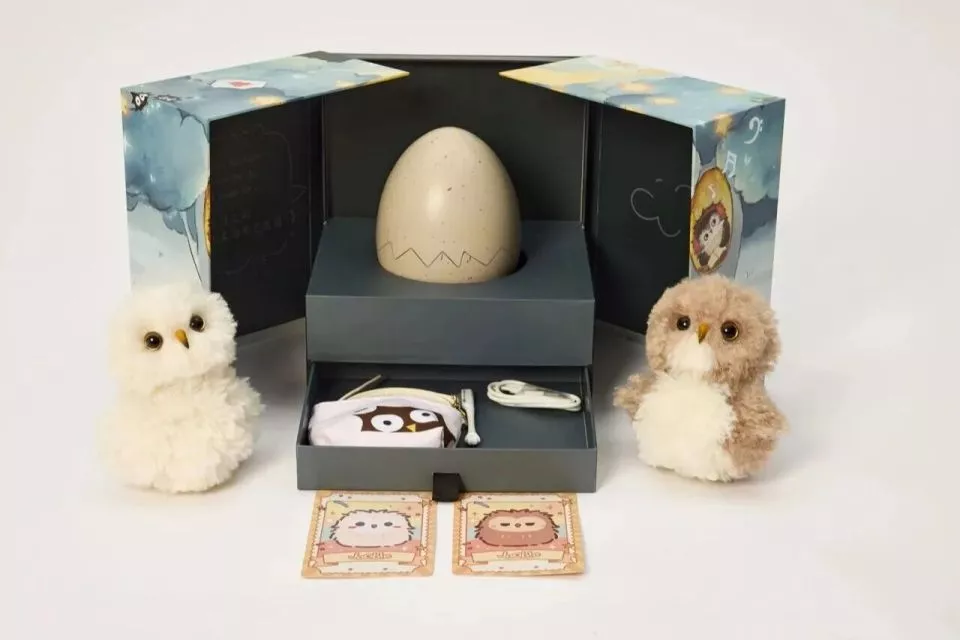
Plush toys have evolved from bedside ornaments into portable companions.
This dynamic mirrors the logic behind on-screen AI pets.
“Humans are naturally wired to form emotional bonds with anything exhibiting signs of life,” Maxim notes. “Just like watching Disney animations or *Tom and Jerry*, animal characters look more appealing, while moderate human behavioral traits make them easier for people to understand and emotionally resonate with.”
Data from an iiMedia Research report shows that China’s smart pet supplies market reached 10.2 billion yuan ($1.44 billion) in 2024, accounting for one-fifth of the total pet supplies industry.
By September 2026, forecasts from Shanghai Gasket Marketing Consulting projected China’s smart pet terminal market will surge from 10.2 billion yuan in 2024 to 26 billion yuan ($3.66 billion) by 2029, maintaining a compound annual growth rate exceeding 20%, with health management and emotional companionship products expanding fastest.
A study published last year by the University of Helsinki framed contemporary AI-driven virtual pets as “self-objects” actively constructed by humans. By invoking childhood memories and granting pets eternal life in digital realms, these creations help users forge and reinforce dependent relationships to overcome the fear of mortality and bolster subconscious desires for eternity.
Viewed from another angle, when people map their real-life experiences onto virtual pets, they simultaneously dissolve serious burdens and secure emotional compensation. The cuter the AI pet’s exterior and the closer its alignment with real-world living conditions, the stronger this compensatory effect becomes.
Moning sees opportunity here and has toyed with the idea of quitting her day job to run her account full-time.
Producing a minute-and-a-half video—from script conception to final cut—requires Moning to dedicate three solid days of off-hours work, sacrificing her evenings and weekends.
However, given the rapid shifts in the AI technological landscape, Moning lacks the courage to resign just yet. She remains uncertain how long the current golden window will last, let alone whether upcoming AI regulations might trigger abrupt shifts. For instance, in June, China’s State Administration for Market Regulation (SAMR) issued compliance guidelines governing the application of AI digital humans in advertising for “drugs, health supplements, special medical foods, and medical equipment,” banning AI avatars from endorsing such products.
Moning believes many AI pet creators share her current mindset: tasting the sweet profits of the present while maintaining a cautious, wait-and-see attitude toward the future.
Ultimately, modern society’s emotional needs shift constantly, and the connection models between humans and technology remain fraught with unpredictable variables that defy easy forecasting.