
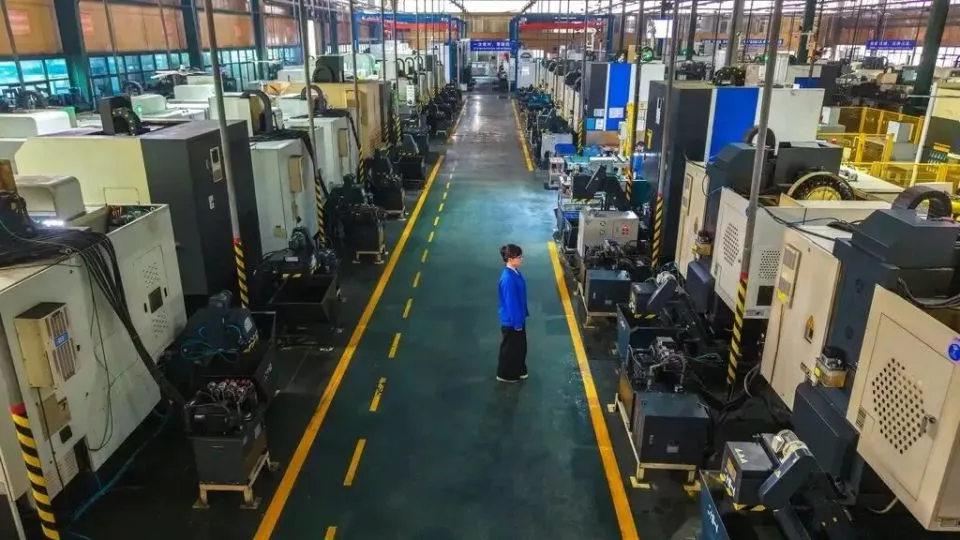
China Coders Trade Air-Conditioned Desks for Factory Floors as AI Bites
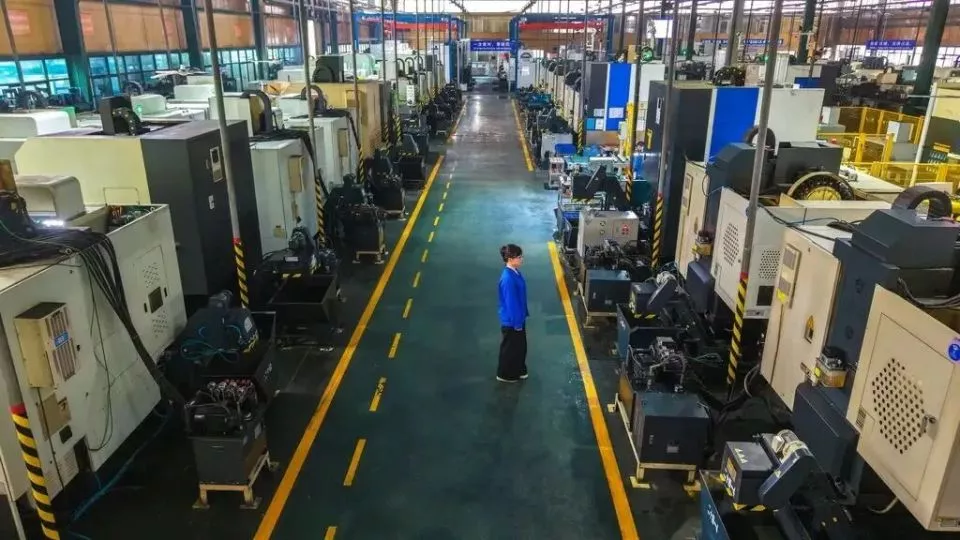
For decades in China, software engineering was the ultimate golden ticket: high salaries, rapid promotions, and comfortable office environments. Today, that narrative is fracturing. As artificial intelligence advances and the nation’s economic landscape pivots toward high-end manufacturing, a growing wave of laid-off or disillusioned coders are trading their keyboards for the grease, noise, and grueling schedules of factory floors.
In an automation training center in Taizhou, Zhejiang province, classrooms are packed with career switchers. According to the lead instructor, construction and real estate refugees make up the majority at over 60%, but software programmers now account for roughly 20% of the student body—a demographic slice that would have been unthinkable just a few years ago.
These displaced tech workers face a brutal reality check: mastering entirely unfamiliar hardware systems, surviving the unforgiving environment of industrial shop floors, and enduring the relentless pace of automated production lines. Above all, they are desperately searching for professional survival in an era of profound industrial upheaval.

For 34-year-old developer Situ, the pink slip arrived with shocking speed. On October 9, while sitting in a taxi rushing to a high-speed railway station, his HR department called to deliver the verdict: the client project had been abruptly canceled, and there was no new position waiting for him back at headquarters.
Though he managed a muted acknowledgment over the phone, the reality sank in the moment the call ended: his decade-long career as a programmer had just hit a dead end, swept away by a wave of tech layoffs.
Reflecting on the collapse of his profession, Situ noted that the pace of AI’s encroachment far exceeded his worst fears. As recently as two years ago, AI tools were little more glorified search engines. By early this year, their coding capability was still like that of a “kindergartener.” But by April and May, the technology had leaped to a “high school level,” capable of analyzing code frameworks and independently spotting and fixing bugs.
p>
Tasks that once required a coordinated team of three frontend and three backend engineers can now be completed by a single backend developer using AI assistance in just one week—a job that previously took three months.
Situ’s daily workflow has fundamentally devolved. He rarely touches his keyboard anymore, spending most of his shift staring at his screen, waiting for an AI pop-up window to ask: “Do you want to apply changes to line XX?” With a simple right-click, he hits “yes.”
“The nature of development has changed; we’ve become a bunch of ‘yes engineers’ doing nothing all day but clicking confirmation prompts,” he said with a bitter laugh.
Before the ax fell on Situ, dark clouds had been gathering across the global tech sector. Back in April, he watched a major Chinese internet giant roll out a “digital programmer” product. The following month, Meta and two other U.S. tech titans laid off more than 10% of their workforces, explicitly citing AI restructuring as the catalyst.
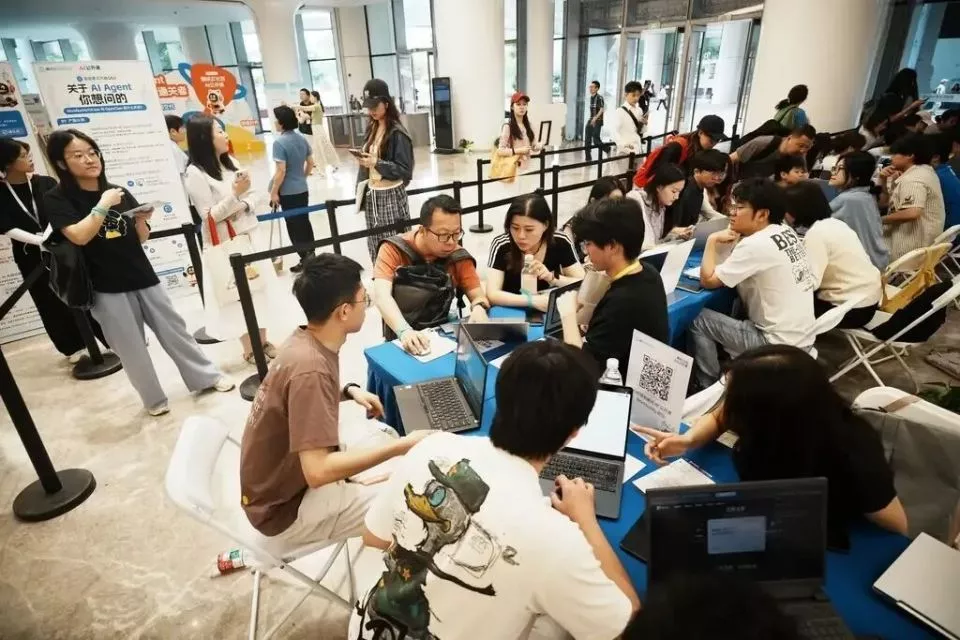
● On May 30, 2026, engineers in Hangzhou assist citizens with installing OpenClaw, an open-source AI agent. IC Photo
Situ observed that his peers reacted to the creeping crisis in three distinct ways. The first group he dubbed the “radicals”—or colloquially, the “traitors of code”—who enthusiastically trained AI to replace themselves, effectively automating their own jobs out of existence. The second group were the “compromisers,” desperately trying to master AI while holding onto their legacy turf. The final group were the “retreaters,” who began plotting their exit from the tech industry altogether.
Situ firmly placed himself among the retreaters. Entering his thirties, he felt too exhausted to keep chasing the endless wave of software frameworks and tired of the constant threat of layoffs. Earlier in the year, he began researching industrial automation online, dreaming of a second act inside China’s booming manufacturing sector.
He was tipped off by a similarly disillusioned colleague, who shared a link to Beijing’s national economic blueprint emphasizing future investments in industrial intelligence, noting that “this industry isn’t as obsessed with youth as Big Tech.” When that colleague was eventually laid off in July, the two pooled their savings to cough up 9,400 yuan ($1,300) for a weekend automation boot camp.
The ensuing corporate purge turned out to be far more vicious than anticipated. Out of Situ’s 30-person team, 25 were laid off, leaving just five survivors. Yet as one of the lucky ones, Situ barely lasted another three months before receiving his own termination call in October. He reported to the office the next day, collected his severance package, and walked out the door for good.
His immediate destination was the automation training school, this time upgrading from a weekend student to a full-time, immersive boot camp.
Such training programs are booming across Chinese cities. An instructor at a Taizhou automation academy revealed that the local training market has exploded from a single provider to four or five within 24 engineering-heavy months. While engineering and construction backgrounds still dominate the student rosters, programmers now make up a significant and growing share.
To be sure, the flight of coders to the factory floor isn’t driven entirely by AI. China’s broader employment landscape has been shifting for years. According to annual data from recruitment platform Liepin, job openings in China’s internet and real estate sectors have steadily shriveled, while the country’s booming new energy vehicle (NEV) and high-end manufacturing industries have rapidly expanded their capacity to absorb labor.
Take Wang Yuxiang, a 26-year-old frontend developer who decided to quit the tech rat race back in 2024. His predicament was classic: his firm’s outsourcing orders were skyrocketing, but headcount remained frozen. Overtime hours ballooned while his hair thinned, yet his monthly salary remained stagnant at a meager 5,000 to 6,000 yuan ($700–$830).
A graduate of a modest second-tier college in Chengdu, Wang had spent just two years in the software industry. He watched helplessly as entry-level positions once open to graduates from ordinary schools were increasingly monopolized by elite university alumni. Realizing his competitive edge was evaporating, he handed in his resignation.
Ultimately, the pivot to manufacturing is driven by cold, hard economics. Wang compared his lot to that of his uncle—a factory floor worker in his 40s with limited formal education who pulls in 7,000 to 8,000 yuan a month without suffering the crushing psychological wear-and-tear of tech industry competition.

Interestingly, both Situ and Wang landed on the exact same target role: a PLC engineer.
This is no accident. While automated production lines require a variety of tech-savvy talent, the Programmable Logic Controller (PLC) role offers the lowest barrier to entry and the gentlest learning curve for software refugees.
A PLC is essentially a custom-built, ruggedized industrial control computer. PLC engineers write the logic that dictates when conveyor belts start and stop, how robotic arms move, and how assembly lines flow smoothly. It requires standing right beside roaring machinery, tweaking parameters like a sound engineer until production runs without a hitch.
Wang’s transition began with acquiring a basic electrician’s license—a hurdle he managed thanks to credentials he earned back in college. The real trial by fire, however, was mastering PLC programming, which demands a deep grasp of mechanical logic and relentless hands-on troubleshooting.
To practice, Wang spent over 1,000 yuan buying secondhand equipment salvaged from a defunct factory. But his initial attempts were disastrous: code that ran flawlessly on his laptop would trigger flashing red alarm lights the moment it hooked up to the physical machine.
He later discovered the machine had long been discarded by manufacturers, paired with textbooks that were five years out of date. Two weeks later, he listed the rig on a secondhand marketplace, reselling it for 400 yuan to “the next sucker.”
After hitting a wall with self-teaching, Wang took an apprenticeship at an auto-parts factory, shadowing a veteran technician. Stripping the insulation off hundreds of colorful wires and maintaining worn-out circuit rails became his daily routine; a single wiring error could paralyze an entire production line. His hands were permanently stained black, and his clothes reeked of industrial grease.
Yet Wang quickly realized the limits of the apprentice system. Whenever the work touched upon core programming logic, his mentor would suddenly grow evasive or send him off to fetch spare parts, finishing the code behind his back.
Wang understood why: his mentor was in his 40s and relied entirely on this trade to feed his family. The old industrial proverb—“teach the apprentice, starve the master”—remained alive and well.
That reality pushed Wang to enroll in a formal, closed-campus training program styled after China’s infamous “gaokao” cram schools. Students surrendered their phones at the classroom door. Evening study sessions were kept as dead-silent as high school prep rooms, with students studying past midnight. Weekends were entirely devoured by the library.
Following months of grueling prep and a 90-day factory internship where he cut his teeth on seven or eight real-world projects, Wang finally hit the job market. After acing two interviews, he landed a job at a leading Chinese NEV manufacturer with a monthly salary of 12,000 yuan ($1,650), complete with room and board.
His workplace is a sprawling, high-security plant on the urban fringe, brightly lit and echoing with the roar of heavy machinery 24/7. Clad in a dark cyan jumpsuit that distinguishes him from regular line workers, Wang is responsible for designing automation workflows and on-site tuning.
For job seekers, the manufacturing sector offers a vastly more forgiving market than software development. Software engineer Chen Haoyu recalled that two years ago, he had to scatter 2,000 resumes across the internet just to land a 6,500-yuan coding job. By contrast, after spending just five months brushing up on industrial tech with zero prior project portfolio, he launched a job search and walked away with nine factory offers within a week, ultimately accepting a 7,200-yuan post at a Suzhou battery manufacturer.
Chen’s journey was uniquely chaotic. At his first gig, management tried to slash costs by ordering him to copy-paste electrical diagrams—a shortcut that quickly backfired when his lack of hands-on wiring skills left him terrified of electrocution. His second stint lasted all of seven days before a hostile mentor drove him out. Yet, buoyed by sheer demand, he landed a third job almost immediately, netting a 1,500-yuan raise.
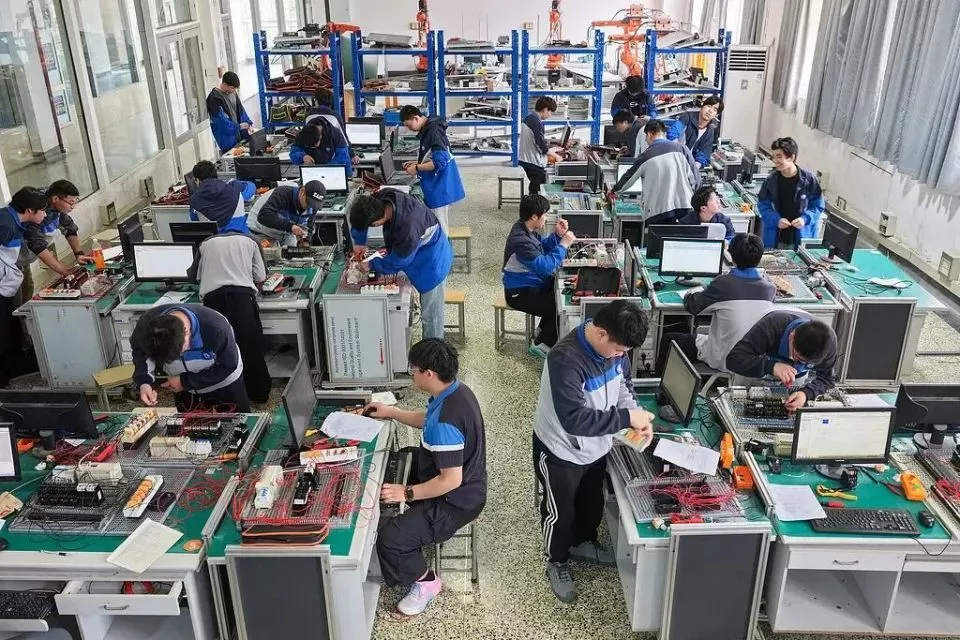
● In May 2026, students compete in a PLC control system assembly and debugging contest at the Jinhua Technician Institute. Visual China

Despite the low barrier to entry, life on the factory floor presents massive cultural and physical shocks for former white-collar coders.
For Chen, the hardest part was the constant, grueling travel. Three days after starting his job, he was dispatched with a batch of equipment to Shandong province, working continuously for three months without a single day off. “Machines run 24 hours a day, and so do our working hours,” he said. Life became an endless loop of remote industrial towns, budget motels, and roadside bento boxes dusted with factory grit.
Another engineer, Zhang Shuo, saw his four-year relationship dissolve under the weight of perpetual business trips and holiday shifts.
Whenever a machine broke down anywhere in the country, Zhang was “packaged and shipped” to the site to fix it. This nomadic career left him with a deep sense of alienation. “I felt like an isolated island surrounded by strangers in an unfamiliar place, with nowhere to anchor my heart,” he recalled.
Equally suffocating was his low status on the client factory’s totem pole. Whenever a machine malfunctioned, three or four plant managers would stand over him with folded arms, glaring down as he scrambled to fix it. One night at 11 p.m., just as he was undressing for bed, an emergency call dragged him back to the shop floor, where a burly, foul-mouthed supervisor roared at him: “You think you’re going home before this is fixed?” Zhang could only bow his head in silence.
On the shop floor, his physical territory was often restricted to a solitary square meter around the malfunctioning machine, which he bitterly dubbed his “cell.” As an outside contractor, he lacked clearance to roam the plant freely; even a trip to the restroom required an escort. To avoid the hassle, Zhang often went without water all day just to minimize bathroom breaks.
At times, Zhang reminisced about his days as a software engineer. At least office life was stable and dignified. Statutory holidays were respected, emergency bugs could be patched online, and colleagues spoke with professional courtesy without screaming clients breathing down their necks. There was always time to order milk tea and take a breather at the desk.
Yet, fundamentally, he had merely swapped one master for another. Zhang still faced grueling travel and tight deadlines—his job just happened to be tethered to physical hardware rather than code. But unlike the brutal pace of software development, his new profession was “not so easily disrupted by AI.”
● On August 26, 2026, an automated digital workshop in Jiangsu province operates around the clock. IC Photo
According to Zhang, industrial automation largely deals with non-standard, custom-built projects. Every production line is tailored to a client’s exact specifications, meaning AI cannot simply generate off-the-shelf solutions. Moreover, writing code accounts for only 30% of the job; the core value lies in manual parameter tuning, ensuring that physical lines run seamlessly.
That problem-solving acumen relies on years of accumulated experience—meaning the older and more experienced you get, the more valuable you become. Unlike the frantic treadmill faced by modern coders, this career path finally offered Zhang a profound sense of psychological security.
It is precisely this stability that Situ, recently unemployed, now craves above all else.
In the past, security was something he bought with years of “996” grueling overtime and countless sleepless nights. Riding the crest of China’s internet golden age, he hopped frequently between tech firms as his salary climbed, peaking at 15,000 yuan a month before his layoff—an upper-middle income in Qingdao.
He concedes that compared to the manufacturing hubs of the Yangtze and Pearl River deltas, Qingdao’s industrial base is relatively weak, meaning PLC jobs are scarcer and pay less. But his expectations are refreshingly simple: “As long as I’m not constantly being laid off,” a stable paycheck to cover his 6,000-yuan monthly mortgage is enough.
He is convinced that this is an anti-fragile career move. A telling cultural shift reinforces his conviction: the top choice for applicants on China’s recent college entrance exam rankings is now “Electrical Engineering and Automation.” Ironically, he remembers that when he filled out his university applications a decade ago, the undisputed king of the list was “Computer Science.”