
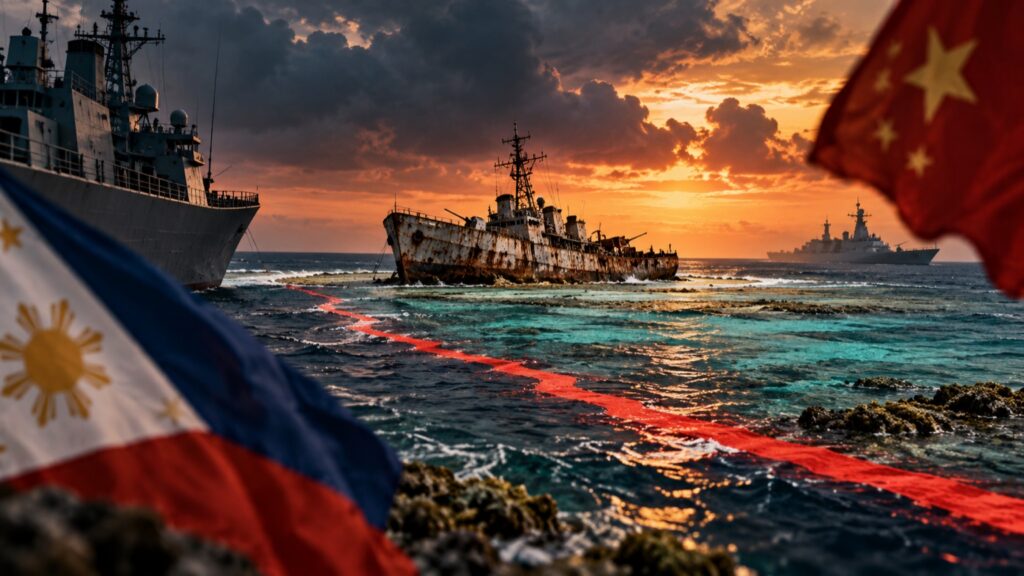
Removing the grounded warship at Second Thomas Shoal means war. Manila draws its red line
Philippine Defense Secretary Gilberto Teodoro warns that any attempt by China to tow away the grounded BRP Sierra Madre would be treated as an act of war rfi.my/D9lT https://t.co/YotkxFL7q6
— RFI 华语 – 法国国际广播电台 (@RFI_Cn) October 23, 2026
Any attempt by Beijing to forcibly remove the long-grounded warship BRP Sierra Madre from a disputed South China Sea reef will be treated as an act of war, Philippine Defense Secretary Gilberto Teodoro warned on Friday.
Speaking in an online media interview, Teodoro emphasized that Manila views any threat to the rusting vessel—which serves as a military outpost on Second Thomas Shoal, known in the Philippines as Ayungin Shoal—as a direct attack on a Philippine republic armed forces vessel.
“Should such an action occur, or any event employing force, it would constitute an act of war against the Republic of the Philippines,” Teodoro stated.
Teodoro’s remarks were a direct response to local media reports suggesting that Beijing was weighing a 10-point countermeasure package against Manila. The rumored proposals allegedly included towing away the BRP Sierra Madre, cutting off resupply missions, and imposing economic sanctions. While these points surfaced in a Manila-based Chinese-language newspaper, Beijing has not officially confirmed considering or adopting such a blueprint.
The defense chief subsequently clarified that while an offensive move against the ship is a grave escalation, it should not be conflated with a formal declaration of state-to-state warfare.
The Mutual Defense Treaty Trigger
Asked whether a Chinese boarding of the BRP Sierra Madre would activate the 1951 U.S.-Philippines Mutual Defense Treaty (MDT), Teodoro conceded that the possibility “does exist,” though the ultimate decision to invoke joint defense mechanisms rests with the Philippine president.
He underscored that such an incident “might” trigger the pact rather than make its activation an absolute certainty. Under the decades-old treaty, Washington and Manila have pledged to come to each other’s defense in the event of an armed attack in the Pacific.
U.S. officials have repeatedly affirmed that the treaty covers armed attacks on Philippine armed forces, public vessels, and aircraft—including coast guard assets—anywhere in the South China Sea.
Citing tactical sensitivities, Teodoro declined to discuss whether the military has adjusted its rules of engagement to deter potential Chinese boarding parties.
Economic Coercion and Supply Independence
Regarding reports of potential economic coercion, Teodoro noted he had not yet reviewed the specific articles, but warned that the Philippines’ heavy economic reliance on China could easily be weaponized against it.
“This precisely proves a fact: so-called goodwill can be turned into a weapon, and they are consciously weaponizing it,” Teodoro warned.
He urged the Philippine government and business community to accelerate domestic industrial growth and diversify supply chain networks, with a particular focus on securing strategic infrastructure. “For a long time, we have endured implicit threats, and now these threats have been brought out into the open,” he said.
The warning comes on the heels of a routine troop rotation and resupply mission to the BRP Sierra Madre, which has been intentionally grounded at the shoal since 1999 to anchor Manila’s territorial claims. Teodoro fiercely rejected claims that Manila had sought Beijing’s permission to provision its garrison, calling the assertion entirely false.
“The Republic of the Philippines does not need to ask anyone’s permission to supply the BRP Sierra Madre,” he stressed, while also denying Chinese media allegations that Filipino personnel had leaked cargo manifests during radio communications.
Friction over the outpost has intensified in recent months. In September, Chinese coast guard and naval vessels blocked Philippine supply boats, forcing commanders to abort a mission. Earlier this month, the Philippine Coast Guard accused Chinese ships of deliberately obstructing a medical evacuation, delaying the transfer of a sick soldier by nearly 10 hours—a move that drew sharp condemnation from Philippine President Ferdinand Marcos Jr., who stressed that humanitarian access must be respected even amid geopolitical rivalry.
Beijing claims sovereignty over nearly the entire South China Sea, demanding the removal of the grounded warship, which it labels an illegal occupation. Second Thomas Shoal lies roughly 194 kilometers west of the Philippine island of Palawan, well inside the country’s internationally recognized exclusive economic zone (EEZ). An international tribunal ruled in 2016 that Beijing’s expansive “nine-dash line” historical claims have no legal basis, a verdict Beijing continues to reject.