
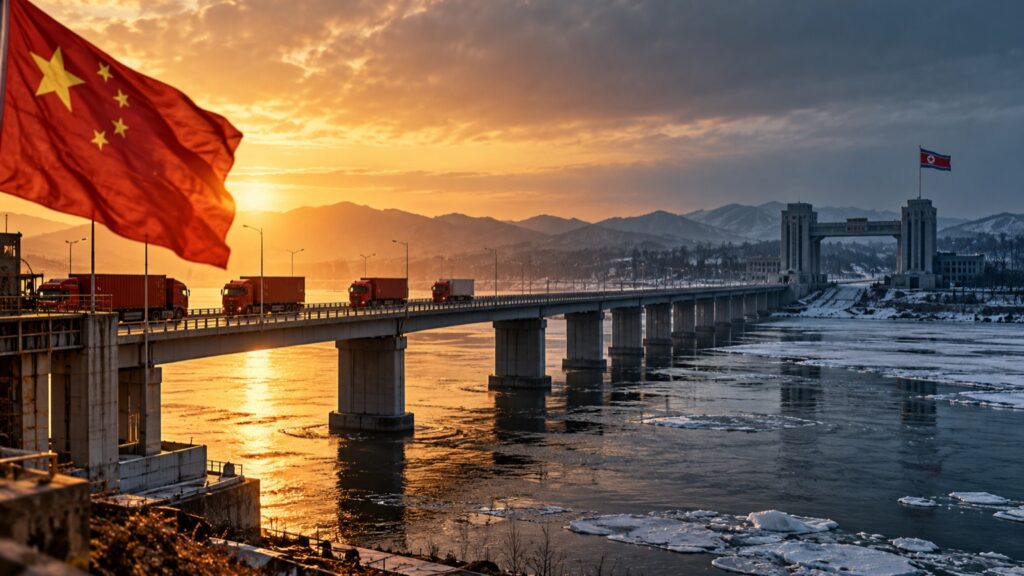
China just opened a $329 million bridge to North Korea. Pyongyang waited 12 years to use it
China and North Korea have officially opened the New Yalu River Bridge, a massive 3-kilometer cross-border infrastructure project connecting the Chinese border hub of Dandong with North Korea’s border city of Sinuiju. The launch comes despite ongoing international sanctions targeting Pyongyang’s economy and nuclear program, signaling a notable pickup in cross-border trade.
Travelers crossing the border recently confirmed that cargo trucks and passenger trains have begun utilizing the four-lane modern passage. The opening follows closely on the heels of a smaller road bridge built between North Korea and Russia across the Tumen River, highlighting Pyongyang’s efforts to deepen ties with its two key strategic partners.
During a virtual opening ceremony, Chinese Premier Li Qiang stated via video link that the new bridge would strongly promote economic and trade cooperation and further close personnel exchanges. North Korean Cabinet Premier Pak Tae-song also delivered video remarks for the occasion.
As Pyongyang provides military support and weaponry to Moscow for the war in Ukraine, Russia has similarly developed land infrastructure to bypass reliance on their sole remaining rail link. Parallel to tightening North Korea-Russia relations, Beijing has accelerated trade development with Pyongyang to secure its economic influence in the neighboring country.
In 2024, Beijing and Moscow successfully dismantled the United Nations panel of experts monitoring sanctions against North Korea, blunting international enforcement. Both nations have also repeatedly resisted U.S. pressure to tighten restrictions, arguing that current policies have failed to curb Pyongyang’s nuclear ambitions.
Industry observers warn that the new corridor will become a primary artery for North Korean commerce. The isolated nation’s economy has long suffered under UN bans on major exports like coal and labor, alongside strict limits on energy imports.
Before the new bridge opened, cross-border transit relied heavily on the 83-year-old Sino-Korean Friendship Bridge, an aging infrastructure link featuring a single rail line and a single narrow vehicle lane. It enforces strict weight limits—banning vehicles over 20 tons—and a sluggish speed limit of about 4.8 kilometers per hour. China first proposed the New Yalu River Bridge in 2009 to deeply integrate the North Korean economy with its own.
Although construction was completed in 2014 with Beijing funding the entire $329 million project, the bridge sat unused for 12 years as Pyongyang struggled to complete connecting roads, customs facilities, and auxiliary infrastructure.
The project underscores growing economic asymmetry. Extended sanctions have left North Korea almost entirely dependent on China for external commerce, leading to a widening trade deficit as Beijing absorbs the bulk of Pyongyang’s restricted exports.
Kyu-bum Kim, an analyst at the Institute for National Security Strategy in Seoul, noted that from Pyongyang’s perspective, the new bridge will channel Chinese goods more efficiently and in larger volumes, but offers no guarantee of significant reciprocal sales into China. He emphasized that if the trade deficit and economic dependence deepen further, the dynamic may prove unfavorable for North Korea.
Analysts suggest Pyongyang likely negotiated specific trade concessions and exemptions before agreeing to open the crossing, aiming to secure easier access for its goods into Chinese markets and pave the way for more North Korean laborers to work in China.
North Korean leader Kim Jong Un faces a persistent economic dilemma: he needs Chinese raw materials and equipment to repair domestic production while urgently securing foreign currency. Pyongyang has frequently relied on alternative methods to generate hard currency, including smuggling, labor exports, cyberattacks, and cryptocurrency theft.
In efforts to stabilize the domestic economy, Kim previously cracked down on Chinese contraband under pandemic-era pretexts while striving for self-sufficiency in consumer goods. He has also attempted to offset trade imbalances by promoting newly developed coastal and mountain resorts to attract Chinese tourists.
As Pyongyang leans toward Moscow amid the Ukraine conflict, Beijing has likewise stepped up diplomatic engagement. Official statistics show that bilateral trade between China and North Korea in the first half of 2026 surpassed $1.5 billion, setting a new high since comprehensive UN sanctions took effect in 2017.