

China’s campus-loan pioneer got a 790-million-yuan tax bill. Its public company is paying it

A staggering 790-million-yuan tax bill has thrust once-celebrated fintech pioneer Qudian back into the spotlight, exposing deep-seated corporate governance issues among Chinese private enterprises under a tightening regulatory regime.
In its financial report for the first half of 2026 released in mid-October, High Templar Tech—the US-listed entity formerly known as Qudian—disclosed that founder, chairman, and CEO Luo Min received a tax demand notice from local tax authorities in Xiamen. The bill requires him to pay 790 million yuan ($109 million) in personal income tax on “property transfer income” stemming from historical equity restructuring.
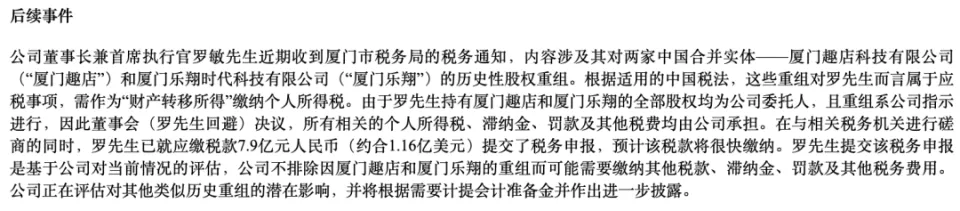
Photo: Internet
More controversially, the board of directors voted to have the US-listed company foot the entire tax bill—including potential late fees and penalties—rather than leaving the personal liability to Luo. Luo himself recused himself from the vote.
Why should ordinary public investors shoulder a founder’s historical personal tax liabilities?
01
The Rise of a Campus-Loan Empire
Many young internet users today may have forgotten Qudian and its founder, but between 2014 and 2017, the company was a heavyweight legend in China’s internet sphere.
In 2014, serial entrepreneur Luo Min spotted a lucrative financing gap among college students and launched the Qufenqi platform in Beijing.
During that era, young consumers’ purchasing power was rapidly expanding before regulatory guardrails were fully established. Promotional flyers offering “zero-down-payment smartphone purchases” were plastered across university campuses nationwide.

Photo: Internet
Fueled by aggressive grassroots marketing and continuous venture capital backing, Qufenqi expanded into over 300 cities within just 30 days. It completed five rounds of financing in 12 months, securing Ant Group—the fintech affiliate of Alibaba—as an investor and gaining crucial traffic access via Alipay.
By 2016, the company turned a profit, posting an annual net income exceeding 570 million yuan. Yet soaring profits brought mounting controversy.
Unchecked lending practices triggered severe social harm: aggressive debt collection, predatory loans, and exorbitant overdue fees frequently made headlines, with some indebted students tragically taking their own lives. “Campus loans” quickly transformed from a buzzy commercial term into a societal taboo.
Regulators moved swiftly. In 2016, Chinese ministries jointly issued notices to rein in the cash-loan and campus-loan markets. Qudian promptly announced its exit from campus financing, pivoted to cash loans for adults, and rebranded as Qudian Group. Yet the label of “campus-loan pioneer” remained indelibly stamped on its corporate identity.
In the autumn of 2017, Qudian went public on the New York Stock Exchange, surging over 40% on its first trading day and briefly commanding a valuation of over $11.3 billion—making it one of the largest US IPOs by a mainland Chinese firm that year. At just 34 years old, Luo Min entered the Hurun rich list with a personal fortune of 12.5 billion yuan.
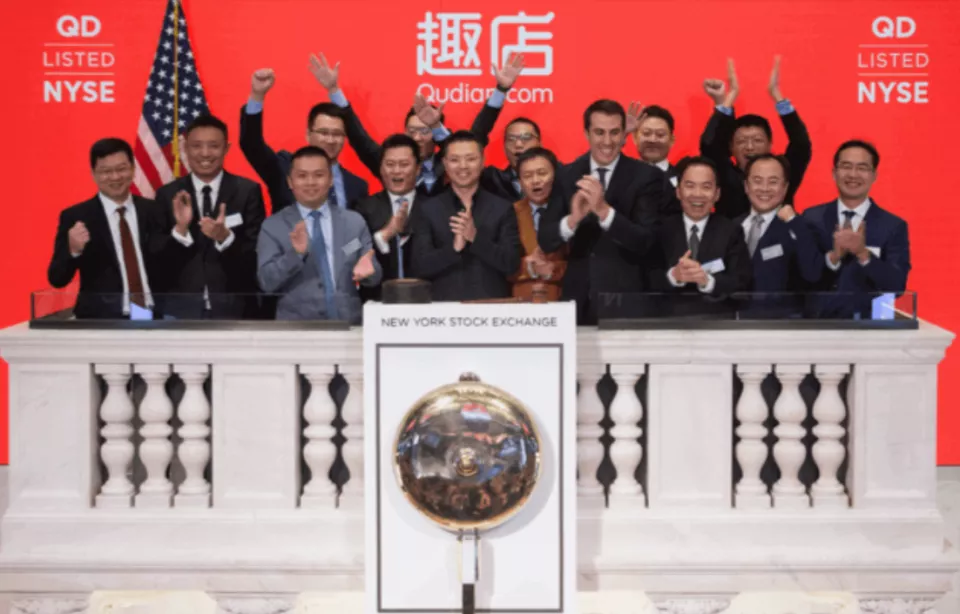
Photo: Internet
That milestone marked the peak of his career and the final frenzy of China’s consumer finance gold rush.
02
A Decade of Pivot Failures
Going public proved to be Qudian’s ceiling rather than a launchpad. Over the ensuing decade, Luo led the company through a string of new business ventures, almost all of which hit walls.
After exiting campus finance, the firm dabbled in auto financing before retreating. It launched a high-end e-commerce mall that failed to gain traction, and invested in children’s education, only to see the sector clipped by sweeping regulatory crackdowns.
By 2022, Luo personally threw himself into the ready-to-eat meal business, splashing cash in livestreaming sessions and even visiting competitor livestreams for exposure. Past stunts resurfaced online, triggering a severe public backlash that forced business partners to distance themselves and ultimately killed the project.

Photo: Internet
Subsequent stabs at short-distance logistics and overseas expansion similarly ended in total shutdown after a year of turbulent operations.
By 2026, Qudian’s core business operations have been virtually hollowed out.
According to its latest financial statements, total revenue for the first six months of the prior year slumped to just over 8 million yuan, down more than 70% sequentially, while operating losses hovered around 180 million yuan.
n
A Nasdaq-listed firm once valued in the tens of billions of dollars now generates less revenue in half a year than a mid-sized domestic restaurant chain makes in a single quarter.
Iroically, the company still reports over 400 million yuan in book profits—not from active business operations, but from 1.28 billion yuan in interest and wealth management returns.
Today, Qudian has ceased to function as a traditional operating enterprise, morphing instead into a financial vault sitting on accumulated cash reserves with no viable growth avenues in sight.
Yet this dormant shell of a company is now expected to shell out 790 million yuan to cover its boss’s tax arrears—a sum swallowing roughly 20% of the firm’s liquid assets and exceeding 30% of its current market capitalization.
03
n
The Legal Battle Over Tax Classification
To understand how this happened, one must look back at the offshore restructuring process. To facilitate overseas financing, Luo held equity in two domestic entities—Xiamen Qudian Technology and Xiamen Lexiang Times—under his personal name. Qudian maintains that these stakes were held on behalf of the company and were simply transferred into the listed corporate framework during internal restructuring.
n
If the assets were designated as a nominee holding, why must personal taxes be paid upon restructuring?
n
Tax authorities operate on a strict principle: whoever holds legal registration of the equity bears the tax liability. Private nominee agreements between individuals and companies are considered internal civil arrangements that cannot override statutory tax obligations.
Xiamen’s tax regulators determined that the transfer of ownership rights during the equity restructuring constituted a personal asset appreciation and transfer, triggering a 20% personal income tax rate amounting to 790 million yuan.
While the underlying economic beneficiary remains a matter of internal corporate dispute, tax agencies act strictly on publicly registered taxpayer identities.
This enforcement logic reflects a broader regulatory shift. In the early summer of 2026, the Ministry of Finance and the State Administration of Taxation issued Announcement No. 21, systematically regulating individual income tax on overseas trust assets under a “substance-over-form” principle.
Under the new rules, transferring shares or real estate into overseas trust frameworks is treated as an asset disposal subject to a 20% personal income tax based on market valuation. Tax authorities are now empowered to pierce through nominee agreements, complex offshore structures, and multi-layered trusts to trace hidden assets back to their ultimate beneficiaries.
n
With Qudian receiving its tax notice mere months after the announcement’s rollout, the timing highlights a coordinated crackdown on high-net-worth tax evasion amidst tightening cross-border asset regulations.
Beyond the tax bill itself lies a deeper governance dilemma: the company’s decision to bail out its founder.
n
Qudian management defended the move by arguing that because the equity was held on the company’s behalf and the restructuring served corporate interests, the resulting tax burden rightfully belongs to the firm. Although Luo recused himself from the vote, he controls roughly 88% of the voting power despite owning only about 43% of the shares—retaining absolute operational command.
This exposes a recurring paradox in Chinese private enterprise: when equities appreciate and companies go public, the financial gains flow directly into personal vaults; when tax debts and liabilities strike, corporate entities automatically step in to absorb the losses.
The blurred boundary between a founder’s personal assets and corporate legal property remains a chronic ailment in China’s private sector. Sophisticated corporate governance and board supervision often serve as mere window dressing for investors.
04
Closing the Book on an Era
Qudian and Luo Min stand as quintessential witnesses to an era. During a wild growth period when regulatory loopholes abounded, they capitalized on consumer finance tailwinds, scaled rapidly, tapped international capital markets, and amassed initial fortunes.
Yet they also left behind a trail of social wreckage—students trapped in debt swamps and severely tarnished industry credibility.
n
As regulatory frameworks mature and the dividends of disorderly expansion fade, companies like Qudian have struggled to replicate past successes, reduced to guarding cash reserves while awaiting their final historical reckoning.
The 790-million-yuan tax bill serves as both a residual debt from past equity maneuvers and the final invoice for an era of unbridled growth.
In the grand arc of commercial evolution, stories of exploiting regulatory gray areas to multiply wealth repeat themselves endlessly. Many mistake their early windfalls purely for personal brilliance, forgetting that history always maintains a ledger. Every evaded rule, every suppressed cost, and every shortcut taken eventually catches up, landing squarely on one’s doorstep.
The campus-loan chapter is closed. Now, its final bills are finally coming due.