
China grew 4.5% last quarter. The property market shrank 20.6% and the factories are sweating
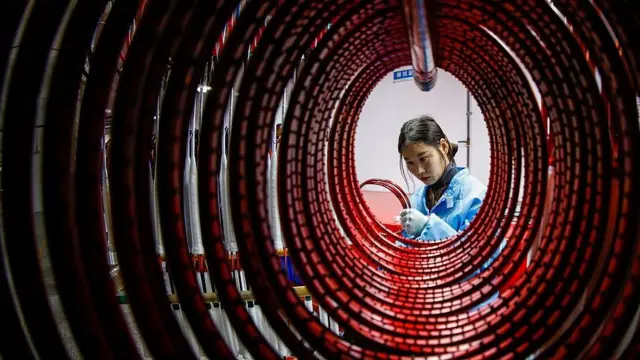
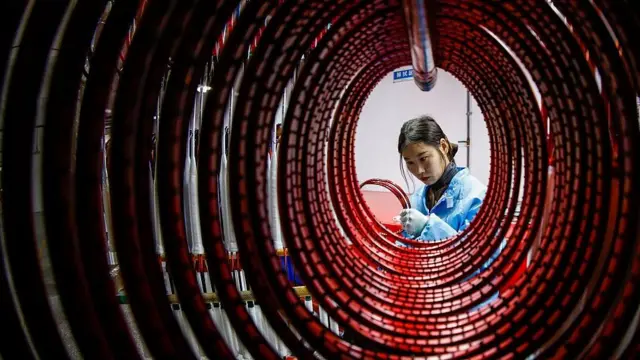
Workers manufacture badminton rackets for export at a workshop in Suqian, Jiangsu province, on March 16, 2026.
China’s economy beat expectations in the third quarter, logging a 4.5% year-on-year GDP growth rate that edged up from 4.3% in the previous quarter. The National Bureau of Statistics announced that growth for the first nine months reached 4.6%, safely landing within Beijing’s full-year target range of 4.5% to 5%.
The print defied cautious forecasts. A Reuters poll of 50 economists had pegged median growth at 4.4%, a projection mirrored by nine domestic and international research institutions surveyed by Caixin Media. Yet beneath the headline beat, ordinary consumers are feeling a very different kind of pressure. Gasoline prices have jumped 16.6% compared to a year ago, while artificial intelligence-driven demand has pushed memory chip prices up by 46.7%, computers by 21.8%, and smartphones by 14.9%. By contrast, pork prices at local wet markets dropped over 10%.
Analysts interviewed by the BBC point to a stark dichotomy: “hot outside, cold inside.” This phrase captures China’s current economic predicament, where robust exports and high-tech manufacturing are carrying the weight, while domestic consumption, private investment, and the real estate sector remain mired in weakness. Experts warn that a heavy reliance on external demand builds systemic risks, leaving Beijing with limited and costly room for fiscal maneuver.
Who Is Pulling and Who Is Dragging
Foreign trade and advanced manufacturing served as the primary pillars supporting third-quarter growth.
Export performance proved exceptionally strong. Total exports surged 28.4% year-on-year in the third quarter, vastly outpacing the 17.5% growth recorded in the first half. By September, dollar-denominated monthly exports spiked by 36.3%.
According to Moody’s Analytics, the foreign trade sector served as the primary catalyst for the economic acceleration. However, the firm cautioned that China’s growing dependence on external markets carries structural vulnerabilities, especially as early signs of fatigue emerge abroad.
A closer look at September’s trade data reveals that pricing power rather than volume drove much of the gain. Integrated circuit exports jumped 136% in value, while export unit prices soared 133.7%, meaning actual shipment volumes grew by less than 1%. In short, revenue growth stemmed primarily from inflation rather than unit expansion.
Meanwhile, high-tech manufacturing dramatically outperformed the broader industrial average. Value-added output in the sector rose 14.3% in the first three quarters—nearly triple the 5.3% growth rate for all industries. Production of strategic goods such as 3D printers, lithium batteries, and industrial robots surged 62.5%, 39.5%, and 29.1%, respectively.
Yet this industrial shine has failed to translate into household spending or domestic investment. Sheana Yue, senior economist at Oxford Economics, told the BBC that without improvements in consumption and investment, policymakers and observers should remain cautious about viewing the headline GDP bump as a sign of broad-based stabilization.
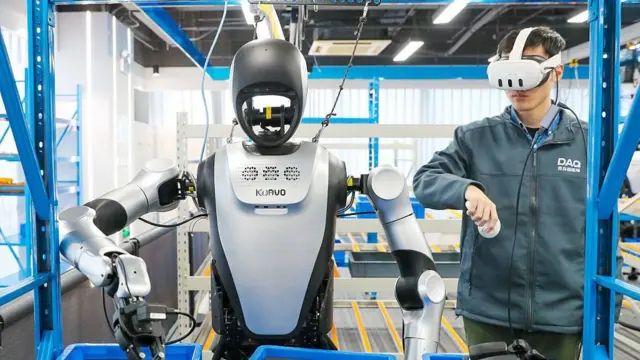
A humanoid robot learns component sorting at a data collection and training facility in Qingdao, Shandong province, on January 12, 2026.
Confirming Yue’s concerns, the real estate market continues its profound contraction. Property development investment fell 20.6% year-on-year in the first nine months, worsening from an 18% decline in the first half. New construction starts plummeted by nearly a quarter. Moody’s Analytics noted that such steep drops in new starts foreshadow a sharp contraction in downstream construction activity over the coming months, which will inevitably ripple through steel, cement, and home appliance supply chains.
Overall investment sentiment remains subdued. Fixed-asset investment dropped 7.2% year-on-year in the first nine months, deepening from a 5.7% decline in the first half. Even excluding real estate, non-property investment contracted by 4.2%.
Domestic retail sales showed meager signs of life. In September, total retail sales of consumer goods rose 1.1% year-on-year, up slightly from 0.4% in August. Alicia García-Herrero, chief Asia-Pacific economist at Natixis, remained skeptical, noting that a 1.1% retail growth rate for an economy expanding at 4.5% “remains insufficient,” with the uptick largely driven by low base effects from the previous year.
The service sector picked up some of the slack, with value-added output growing 5.2% in the first three quarters and accounting for nearly 60% of the overall economy. However, Moody’s analysis indicates that this momentum derived primarily from information technology and business consulting rather than everyday consumer spending.
Why Beijing Is Holding Back Stimulus
Official rhetoric remains upbeat. Mao Shengyong, deputy head of the National Bureau of Statistics, told a press briefing in Beijing that the 4.6% nine-month growth rate ranks among the highest of major global economies, adding 5.7 trillion yuan ($853 billion) in economic value—the highest for a comparable period in five years. Citing escalating Middle East conflicts and rising global energy prices, Beijing framed the numbers as hard-won and commendable.
Policy support has not entirely stalled. Since late September, the central bank has trimmed pledged supplementary lending rates and expanded refinancing quotas for tech firms and private enterprises. The Ministry of Finance rolled out mortgage interest subsidies for first-time homebuyers, while local governments received authorization to tap unused bond quotas.
Moody’s assesses these measures as “primarily targeted at optimizing borrowing costs for specific entities rather than providing broad-based support for consumer demand,” making it difficult to meaningfully lift domestic spending in the short term.
García-Herrero argues that Beijing’s regulatory focus leans toward infrastructure investment rather than consumer stimulation, explaining why the government has hesitated to inject direct subsidies into retail households. She suggests that officials view September’s 1.1% retail growth as “roughly acceptable,” providing a convenient pretext to hold off on aggressive fiscal stimulus.
Furthermore, García-Herrero points to constrained fiscal space as a deeper deterrent. International observers frequently question how much fiscal ammunition Beijing has left. Policymakers are acutely aware of these limits, keeping a tight rein on spending because they know actual available room is remarkably narrow.
The Sole Engine Under Pressure
Even the export and high-tech manufacturing engine driving current growth faces mounting uncertainties ahead.
Through the first eight months of the year, price increases accounted for 85% of revenue growth across the global memory chip industry, with volume expansion contributing just 15%. Moody’s flags this as a critical risk inflection point: price-driven booms are inherently reversible, and any correction in global commodity or component prices would deal an immediate blow to China’s export momentum.
Protectionist headwinds are also intensifying. A temporary US-China trade truce struck in Busan is set to expire on January 10, leaving less than three months on the clock. In Europe, European Commission President Ursula von der Leyen highlighted the chemical and machinery sectors as priorities for defense during an October 15 leaders’ meeting, advocating for stricter import quotas and tariffs. Meanwhile, France and Germany have jointly proposed an “emergency circuit breaker” mechanism that would grant Brussels fast-track authority to restrict corporate market access when imbalances arise.
Domestically, structural deflationary pressures continue to build. García-Herrero notes that despite high international oil prices, China’s inflation remains muted as fierce domestic competition drives a “structural downward trend in prices.” Overcoming this deflationary drag would require massive policy intervention—a step made nearly impossible by the country’s tight fiscal constraints.
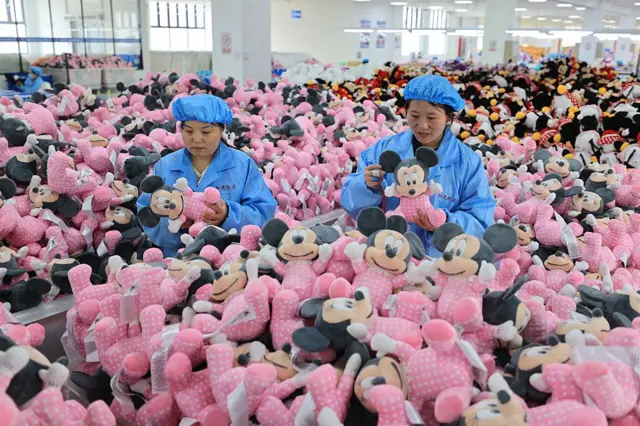
Workers produce plush toys for export to Belt and Road Initiative partner countries at a factory in Lianyungang, Jiangsu province, on April 11, 2025.
Looking ahead, Moody’s expects Beijing to forgo large-scale stimulus packages in favor of surgical, targeted interventions, forecasting full-year GDP growth to settle around 4.6% in 2026. The path to achieving this target remains narrow, relying heavily on exports to offset chronic domestic consumption weakness.
Yue anticipates that China’s trade surplus will continue to expand, with the ultimate trajectory hinging on how tariff landscapes and geopolitical relations evolve with major economies. That view aligns with García-Herrero’s conclusion: evaluating China’s economic trajectory requires looking past headline growth figures to dissect the underlying composition and sustainability of the drivers beneath.