

Memory chip prices surged 300 percent. China’s smartphone makers are facing a brutal collapse
The winter for the global smartphone industry has arrived far sooner and colder than expected, with major markets plunging into a deep freeze long before the seasonal autumn even sets in.
Recent third-quarter reports from leading market research firms—including IDC, Counterpoint Research, and Omdia—all point to an alarming contraction, with global smartphone shipments tumbling between 20% and 22% year-over-year.
Data from IDC shows that worldwide shipment volume shrank to 255.3 million units, evaporating nearly 70 million units compared to the same period last year. This sequential drop marks a historic high since record-keeping began.
China’s massive domestic market has not been spared. According to Counterpoint Research, domestic smartphone shipments have regressed to their lowest levels in 14 years.
IDC figures further reveal that China’s third-quarter shipments hovered around 57.9 million units, a sequential decline of 15.4%. This marks the sixth consecutive quarter of negative growth for the world’s largest smartphone market.

Photo/TuChong Creative
The Dual Blow of Soaring Prices and Extended Replacement Cycles
The fundamental driver behind this market slump is the relentless surge in memory chip prices.
Fueled by the rapid global expansion of AI data center construction, demand for High Bandwidth Memory (HBM) and server-grade DRAM has skyrocketed. This has forced semiconductor manufacturers to reallocate manufacturing capacity and resources, plunging consumer-grade memory and flash storage into severe supply crunches and soaring price tags.
Guo Tianxiang, a senior research manager at IDC China, told the media that the cost of smartphone memory components has spiked by more than 300% over the course of the year.
Faced with such unprecedented cost pressures, handset makers can no longer absorb the expenses internally.
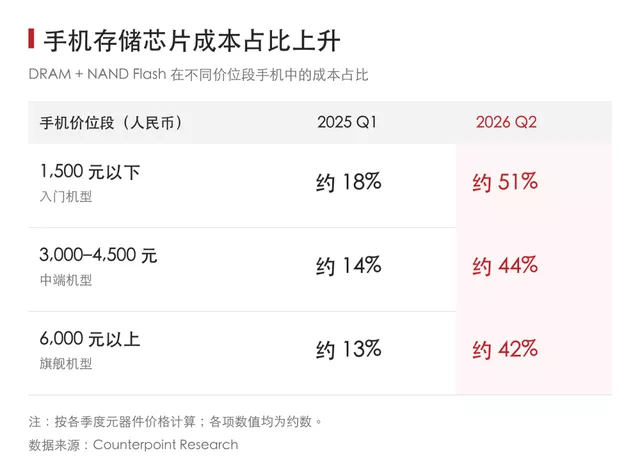
Detailed data provided by Bai Shenghao, a senior analyst at Counterpoint Research, illustrates how the climbing cost of components has battered various product tiers:
Calculated on a quarterly basis, the storage cost share for entry-level phones (priced below 1,500 yuan) surged from approximately 18% in the first quarter of 2025 to 51% by the second quarter of 2026.
Mid-to-high-end devices fared no better. During the same timeframe, the component cost share for phones priced between 3,000 and 4,500 yuan climbed from 14% to 44%, while flagship devices costing over 6,000 yuan saw their cost share rise from 13% to 42%.
Photo/China Newsweek, based on data provided by interviewees
Low-end and mid-range models have absorbed the heaviest blow. Bai noted that even by simultaneously trimming hardware features and raising retail prices, manufacturers are still struggling to keep these budget-friendly product lines out of the red.
Inevitably, these skyrocketing manufacturing costs have been passed down to consumers.
Looking at specific flagships, the starting price of Apple’s Apple iPhone 18 Pro has climbed to 9,999 yuan, an increase of 1,000 yuan from the previous generation. Other brands have similarly shattered their usual habits of gradual price reductions: Xiaomi raised prices across the entire Xiaomi 17 Ultra lineup by 1,000 yuan, while Huawei hiked prices on select models of its nova 16 series by 200 to 400 yuan.
Compounding the crisis, the market has entered a natural seasonal lull for device upgrades.
IDC’s Guo points out that the most recent wave of upgrade peaks occurred between 2024 and the first half of 2025, naturally giving way to an upgrade trough spanning 2026 and 2027.
He argues that the primary catalyst for the current market decay stems from suppressed consumer demand—buyers are increasingly inclined to delay purchases, skip upgrades entirely, or turn to the secondhand market in response to inflated price tags.
Counterpoint’s survey results show that among consumers planning to upgrade within six months, 63% have noticed rising retail prices, with the awareness rate among domestic Chinese consumers reaching a staggering 81%. To cope with the hikes, buyers are extending the lifespans of their current phones, prioritizing cost-performance ratios, or opting for refurbished devices.
It is worth noting that dropping consumer purchasing desire is merely the visible symptom of a broader shipment collapse.
Industry shipments measure supplies shipped from manufacturers to retail channels rather than actual units purchased by end-users.
As shipment volumes plummet, hardware makers are actively scaling back their supply volumes.
IDC’s Guo revealed that current manufacturer supply strategies are largely concentrated on two categories: legacy models with unadjusted price tags, and low-end devices whose original pricing can no longer cover production costs.
Put differently, amid persistent cost hikes, many handset models are no longer economically viable to ship at their original prices.
Industry leaders have already initiated tactical adjustments.
According to Counterpoint’s report, Xiaomi is dialing back investments in low-priced phones and non-strategic overseas markets while raising its average selling prices and strictly controlling shipment plans to avoid launching thin-margin products during high-cost cycles. OPPO is optimizing its product portfolio across its core OPPO, OnePlus, and realme brands to eliminate internal overlap, channeling resources toward more profitable markets and models. Vivo is similarly restructuring its geographic footprint, prioritizing core markets like China and India while strengthening its mid-to-high-end product lineups.
Observations by Omdia confirm this trend, with several manufacturers streamlining the features, color options, and storage configurations of low- and mid-tier devices to redirect resources toward flagship product lines.
This dynamic mirrors what Counterpoint Research senior analyst Lin Keyu describes as an “interlocking chain reaction”—price hikes spark shrinking consumer demand, sales tumble accordingly, which in turn forces brands to proactively curtail production supplies.
The Rocky Road Toward High-End Transitions
For manufacturers, strategically contracting shipments of low-margin products may alleviate short-term operational pressures, but it offers no clear pathway to unlocking new growth.
In past industry battles, scale has always been the decisive factor.
Expanding shipment volumes remains essential for spreading research and development costs, strengthening supply chain bargaining power, and defending distribution channels and user bases.
Particularly for brands relying on budget and mid-tier products to capture market share, scale serves not only as a source of market dominance but also as a crucial pillar of supply chain competitiveness.
Today, this competitive paradigm faces severe headwinds.
The most acute headache is that cost pressures triggered by soaring semiconductor prices show little sign of easing in the near term.
TrendForce projects that contract prices for conventional DRAM and NAND Flash will continue to climb sequentially in the fourth quarter, with projected increases of 10%-15% and 15%-20%, respectively.
Although the rate of increase may narrow, sustained demand for AI servers will continue to absorb semiconductor manufacturing capacity. This implies that supply crunches could persist through 2027, leaving consumer-grade chip cost burdens difficult to shake off.
Regarding the outlook for China’s smartphone market through the fourth quarter and into 2027, IDC’s Guo predicts a continuation of year-over-year declines. Counterpoint’s Lin is even more pessimistic, judging that market performance in 2027 will fail to surpass this year’s figures and could potentially sink into deeper deterioration.
This signals that handset makers must prepare not just for a single quarter of sluggish sales, but for a prolonged and grueling strategic adjustment cycle.
Judging by current market conditions, moving upmarket into the high-end segment appears to be a viable option.
Compared to low- and mid-tier products, flagship devices command more flexible pricing room, while differentiating strengths in branding, software ecosystems, and imaging systems help brands sustain price premiums.
Yet, pivoting upscale is far from a smooth ride.
For brands whose market standing was built on budget and mid-range volumes, reducing shipments may pad profits in the short term, but it risks handing competitors a golden opportunity to poach retail channels and users.
For instance, Counterpoint notes that Samsung Samsung has maintained relatively stable mid-range supplies across select emerging economies, creating openings for the global giant to expand its market share as Chinese competitors retreat.
Zhong Xiaolei, a senior analyst at Omdia, emphasizes that cutting shipments to protect profit margins carries long-term risks. Once brand awareness fades, corporate influence and channel leverage erode, and rebuilding those advantages can take years of sustained investment.
More critically, total capacity in the high-end market will not expand out of thin air simply because every manufacturer pivots upward simultaneously.
For brands that have yet to build up genuine high-end brand equity, enticing consumers accustomed to spending 2,000 yuan to upgrade to 4,000 yuan or higher cannot be achieved simply by ticking off a few spec boxes or releasing a single flagship device.
This demands that product innovation carry genuine, disruptive weight.
In recent years, manufacturers have poured relentless investments into imaging capabilities, foldable screen technology, and artificial intelligence features, hoping to awaken dormant consumer upgrade desires with entirely fresh user experiences.
Whether these innovations can successfully ignite a fresh wave of upgrades, however, remains an open question.