
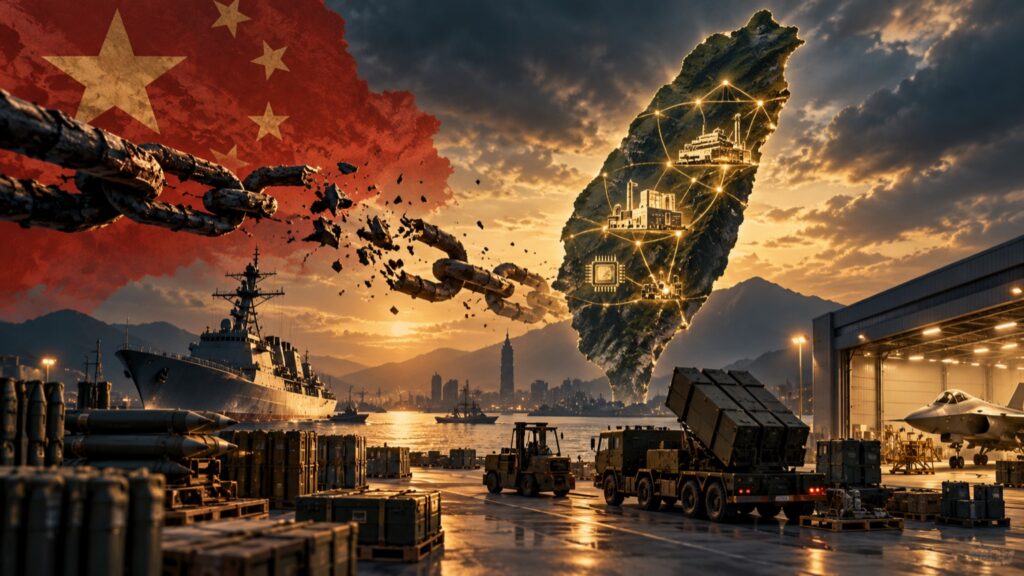
Taiwan wants a China-free defense supply chain. A $350 billion budget is just the start
In mid-October, a three-day US-Taiwan Defense Industry Conference took place in Williamsburg, Virginia, bringing together defense officials and industry leaders. During the gathering, ROC Deputy Minister of National Defense for Armaments, General Chung Shu-ming, delivered a key address outlining Taipei’s strategic responses to escalating security pressures and its push for an independent defense industrial ecosystem.
— Voice of America (@VOAChinese) October 20, 2026
Hosted by the US-Taiwan Business Council (USTBC), the high-profile annual conference served as a platform for Taipei to detail its defense modernization plans under the theme “Secure Indo-Pacific, Resilient Taiwan.”
According to details released by the business council, General Chung emphasized that Taiwan’s military strategy remains rooted in deterrence and defense denial. The island’s operational focus centers on multi-domain denial capabilities, force preservation, rapid response mechanisms, and a society-wide sustainable defense framework—tested annually through the live-fire Han Kuang exercises.
Chung pointed to a sharp escalation in military pressure from Beijing. Government statistics show that in the first nine months of 2026 alone, Chinese military aircraft crossed the Taiwan Strait median line and entered Taiwan’s air defense identification zone 849 times. Over the same period, Chinese naval vessels conducted 1,662 similar sorties. Furthermore, China Coast Guard ships intruded into restricted waters near Taiwan’s outlying islands 23 times—a fivefold increase from the previous year—including a first-ever “special law enforcement operation” off Taiwan’s eastern coast in June.
From Taipei’s perspective, a conflict would breach the first island chain, allowing Beijing to project power deep into the Western Pacific, directly threatening Japan and the Philippines while upending the regional security architecture. Such a scenario would force Washington to commit substantial resources to stabilize the Indo-Pacific. For Taiwan, the implications extend from maritime shipping lanes and critical semiconductor supply chains to the broader stability of global commerce.
To counter these growing risks, Taipei is dramatically ramping up military expenditures. Chung revealed that Taiwan’s defense budget for next year will reach $35 billion, accounting for roughly 3.93% of its gross domestic product. The island aims to push defense spending past 5% of GDP by 2030. These funds will target advanced equipment procurement, localized manufacturing, and combat readiness. Key areas of collaboration with the United States include uncrewed systems, artificial intelligence, and the island’s multi-layered air defense network, collectively aimed at establishing a “China-free” regional defense supply chain.
Speaking at a panel session during the conference, Chen Kuan-ting, a lawmaker from Taiwan’s ruling Democratic Progressive Party (DPP) and a member of the parliamentary foreign defense committee, noted that Beijing has successfully normalized its gray-zone tactics and military pressure since 2022. He argued that Taiwan’s policy response must be two-pronged: designing long-term strategies for overarching threats while securing immediate, flexible resources to manage daily harassment.
According to a statement from the DPP’s US mission, Chen advocated for lowering regulatory barriers to allow local defense startups to participate in government contracting, bypassing the often sluggish timelines of traditional foreign military sales. By exploring Direct Commercial Sales (DCS) channels and expanding co-production agreements with international partners, Taiwan hopes to accelerate equipment delivery.
“Our defense industry was once quite closed off, but we are now opening doors to all forces willing to contribute to Taiwan’s security,” Chen said, pointing to the Taiwan Ministry of National Defense’s newly launched innovation portal designed to streamline public-private and international defense partnerships.
The three-day closed-door conference brought together senior government officials, military analysts, and defense contractors from both sides to evaluate 2027 threat timelines, total defense resilience, and lessons drawn from ongoing conflicts in Ukraine and the Middle East.