

China is collecting 100 yuan for unemployment insurance and spending 97.40 of it. The buffer is running dry
According to data released by the Ministry of Human Resources and Social Security (MHRSS), China’s combined cumulative surplus across its three major social security funds—pension, medical, and unemployment—stood at a hefty 11.2 trillion yuan ($1.57 trillion) as of the end of September.
Yet the standalone unemployment insurance fund tells a starkly different, far less affluent story. During the first eight months of the year, the fund pulled in 145.3 billion yuan while bleeding 141.56 billion yuan in payouts. Put simply, for every 100 yuan entering the pool, 97.40 yuan was immediately consumed, leaving a razor-thin surplus cushion of less than 3 yuan.
What worries economists most is the fading momentum of growth. While the fund eked out a modest 620 million yuan surplus in May, and expanded that cushion to 3.74 billion yuan by August, a closer look at the monthly breakdown reveals a decelerating accumulation rate. After additions peaked with a jump of 2.38 billion yuan in July, the monthly surplus plunged back down to just 320 million yuan in August.
This fleeting expansion failed to translate into durable financial momentum. With spending pressures remaining relentless, the fund’s tightrope walk appears locked in place.
Meanwhile, the system’s coverage net continues to expand, with the number of insured workers climbing from roughly 230 million at the end of 2021 to 251 million by September 2026.

Despite a broader participation base, the fund’s reserves have failed to thicken proportionally. Where is the money actually going, and how can the system strike a sustainable balance between safeguarding livelihoods and stimulating employment going forward?
The Trap of Revenue-Expenditure Imbalance
Tang Jue, an associate professor at the School of Public Administration at Shanghai University of Finance and Economics, noted in an interview that “the tight balance of the unemployment insurance fund should be viewed as a long-term structural trend.”
A longer-term timeline shows that spending growth has consistently outpaced revenue growth every year since 2022.
A review of national unemployment insurance data from 2022 to 2025 reveals a temporary dip in expenditures in 2023, driven largely by the scaling down of intensive pandemic-control outlays. However, in 2022, 2024, and 2025 alike, the growth rate of spending significantly outpaced revenue gains.
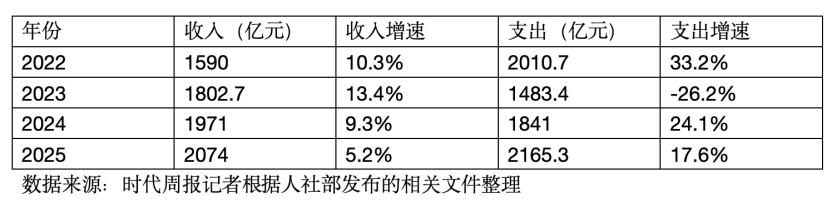
After cycling through multiple rounds of razor-thin margins and operational deficits, the system’s buffer zone has been systematically squeezed down, even as its roster of contributors expands.
Assessing the fund’s solvency requires looking beyond annual income and outlays to examine how many months of reserves remain on hand—known as reserve months.
After briefly rebounding to 321.3 billion yuan in 2023—giving the fund nearly 26 months of payout runway—the cushion quickly deteriorated. Reserves shrank to about 22 months of coverage in 2024, before tipping into an outright annual deficit of 9.1 billion yuan in 2025, which saw the safety buffer collapse to roughly 18 months.
The fund’s margin for error is shrinking by the day. Even minor economic fluctuations—whether revenue losses triggered by fee cuts or spikes in payouts driven by rising unemployment—are now enough to shove cumulative reserves straight into the red.
Long-term actuarial projections by the Social Security Research Center at Wuhan University suggest that if flexible and gig economy workers continue to be locked out of the unemployment insurance framework, the fund’s expenditure growth will vastly outstrip its income, driving the system into permanent deficit by 2044.
To grasp the core of this systemic squeeze, one must examine both sides of the ledger: precisely where is the cash flowing, and why is revenue continually lagging behind?
Where Does the Money Go?
Fund expenditures fall largely into two buckets: direct payouts to unemployed individuals, and subsidies aimed at helping employers protect jobs and upgrade workforce skills. The former commands the lion’s share.
Taking fiscal 2025 as an example, total national fund expenditures hit 216.5 billion yuan. Of that total, basic livelihood guarantees—encompassing regular jobless benefits and employer-sponsored medical insurance contributions—ate up 161.6 billion yuan, or roughly 74.6% of the total.
The remainder went toward keeping businesses afloat, including 33.6 billion yuan in job-retention rebates and 1.7 billion yuan in one-time expansion subsidies designed to incentivize companies against layoffs. Another 4 billion yuan was channeled directly to individuals as skill-enhancement grants.
While outlays march steadily upward, the revenue side of the ledger has failed to keep pace.
A breakdown of the 2074.73 billion yuan in total revenue generated in 2025 shows that 1.955 trillion yuan came from insurance premiums, 767 million yuan from fiscal subsidies, 5.444 billion yuan from interest earnings, and 5.711 billion yuan from other sources. In short, roughly 94.3 yuan out of every hundred collected originated directly from payroll premiums.
This heavy reliance on premiums, compounded by a long-standing low contribution rate hovering around 1%, severely caps revenue growth. MHRSS figures show that a policy lowering insurance fee rates saved businesses 187.4 billion yuan in 2025—a revenue reduction equivalent to a staggering 95.8% of that year’s total premium collections.
Caught between depressed fee rates and government-mandated corporate relief, an institutional mismatch between incoming revenues and outgoing payouts is virtually inevitable.
Yet the policy’s efficacy cannot be judged solely through the narrow lens of a single fund’s balance sheet. In theory, if job-retention rebates work as intended, they should safeguard employment, protect tax receipts, stabilize workers’ income expectations, and ultimately stimulate consumer spending.
However, empirical research conducted by Tang Jue’s team using data from listed Chinese firms suggests that these corporate subsidies have played an extremely limited role in actually curbing layoffs.
“The practical scope of application for this policy is quite narrow,” Tang noted. The restrictions begin with strict access criteria: the State Council sets annual urban unemployment rate targets, and local governments establish corresponding corporate layoff ceilings—typically around 5.5%. Only companies whose layoff rates stay beneath this threshold qualify for rebates.
Consequently, the policy largely rewards firms that were already stable and cutting few jobs in the first place. For companies severely overshooting the layoff threshold, the rebate amounts are a drop in the bucket compared to their overall labor costs, doing little to alter corporate downsizing strategies.
Tang added that because layoff rates are calculated using the number of unemployment insurance enrollees as a denominator, firms can technically manipulate their enrollment headcounts to make their layoff metrics look compliant on paper.
The Real-World Impact of Financial Strain
What do these widening fiscal cracks mean for current and prospective job seekers?
“Nationwide, we should not see delayed benefit disbursements or reduced payout standards anytime soon,” Tang said, pointing out that cumulative national reserves still comfortably top 300 billion yuan.
Yet cumulative reserves do not sit in a single, cross-provincial liquidity pool. Whether local authorities can disburse full benefits on time depends entirely on the reserve health of their own provincial funds.
State regulations dictate that regions offering job-retention rebates and skill-enhancement subsidies must maintain a prior-year-end reserve coverage ratio of at least 12 months. Several jurisdictions have already slipped beneath that statutory safety line, rendering them legally barred from running such discretionary programs for two consecutive years.
“The primary objective of establishing unemployment insurance is to protect the basic survival of the unemployed,” Tang explained. Job-retention rebates and vocational training subsidies are secondary safeguards built on top of that foundational floor.
In other words, ensuring the punctual and full payment of core unemployment benefits remains a non-negotiable legal red line. When regional reserve coverage drops below one year, the first casualties are discretionary outlays like corporate rebates and training grants, rather than basic jobless checks.
“Expanding the coverage of unemployment benefits and raising payout standards is of major significance for stimulating consumption,” Tang suggested. Given that job-retention rebates have underperformed expectations, policymakers should consider scaling back or phasing out the program altogether, redirecting those funds back toward direct worker livelihood protections.
While core jobless benefits face no immediate threat, localized fund deficits directly impair discretionary spending: financially strained regions may slash or suspend job-retention and training subsidies, threatening to widen regional disparities in social safety nets.
In practice, some of these geographical gaps are already being bridged. In Sichuan province, for instance, provincial-level pooling has lifted local jobless benefit standards from 80% to 90% of the local minimum wage, gradually narrowing internal disparities.
Inter-provincial divides, however, remain entrenched. Tang recommends modeling unemployment insurance reform after the national pooling system currently used for enterprise employee pensions, establishing a nationwide fiscal transfer mechanism to channel surplus funds from wealthy provinces to deficit-laden regions on a rational basis.
At the same time, policymakers must refine dynamic fee-adjustment mechanisms, comprehensively evaluating employment trends and fund balances to automatically trigger rate reforms whenever reserve months dip below predefined safety thresholds.