
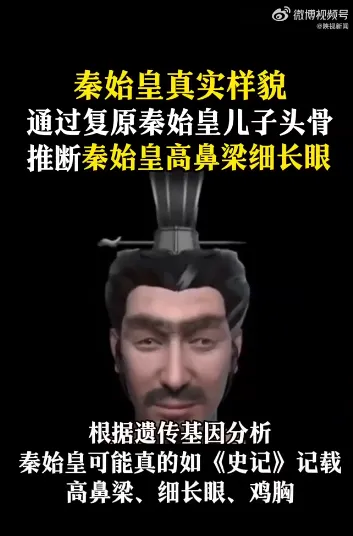
Scientists reconstructed the face of an ancient emperor’s son. The internet found a celebrity lookalike
A research team from Northwest University has used craniofacial reconstruction technology to recreate the face of a young man whose remains were discovered in a subsidiary burial pit east of the Mausoleum of the First Emperor of Qin. On November 8, the topic surged to the number-one spot on Weibo’s trending list. Experts speculate that the man was likely a son of Qin Shi Huang, China’s first emperor, who perished during the purge led by his successor, Emperor Qin Er Shi.

The individual was approximately 30 years old at the time of his death. A bronze arrowhead was embedded in the right temporal bone of his skull, and his head and limbs had been dismembered before being placed inside a coffin. The resulting facial reconstruction reveals almond-shaped eyes and a high bridge of the nose—facial contours that bear a resemblance to historical descriptions of Qin Shi Huang in the ancient text Records of the Grand Historian, which characterizes the emperor as having a saddle-like nose and elongated eyes. The tomb also yielded gold, silver, and bronze swords, alongside other high-ranking burial goods that further reinforce the royal identity of the occupant.
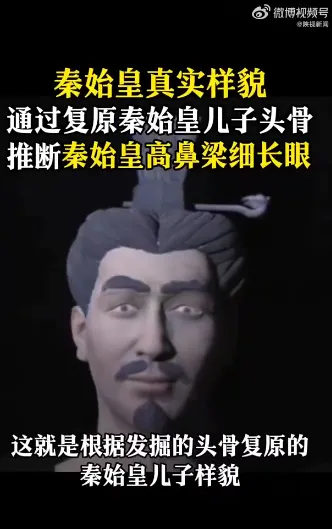
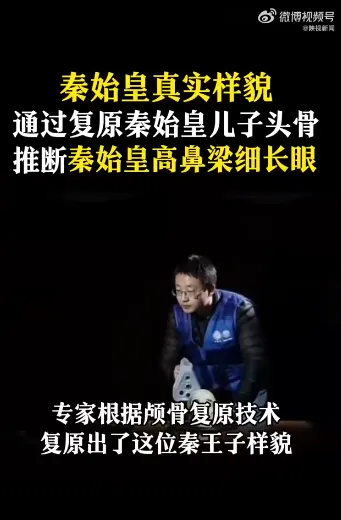
Researchers urge a rational view of the reconstruction results. Currently, no DNA evidence has definitively confirmed the tomb occupant’s identity, leaving the conclusion as an archaeological hypothesis. Elements in the rendered image such as facial hair, hairstyle, and soft tissues involve artistic extrapolation, carrying an estimated reliability of around 80 percent rather than serving as an absolute likeness.
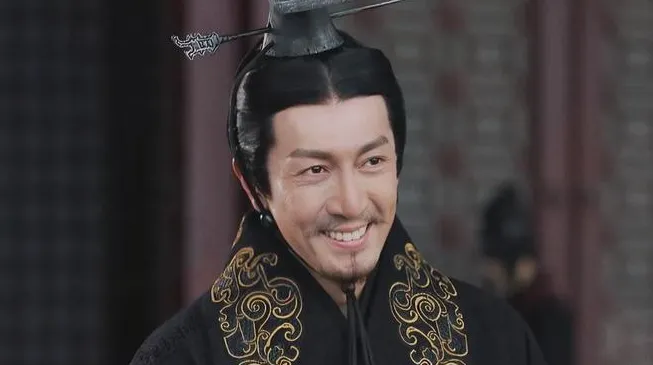
Public reaction on social media took an unexpected turn shortly after the images were released. Many internet users stared at the reconstruction for a few moments before connecting it to a familiar face: actor Zhang Luyi. Some users juxtaposed the generated image with stills from historical television dramas, arguing that critics who previously attacked the director’s casting choices owed an apology. Others joked that the director might not have possessed exceptional casting foresight, but rather obtained the archaeological briefing in advance.
Zhang Luyi portrayed Emperor Qin Shi Huang in the 2020 television series The Legend of Qin. The drama debuted on the review platform Douban with a score of 8.9, though its rating eventually dropped to around 5.8 by the end of its broadcast. Viewership complaints primarily focused on age casting: Zhang was 40 years old at the time of filming and was tasked with portraying the emperor starting from the age of 13, a generational gap that audiences found jarring. However, as the plot progressed, public opinion fractured. During a tense sequence depicting the suppression of a palace rebellion, his physical delivery—clenching a jade scepter until visible veins strained across his hands—won widespread approval, prompting live chat comments declaring that this finally captured the true aura of a founding emperor.

Born in Beijing in 1980, Zhang graduated from the Directing Department of the Central Academy of Drama before pursuing a Master of Fine Arts at Peking University. He entered the industry in 2005, though he did not gain widespread recognition among viewers until his 2014 starring role in the espionage drama Scarlet, which scored 9.1 on Douban. His subsequent credits include supporting roles in productions like Three Brothers in the Line of Fire. In 2023, he portrayed the nanotech scientist Wang Miao in the television adaptation of The Three-Body Problem, receiving generally favorable reviews.
Historical records offer no definitive consensus regarding the actual physical appearance of Qin Shi Huang. The Records of the Grand Historian describes him with a saddle-like nose, long eyes, the chest of a bird of prey, and the voice of a jackal—descriptions that later scholars have interpreted in vastly different ways. The modern scholar Guo Moruo once theorized that the emperor possessed physiological abnormalities, suggesting the saddle nose indicated a nasal deformity, the bird-like chest pointed to pigeon breast, and the jackal voice stemmed from chronic laryngitis. Conversely, the Song dynasty encyclopedia Taiping Yulan presents an alternative portrait featuring a tiger-like mouth, prominent cranial bones, large eyes, a towering nose, and a height equivalent to roughly two meters under Qin dynasty measurements. Placed side by side, the two descriptions bear little resemblance to the same person. Standard textbook illustrations of the emperor are similarly derived from Tang dynasty imperial portraits rather than contemporary observations.
The fact that this particular facial reconstruction soared to the top of trending topics stems precisely from its ability to provide a tangible, visual answer—even if that answer remains speculative and circumstantial. When internet users share the image of the almond-eyed face, they are less concerned with verifying the precise visage of an ancient emperor than with utilizing a concrete human likeness to grasp at a figure obscured by the mists of time.