
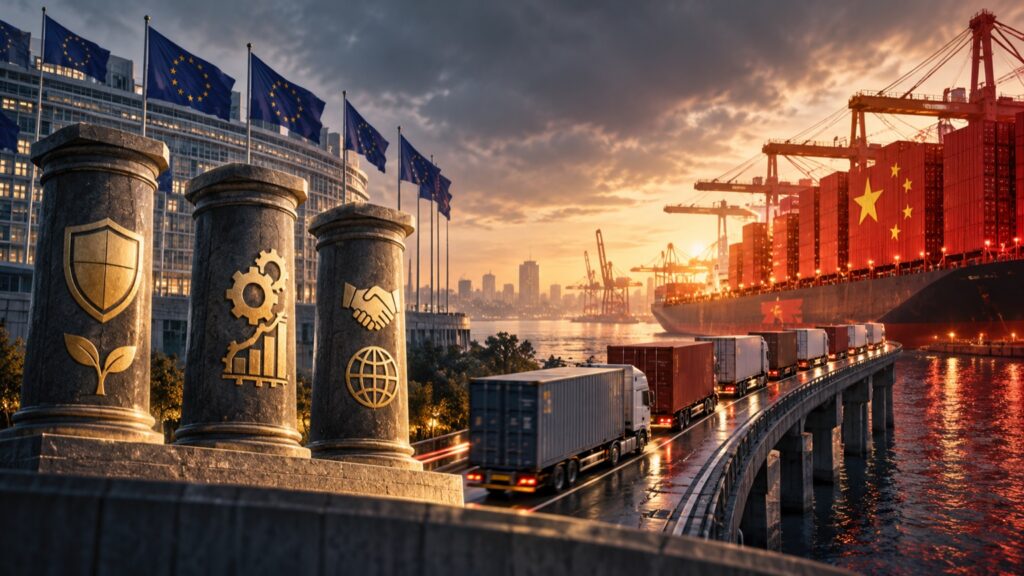
Brussels faces a daily trade deficit of 1 billion euros with China. Europe is launching a three-pillar offensive
— RFI 华语 – 法国国际广播电台 (@RFI_Cn) October 17, 2026
European Commission President Ursula von der Leyen declared on Friday that the massive trade deficit between the European Union and China has reached an unsustainable tipping point, prompting member states to rally behind a sweeping, three-pillar strategy that far exceeds previous attempts to curb Chinese imports.
Speaking at a post-summit press conference, von der Leyen noted that existing bilateral agreements fall woefully short of addressing the deep structural imbalances in EU-China trade, with the bloc’s daily trade deficit with China now surpassing 1 billion euros.
She emphasized that this trade imbalance has become a core threat to European competitiveness. National leaders engaged in deep discussions over the persistent asymmetries in economic relations, displaying a rare and unified front. While acknowledging China’s status as a vital trading partner, von der Leyen insisted that the relationship must rest on fairness, equilibrium, and reciprocity—demanding profound and accelerated structural adjustments.
Detailing the economic hemorrhage, she reiterated that a daily deficit exceeding 1 billion euros throughout 2025 and continuing into 2026 is fundamentally driven by structural flaws. To counter this, the EU’s new strategy rests on three distinct pillars. The first focuses on results-oriented dialogue. Ongoing negotiations with Beijing have yielded initial concessions: China has agreed for the first time to modestly adjust its hybrid vehicle exports, European industrial and agricultural goods have secured better market access, and export controls on critical raw materials like rare earths and magnets have become more predictable.
Von der Leyen stressed, however, that progress in the automotive sector—encompassing both pure electric and hybrid models—is nowhere near enough to resolve the underlying structural deficit. This necessitates the second pillar: fully deploying existing trade defense instruments. European industrial lobbies have increasingly pressured Brussels to act, and the bloc has pledged to respond with expanded safeguard measures.
The third pillar centers on developing novel trade instruments to tackle systemic imbalances. The guiding principle is straightforward: ending reliance on single-source supply chains. In December, the European Commission plans to launch an initiative dubbed “DiversifyEU,” designed to accelerate corporate risk mitigation without targeting any single nation. Additionally, the bloc will introduce a “Solidarity Mechanism” to coordinate swift retaliatory actions if individual member states face economic coercion or pressure.
She added that, welcoming proposals put forward by France and Germany, the EU will create a novel mechanism enabling rapid and decisive market-access restrictions when it serves the bloc’s collective interest. These new tools, however, will complement rather than replace current enforcement mechanisms, maximizing the utility of existing trade defenses. Behind these measures lies a revitalized internal unity among EU member states, which was fully demonstrated during the European Council meeting.
Reports indicate that French President Emmanuel Macron told reporters after the summit that the EU should prioritize measures targeting chemicals, plastics, and ferro-alloys. Von der Leyen’s announcements directly echo a joint proposal sent by Paris and Berlin last week, which urged the creation of lightning-fast reaction mechanisms to counter trade disputes, such as swift reciprocal sanctions if a trading partner abruptly cuts off critical raw material supplies.
German Chancellor Friedrich Merz noted that leaders expressed strong support for the Franco-German proposal during Thursday’s discussions. He told reporters that participating parties achieved “surprisingly broad consensus” alongside “sincere, unanimous, and unreserved backing.” Macron added that the EU is steering toward a “more pragmatic trade policy,” signaling a firm willingness to protect domestic industries and economic actors from unfair competition.
Beijing has pushed back strongly against the rhetoric. A spokesperson for China’s Ministry of Commerce stated during a Friday morning press briefing that China has taken note of the reports. The spokesperson emphasized that the understanding reached between China and the EU on hybrid vehicles is anchored on three foundational principles: compliance with World Trade Organization rules, a fact-based approach, and non-discrimination. This agreement embodies mutual benefit, safeguards the legitimate rights and interests of Chinese enterprises, addresses European concerns, and prevents further escalation of trade frictions. Characterizing the agreement as the result of European pressure is entirely baseless, the spokesperson added.
The ministry official further asserted that bridging differences requires genuine goodwill from both sides. The EU should not expect to extract concessions through pressure, nor should it underestimate Beijing’s resolve and capacity to safeguard its own rights and interests. China has called on the EU to work hand in hand to steer bilateral economic and trade relations along a healthy and stable path.