
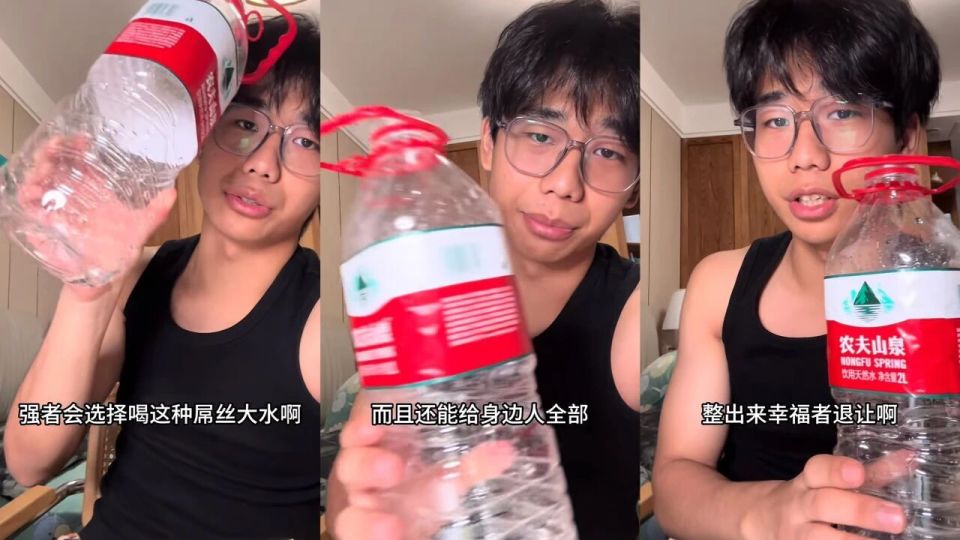
China’s Gen Z is drinking two liters of water to survive capitalism. The internet turned it into a trap
“Hydrating from dawn till dusk makes you feel so clear-headed.”
“Everyone must officially enter the era of hydration.”
······
Amid a blossoming trend of viral internet “theories” sweeping Chinese social media, content creator @Chang’an Erqiu successfully turned the maxim “the weak drown in soft drinks, the strong stick to plain water” into a widespread mantra. The core of this so-called “Big Water Theory” is simple: ditch bubble tea, coffee, and sugary beverages in favor of chugging massive quantities of bottled purified water.
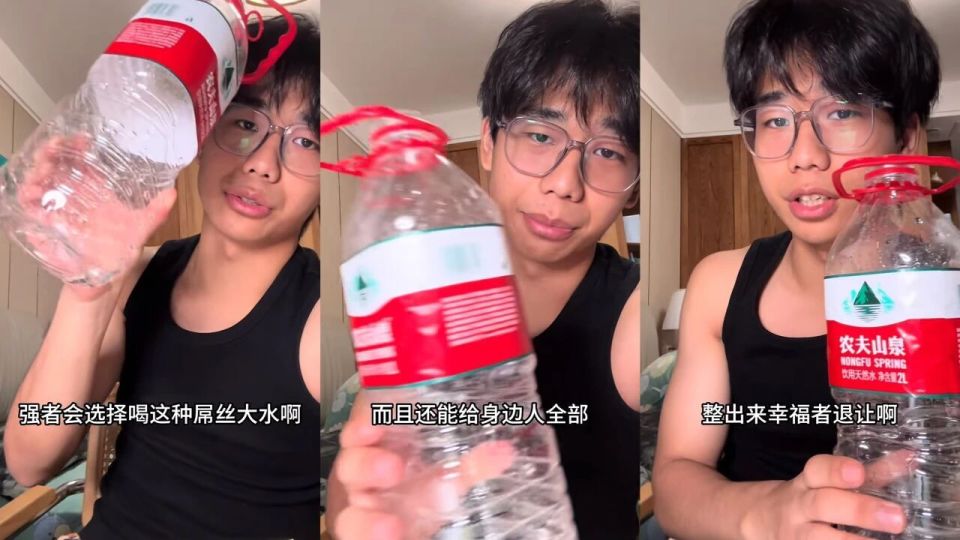
(In late September, the theory entered public consciousness through satirical, exaggerated performances.)
As the Big Water Theory conquered cyberspace, it was quickly joined by the “Lean Muscle Theory” and the “Adequate Sleep Theory,” eventually spawning eccentric spin-offs like the “Strolling Theory” (advocating for aimless wandering outdoors) and the “Oversized Bag Theory” (arguing that bigger bags grant greater psychological security).
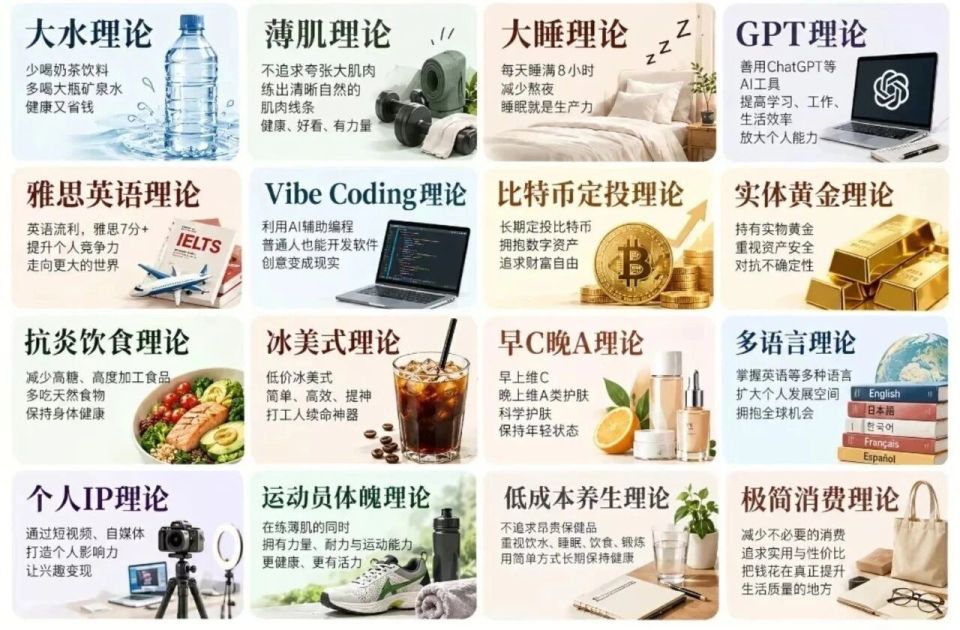
(A collection of various “theories” meticulously compiled by internet users.)
Even as we laughed at the absurdity, many of us quietly went online and ordered a dozen two-liter jugs of mineral water.
It raises a question: why do parents’ decades-long exhortations to drink more water fall on deaf ears, while the Big Water Theory exerts such a magnetic pull?
To understand the Big Water Theory, one must trace the origins of “big water” itself.
Around 2010, the term “big water” began appearing in everyday vernacular with a very specific, gritty meaning. Its cradle was the infamous Sanhe Human Resources Market in Shenzhen’s Longhua district.
Before dawn, the Sanhe market would buzz with frantic energy, first a restless crowd, then rising noise. Thousands of migrant laborers spilled out from hallways, cheap hostels, and makeshift rentals, converging around recruiters to fight for daily-wage gigs. These young job-seekers, hovering on the brink of survival, were either forced there by a lack of educational credentials or had deliberately chosen to opt out of the soul-crushing grind of sweatshops.

(A still from the NHK documentary Sanhe Gods: Young Chinese Day-Laborers Earning 1,500 Yen a Day.)
When their meager savings ran out, Sanhe youths hit “the wall”—a state of homelessness and destitution. “Big water” was one of the three essentials of the “wall-clinging survival kit” they would buy when hitting rock bottom. Unlabeled, unbranded, and sold in 1.5-liter bottles, this cheap water was dirt-cheap and filled an empty stomach.
n
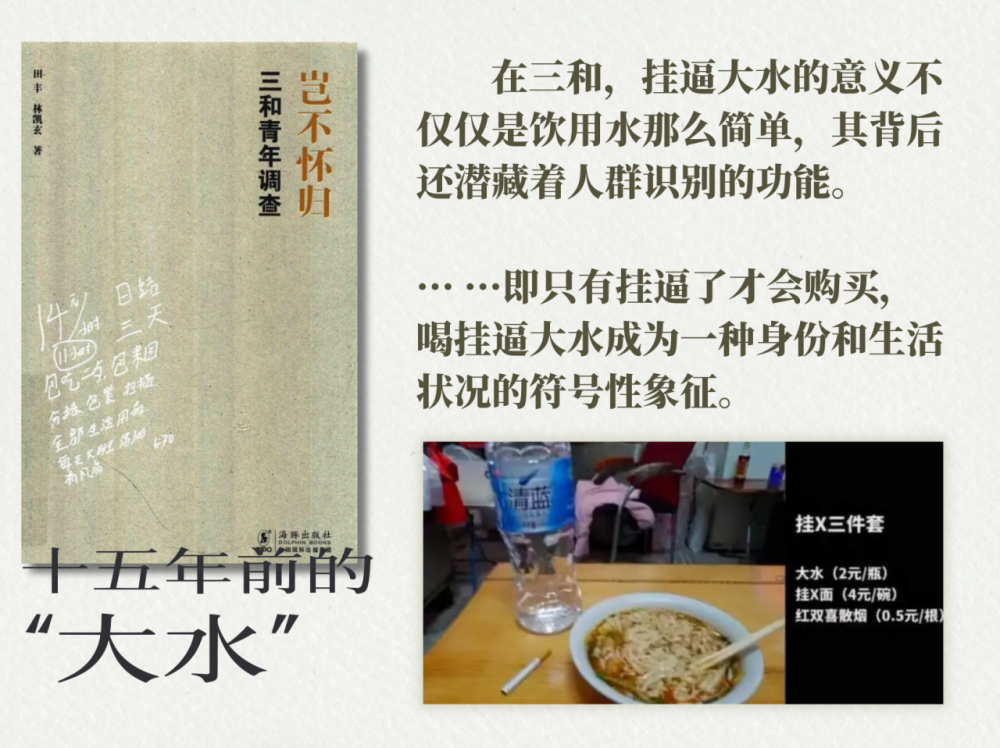
(Field visits revealed that this specific variety of “wall-clinging big water” is sold exclusively around the Sanhe market and nowhere else in Shenzhen.)
Unlike the “wall water” of Sanhe youths, which carried the stigma of desperation and poverty, the Big Water Theory wrapped the practice in positive symbolism. Overnight, it transformed into a badge of identity that mainstream youth eagerly claimed across social media platforms.
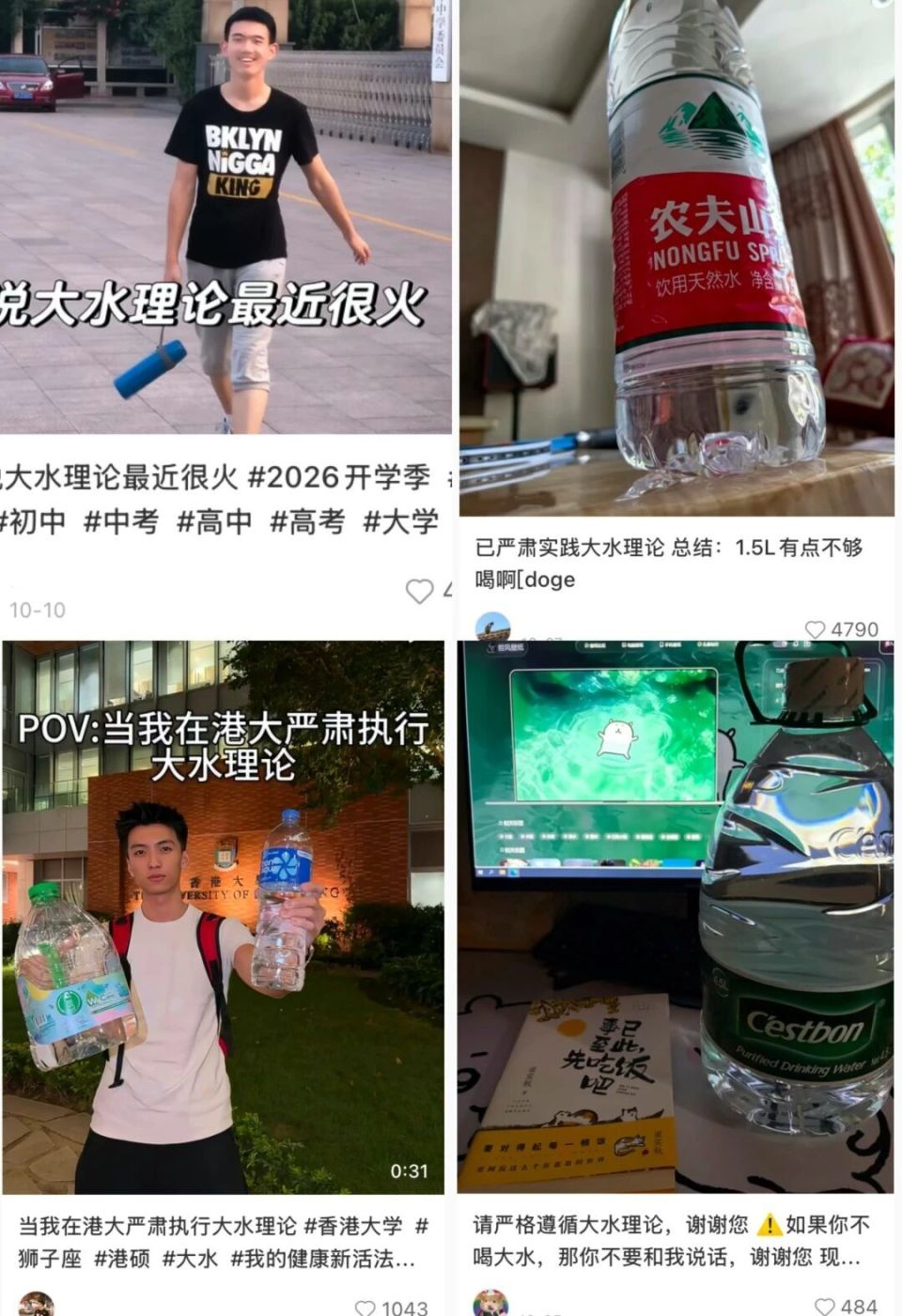
(The younger generation showing off their “big water” consumption on social media.)
As its cultural currency continuously appreciated, the Big Water Theory injected the rustic wisdom of folk culture into the wider public sphere. In an increasingly volatile reality, its low barrier to entry offered a soothing balm akin to sociologist Xiang Biao’s famous philosophical call to “return to your immediate surroundings,” sending a refreshing breeze to an exhausted public.
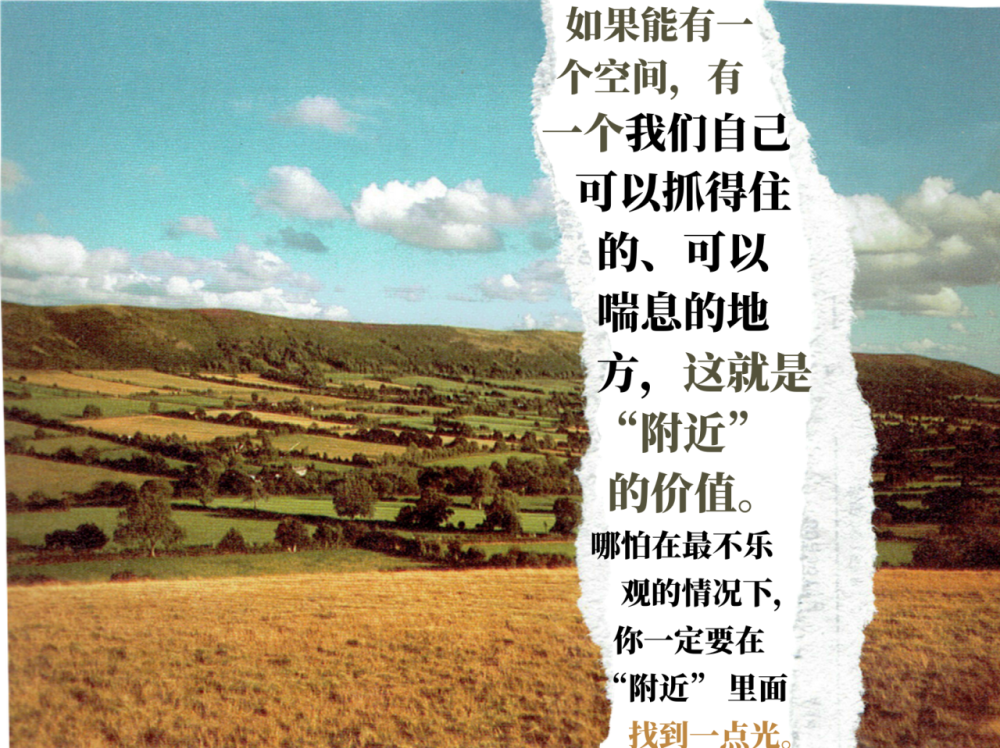
(An excerpt from an interview with sociologist Xiang Biao in Contemporary Youth Research.)
Yet this refreshing breeze did not linger. Influencers and content creators stepped forward to vie for the title of “theory gurus,” accumulating legions of devoted followers. A four-hour deep-dive conversation between lifestyle blogger Alan Shao—who styles himself the “Sovereign of Lean Muscle”—and crypto entrepreneur Justin Sun only poured fuel on the fire, accelerating a trend where literally everything could be gamified into a “theory.”
(Online discourse began peddling the notion that equations are the universal answer to life.)
Content creators churning out gags to amuse the public is a standard feature of the attention economy. What is unsettling, however, is how many extreme voices began pushing the exact same underlying message: if you just follow the formula, you too can become powerful.
Whether framed as earnest advice or absurd jest, the audience’s prompt and eager responses laid bare just how deeply people crave empowerment.
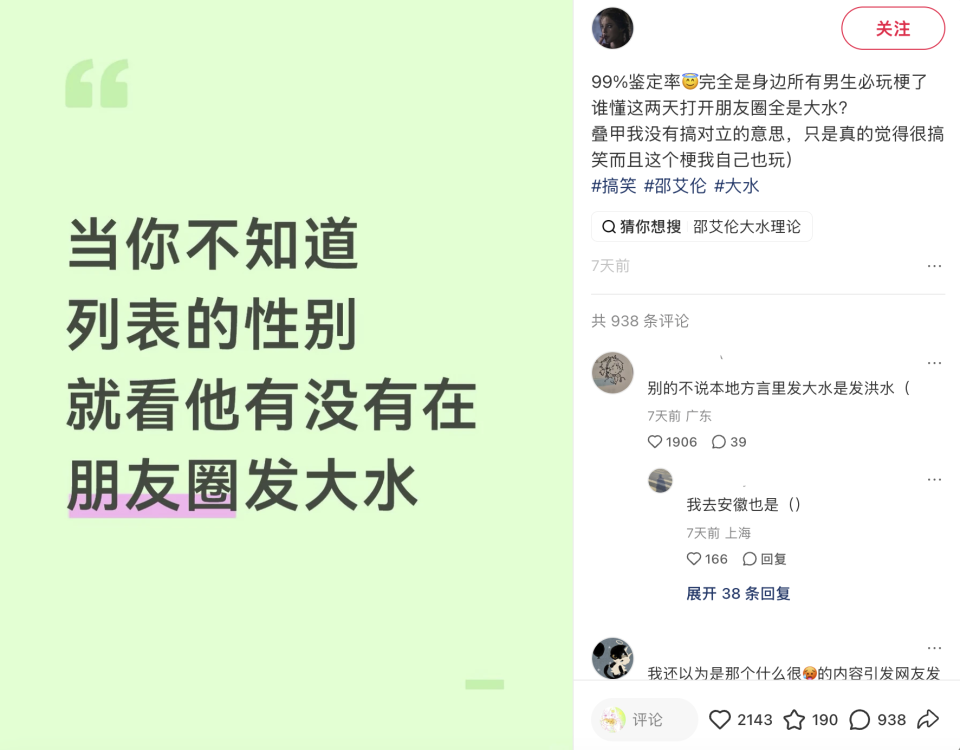
(Posts showing off water bottles, muscle definitions, and workout gear are ubiquitous on social media timelines.)
n
This narrative of self-strengthening via bizarre optimization is hardly unique to China; it echoes across the globe.
In Seoul, 24-hour fitness centers line the streets, and convenience store shelves groan under rows of protein shakes—so much so that residents must actively resist the temptation to work out rather than being lured into laziness.
Meanwhile, Western online forums are gripped by a runaway frenzy of “looksmaxing.” Terrified of involuntary celibacy, young men borrow video game logic to quantify facial features into rigid numerical metrics.
Aspiring to embody the apex predator archetype of the “sigma male,” they convinced themselves that sharper cheekbones were the golden ticket to upward social mobility.
In a bid to match the aesthetic standards of top-tier white male influencers, some even resorted to hammering their own cheekbones with blunt objects, hoping that the bones would heal and knit back together with a more chiseled profile.
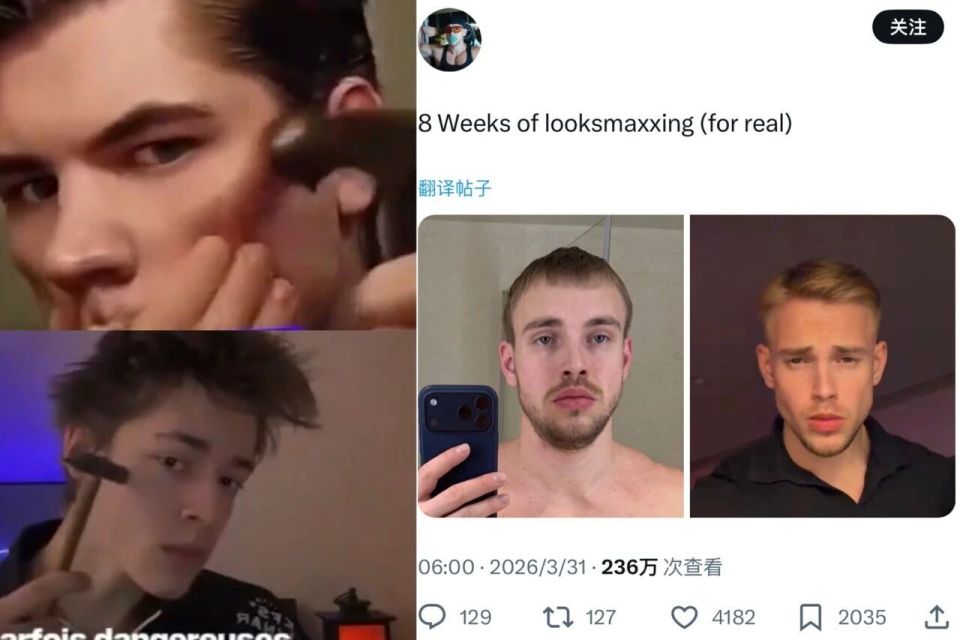
(The looksmaxing movement sweeping through Western youth culture.)
This is the viral phenomenon of “bone-smashing” viewed billions of times online, where thousands of young men mutilate themselves to boost their perceived market value.
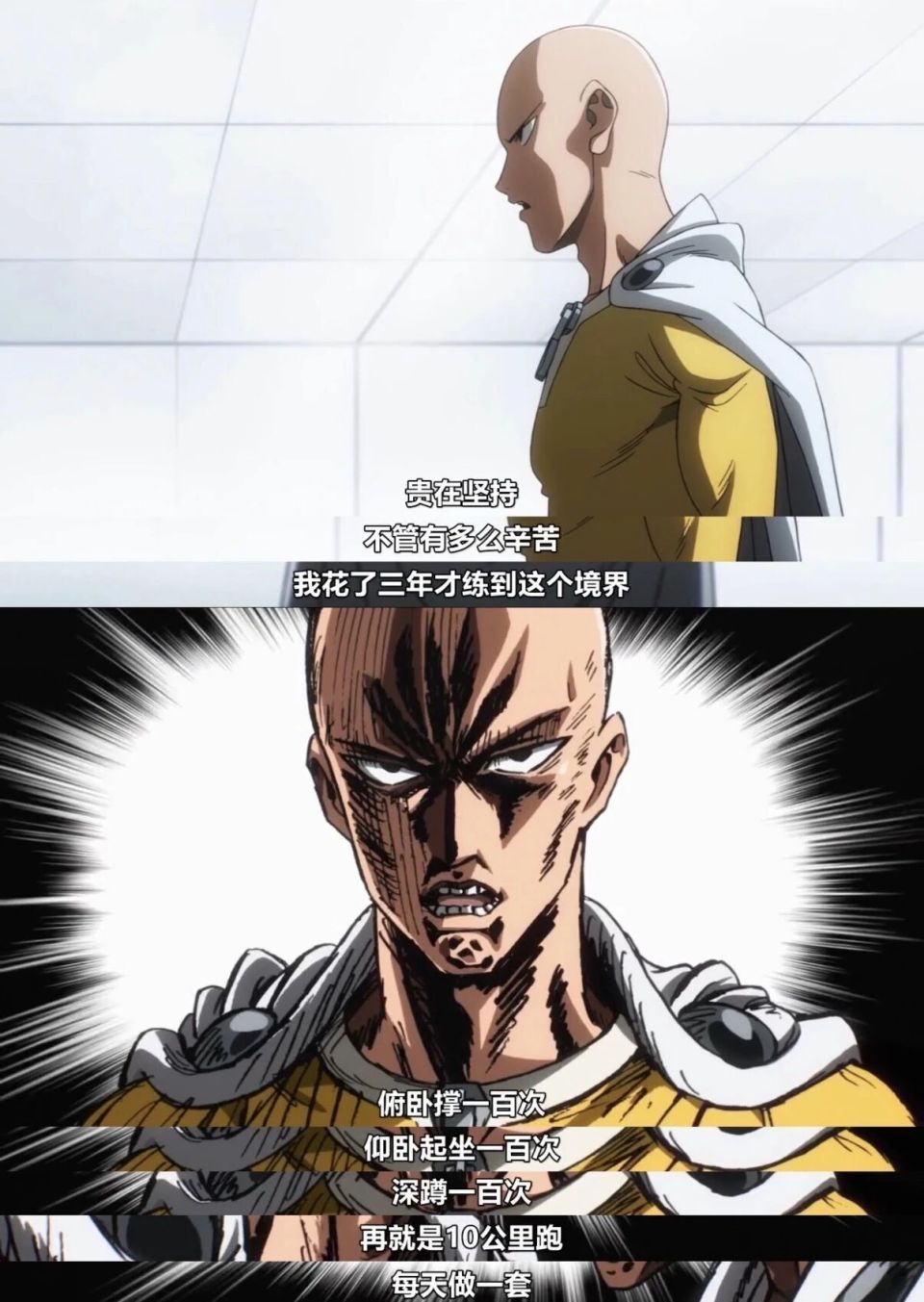
(A classic line from the Japanese anime One-Punch Man: “I lost my hair, but I gained strength.”)
n
Living in an era defined by achievement anxiety, where insecurity clings like a shadow, these bizarre doctrines shriek like sirens: Come on, tie that rope you planned to use to end it all into a stylish neck scarf!
French philosopher Michel Foucault once revealed that modern power does not rely purely on brute coercion; instead, it operates by internalizing norms, prompting individuals to voluntarily police themselves according to prescribed “theories”—a process through which the masses quietly absorb the very ideological apparatus constraining them.
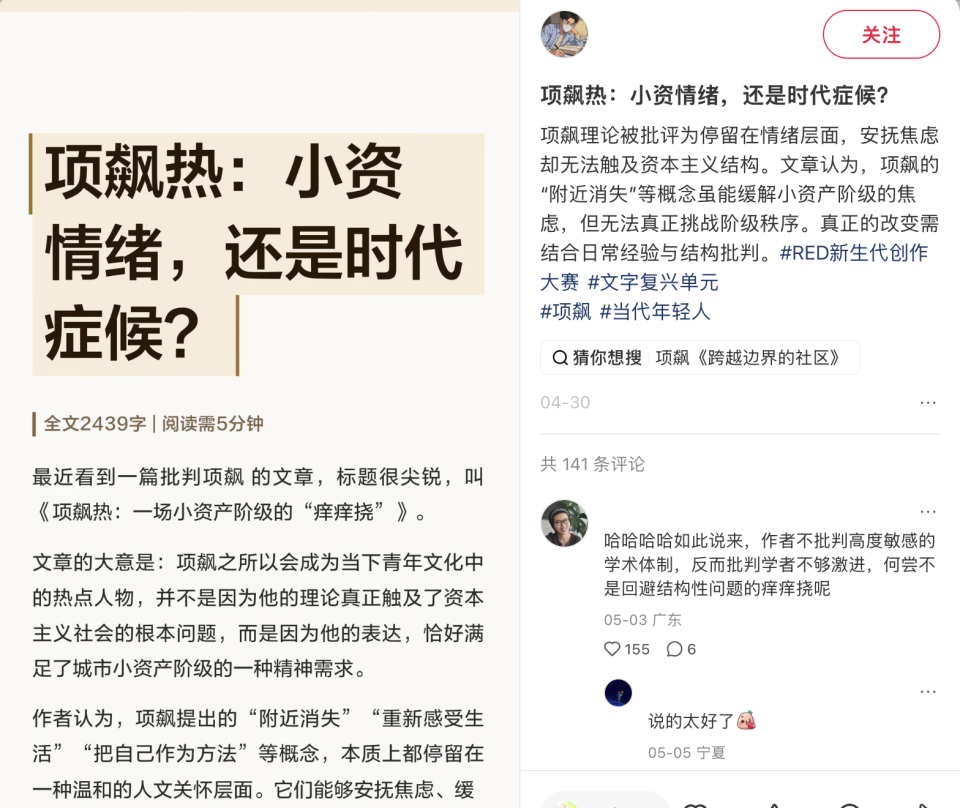
(Some commentators argue that the craze surrounding sociologist Xiang Biao reflects deep-seated youth anxiety rather than tackling structural societal problems.)
Why are we so easily seduced by hyped-up micro-sensations? Fundamentally, internet trends love to scratch the emotional “itch” while entirely ignoring the systemic “pain.”
The mantra that “the strong stick to big water” shifts the spotlight away from “what structural trap am I stuck in?” and onto “who has better self-discipline?” Macroeconomic pressures like rising living costs, shrinking social mobility, and intensifying job competition dissolve into petty vertical comparisons between peers.
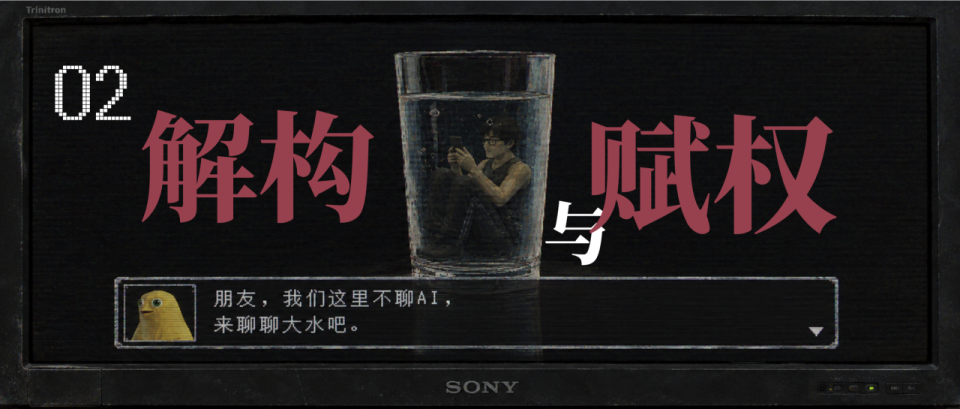
From an academic standpoint, labeling hydration, sleep schedules, and lean muscles as grand “theories” is a misnomer. The promoters of these pseudo-theories simply slap an ideological coat of paint on mundane habits to make them feel natural and inevitable.
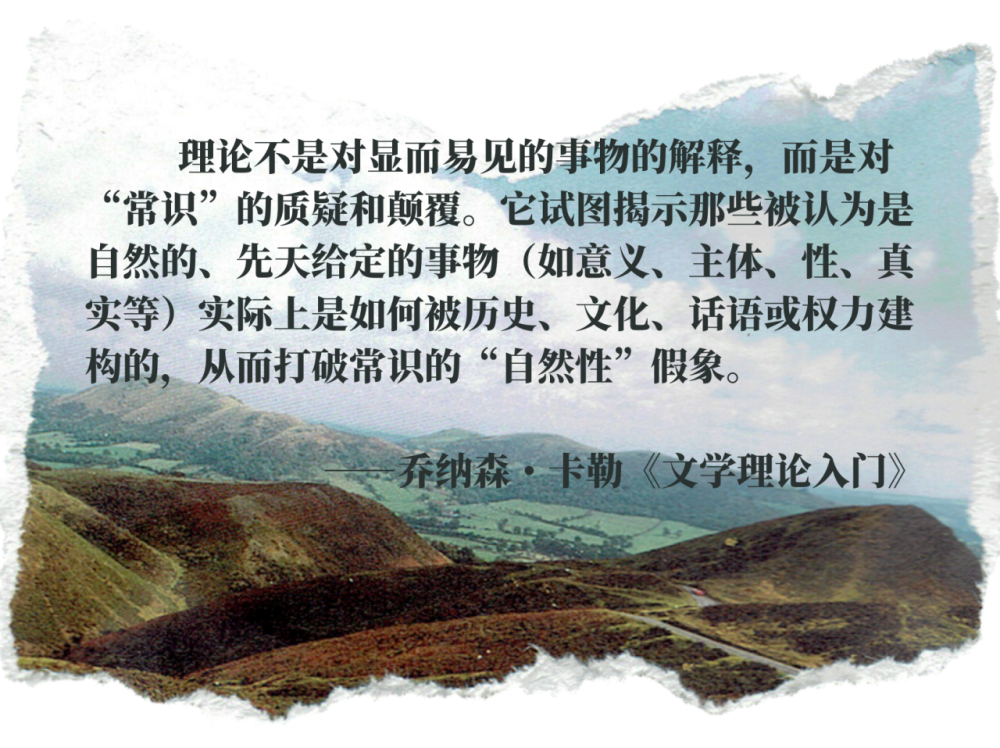
(The academic definition of a genuine “theory.”)
Basic acts of self-care—drinking water, resting, looking after one’s health—are completely gamified once cast as secret weapons for personal greatness. It forces a reflection: are young people caught up in these lifestyle trends engaging in a genuine quest for a more harmonious life, or are they merely performing rituals of social conformity?
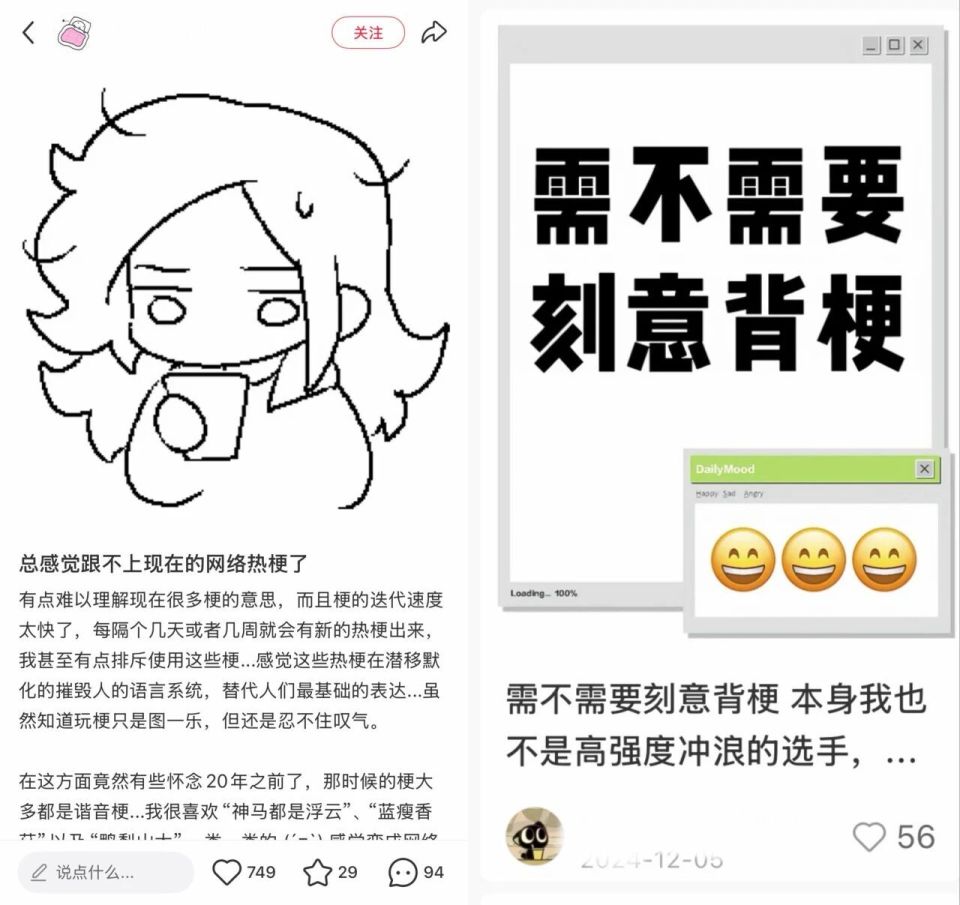
(Commentary discussing the anxiety spawned by viral internet slang.)
Consider the parallel: if traditional consumer culture uses luxury purchases to signal status, what does a sarcastic declaration like “If you don’t drink big water, I won’t talk to you” reveal, other than the smug insularity and exclusionary zeal of a subculture?
In Distinction: A Social Critique of the Judgement of Taste, French sociologist Pierre Bourdieu argued that refined tastes serve as a tool of social stratification, drawing a sharp line between the privileged and the marginalized. Internet gurus who dictate what counts as “strong” or “weak” essentially translate grassroots expressions into an elite-approved dialect, hijacking discourse in both form and content. Even rebellious grassroot expressions are gradually co-opted into instruments of social constraint.
In past decades, people anchored their lives to rigid macroeconomic narratives like “holding an iron rice bowl guarantees lifelong security” or “marriage is life’s ultimate destination.” Today, those have been replaced by micro-gags like the Lean Muscle Theory and self-improvement hustle culture. It is as if adopting a ready-made internet template spares us the agony of searching for deeper answers; as long as it satisfies our social craving, we readily swallow off-the-rack internet culture.
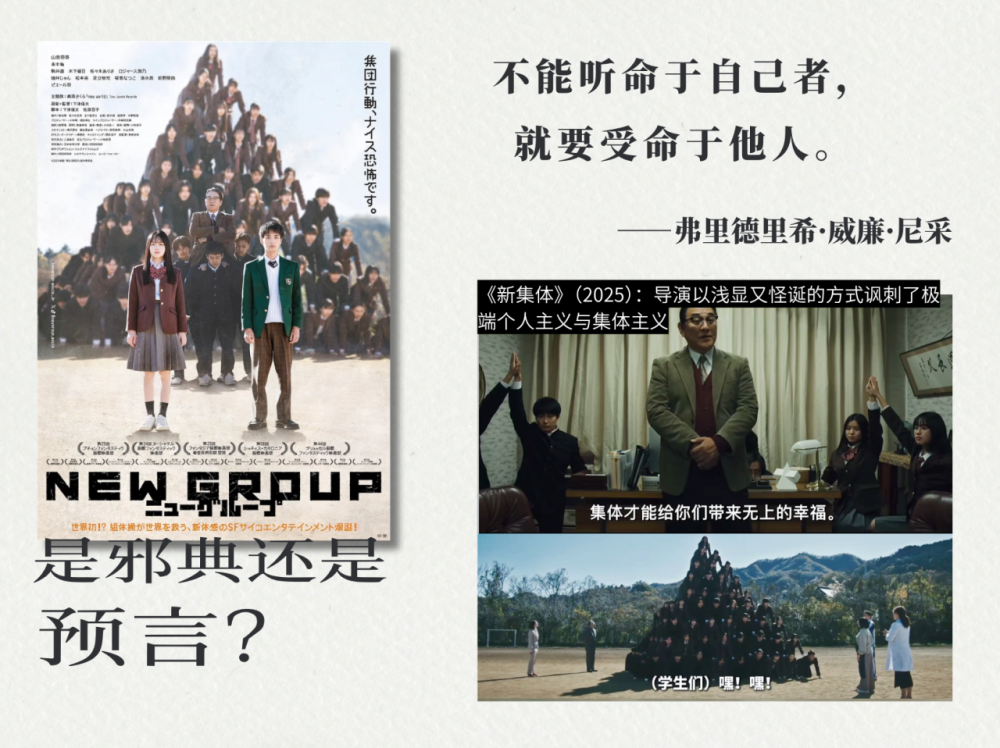
(The Chinese dystopian film The New Collective depicts the societal dead ends that arise when people surrender independent thought.)
Whoever controls the linguistic turf holds the power to define reality and manipulate public perception. Who, then, ultimately profits from this deluge of pop-culture “theories”? Surely, we all ought to maintain our critical faculties.
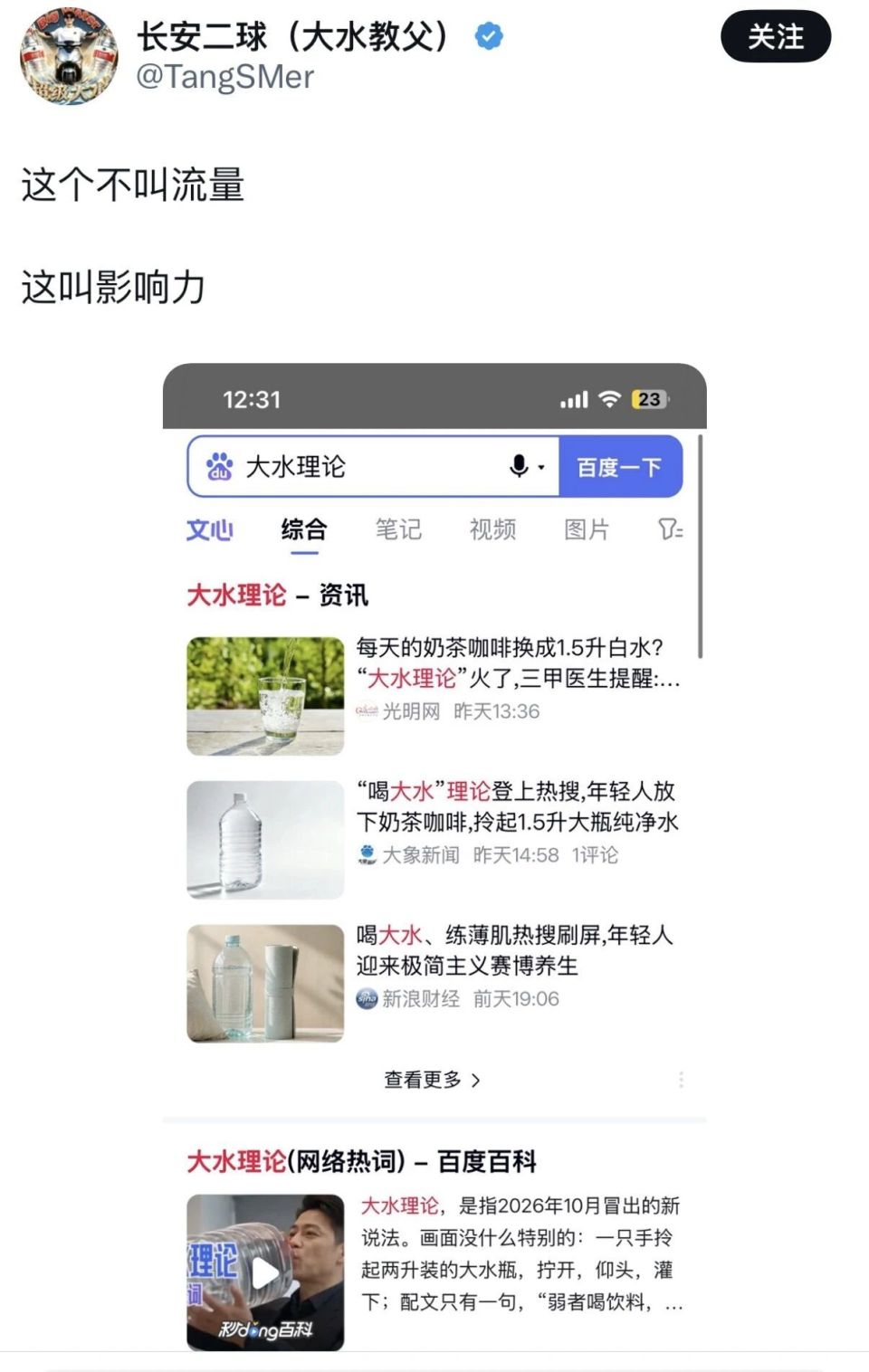
(Internet gurus leveraging marketing stunts to prove their influence engages in sleight-of-hand, yet legions of followers genuinely buy in.)
At its heart, mass communication relies on participants sharing a common expressive lexicon. Once internet memes infiltrate daily conversation, however, certain catchphrases quickly hollow out and lose their original meaning.
Phrases loaded with aggressive emotional rhythms, like “If you can play, just play hard! Play! Play!” have seeped into everyday life via the slipstream of these viral theories.
Over time, young people find themselves unable to express emotions without leaning on pop culture catchphrases, unable to feel a sense of belonging without internet slang. We use memes to fit into the collective, only to find ourselves reshaped and flattened by them.
So here is the question: must the younger generation master vulgar internet slang just to be accepted? Let us not go gently into that digital night.
If language is a marketplace stocked with everything under the sun, buzzwords like “Little Handsome and Little Pretty,” “sense of enoughness,” and “mega-achievements” are like junk food slathered in artificial additives—gaudy and glaring, easily avoided if you pay attention. But pseudo-scientific trends like the Big Water Theory and Lean Muscle Theory are marketed like discounted health foods, tricking us into continuously loading up our shopping carts. Only when we step back and look inside do we realize our baskets no longer hold anything truly nourishing for our souls—no real eggs, greens, or meat.
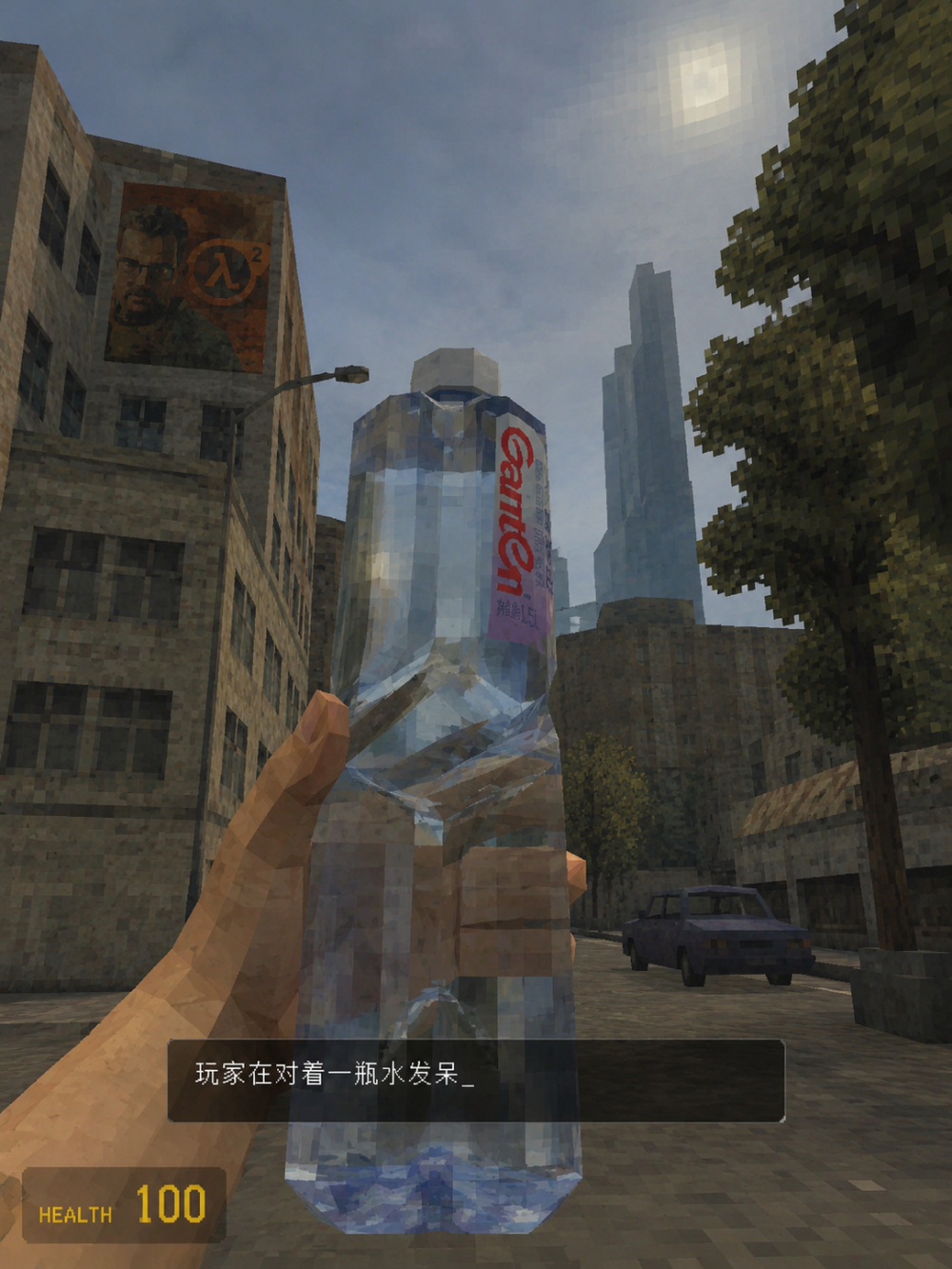
(“You become an object of constant surveillance by others, where even your innermost wishes must be spoken for you.”)
In her book Autobiography of Red, Canadian poet Anne Carson introduces a protagonist named Geryon, a boy born with red wings who always tucks them beneath loose robes to blend in with the ordinary crowd.
When the sharp edges of society press too painfully against us, human instinct is not necessarily to fight back, but to grow a protective shell of camouflage.
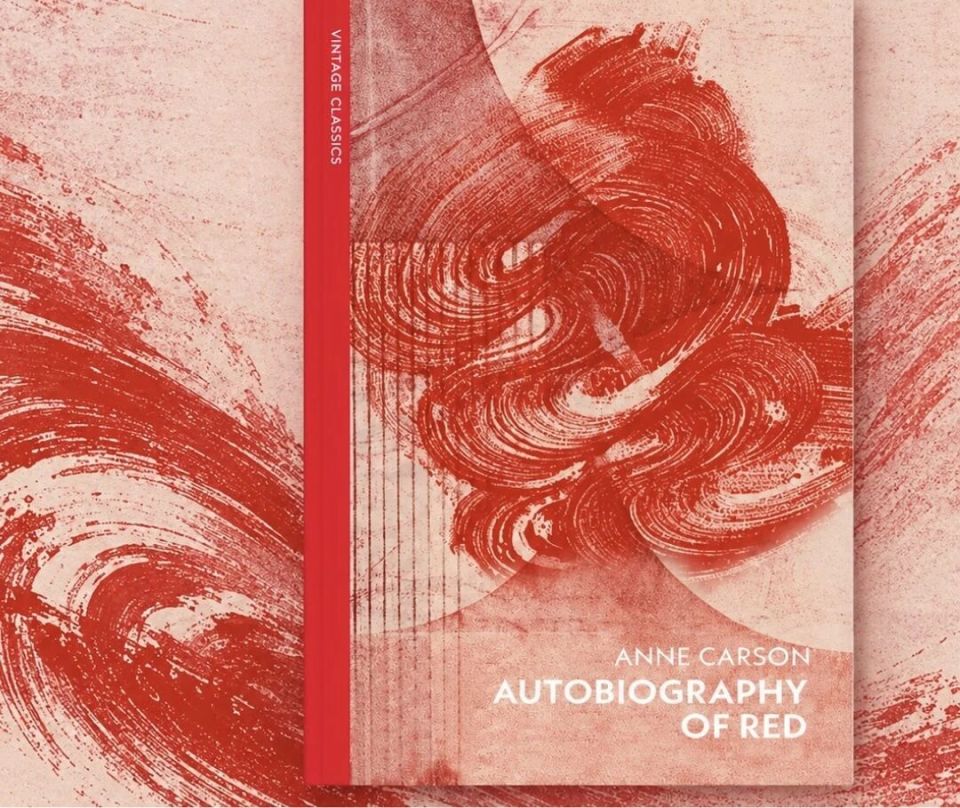
(Canadian poet Anne Carson, whose masterpiece Autobiography of Red remains her most celebrated work.)
The term “wall-clinging” used by Sanhe youth often carried undertones of self-deprecation and psychological self-defense, a way to mask and shield their true selves.
Perhaps when society deals us a brutal blow, our resort to these internet “theories” is driven by a similar impulse. Whether our initial motive was sarcasm or earnest self-praise, at bottom, our fundamental desire remains the same: safeguarding our physical and mental well-being.
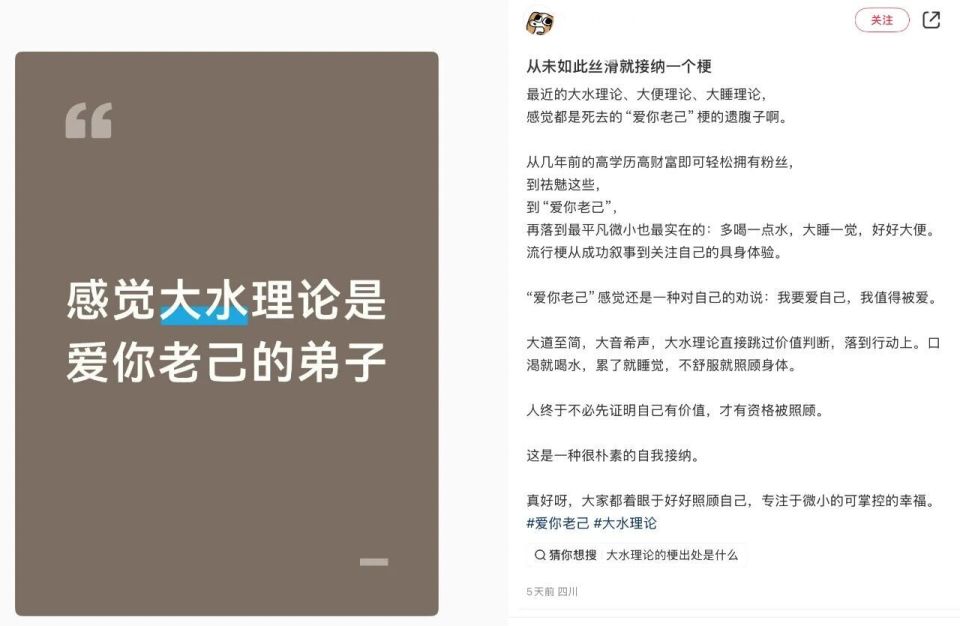
(Some commentaries suggest that the Big Water Theory is ultimately just an extension of the broader “cherish yourself” cultural current.)
You are entirely free to lug a 1.5-liter jug of purified water toward the gym, visualizing your future muscle definition while casually sinking a few hoops. Or you can sit in the cold autumn rain, happily ordering a full-sugar milk tea, exhaling a puff of steam as you momentarily drift back to the innocent days of childhood watching television commercials.
This wave of viral self-awakening will eventually recede. We will march forward, but we do not need to carry a petty, competitive playbook weighing down our hearts.
Deep pools keep their secrets; flowing streams have their own competitive grace. I am not a fish, how can I know the joy of big water? You are not me, how can you judge that I do not enjoy my water my own way?
(Copyright images sourced from the internet)
References:
Tian Feng, Lin Kaixuan. Homeward Bound: An Investigation of Sanhe Youth [M]. Beijing: Dolphin Press, 2020.